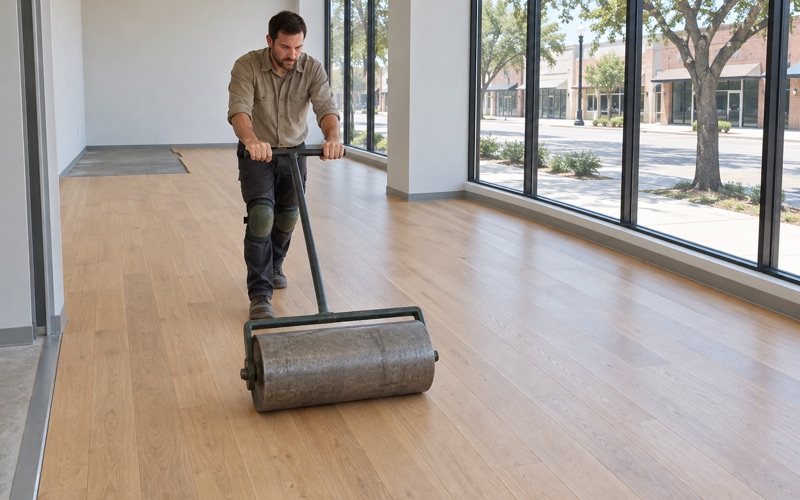
Grapevine Wood Flooring has spent more than twenty years on wood flooring in Bedford, and the call we take most often from this city does not start with a plank width or a stain color. It starts with a sound: a step in the hallway that answers back, a board by a doorway that pops under weight, a line of nail heads that has begun to telegraph through an otherwise sound finish.
Those are fastening symptoms, and they are the predictable late chapter of a floor that has been holding still for four decades. Fasteners are the part of a wood floor nobody thinks about until they are the only part that matters, and in a housing stock of this age they are usually the only thing that has genuinely given way.
We price repair first, refinishing second and replacement last, and we name the cheaper option out loud whenever it is the right one. On a noisy Bedford floor the cheaper option is right far more often than not, which is why most of what follows is about re-securing a floor rather than tearing one out.
Nearly three in five Bedford homes are forty to fifty years old
Bedford’s housing is concentrated in two decades. 36.8% of the city’s housing units were built in the 1980s and another 20.4% in the 1970s, so 57.2% of everything standing here went up across those twenty years. Only 3.0% has been built since 2010, which is 652 of 21,878 units, and 12.6% dates from 2000 or later.
That distribution decides what our work actually is. Essentially every residential floor we sell in this city goes into a house that already has a floor, so removal and disposal of the existing material belongs in the quote from the start rather than arriving as a surprise at the end.
What forty years does to a floor
The dominant cohort is now roughly forty years old, which is past the service life of the builder-grade carpet, vinyl and parquet that came with it. What we find underneath the current floor is frequently not the original floor either. Each previous replacement left something behind: its own fasteners, an adhesive residue, a layer of underlayment nobody removed.
That matters because a fastening repair depends on knowing what a fastener is actually biting into. A cleat that thinks it is going into plywood and instead meets a second layer of old underlayment holds far less than the person driving it believes.
Age is a condition, not a verdict
52.9% of Bedford’s housing units are single-family detached, so most of what we walk into is a house with continuous flooring running room to room, and a noise in one room is often a symptom that travels. None of that means a forty-year-old floor is finished. Solid wood of that vintage generally has plenty of material left in it, and the boards themselves are usually the healthiest thing in the assembly. It is the connection between the boards and the structure under them that has aged.
Looking for wood-flooring closer to Flower Mound? See Wood-Flooring in Flower Mound.
What makes a floor start talking
Where the noise is actually coming from
There are three common mechanisms and they sound different from one another. A fastener that has worked loose lets a board rise and drop a fraction under weight, which is the short, sharp squeak directly underfoot. Two board edges rubbing at the tongue-and-groove give a drier, longer creak that moves as you walk. A subfloor panel that has lifted slightly off the framing produces a deeper flex you can feel through your heel as much as hear.
Each one calls for a different repair, which is why we walk a noisy floor before quoting it rather than pricing squeaks by the room. Nearly all of it is a fastening and movement story. A floor that talks is telling you that something has come loose, not that something is wrong with the house around it.
Why it comes and goes with the season
Wood moves with the humidity around it, and every floor is slowly chasing an equilibrium moisture content set by the conditions inside the house. We take moisture meter readings before we commit to a repair plan for exactly that reason. A floor that squeaks hard in February and goes quiet in July is showing you how much the boards shrink and swell across the year, and it is also warning you that a repair made at one extreme has to still work at the other.
That seasonal swing is why the expansion gap at the perimeter is not optional trim detail. A floor with no room to grow pushes against itself, and the pressure has to go somewhere.
Why old floors talk more than young ones
Cleats and staples hold largely by friction along their legs. Every seasonal cycle compresses the wood fibers around the fastener a little, and after four decades of that the hole is marginally larger than the fastener in it. Nothing dramatic happened. The grip simply relaxed, a fraction at a time, until the board could move.
Nail pops, and why they keep coming back
A nail pop on a wood floor is a fastener backing out. Sometimes it is a face nail working up through a board and breaking the finish around its head. Sometimes it is a cleat or staple in the tongue lifting just enough to raise the board and leave a ridge you can find with a bare foot before you can see it. In a floor of this era it is rarely just one.
Re-driving the same fastener is not a repair
Driving a fastener back into the hole it just came out of puts it into wood that has already been enlarged and crushed by its previous tenant. It holds for a season, sometimes two, and then the homeowner concludes the repair failed. It did not fail; it was never a repair.
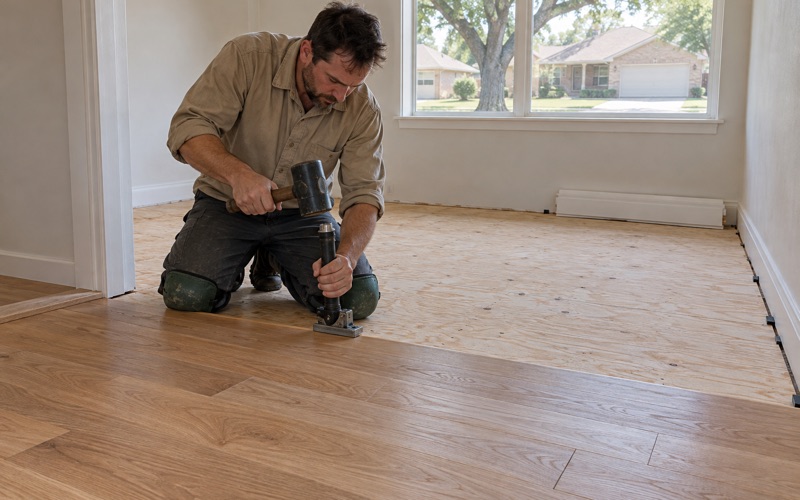
What holds is a new fastener in fresh material, set at a different point in the board, and wherever we can reach it, biting into framing rather than into the subfloor alone. Fastener gauge, crown width and the spacing schedule all get decided per floor, because a fastener sized for the board it holds in one room is not automatically right in the next one, and older work in Bedford houses turns up cut nails and face-nailed repairs that have to be removed rather than worked around.
When a board has to come out
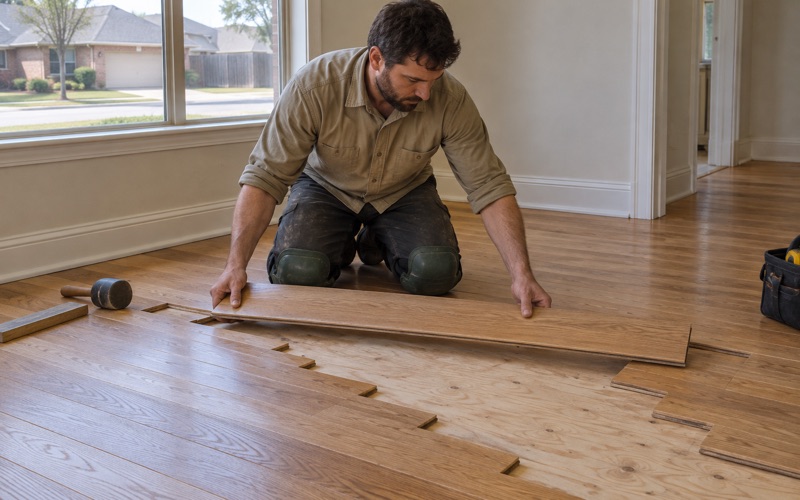
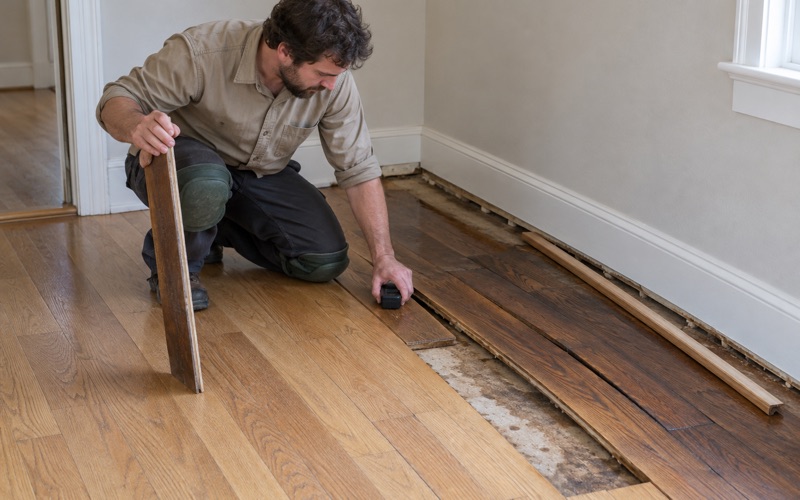
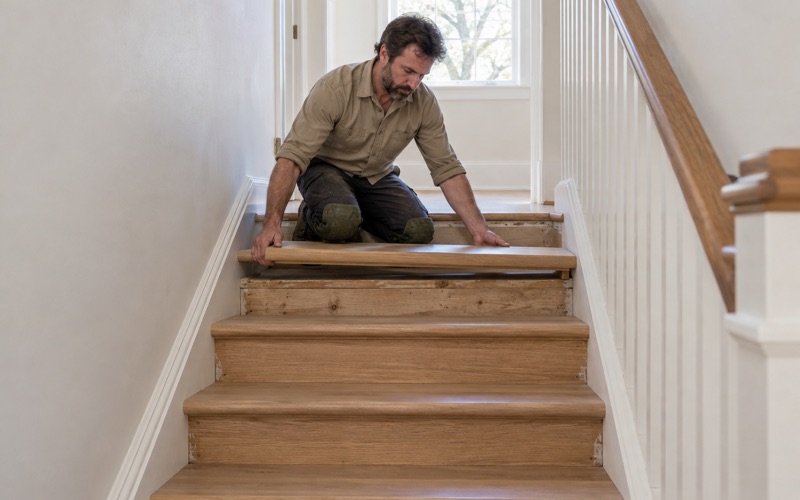
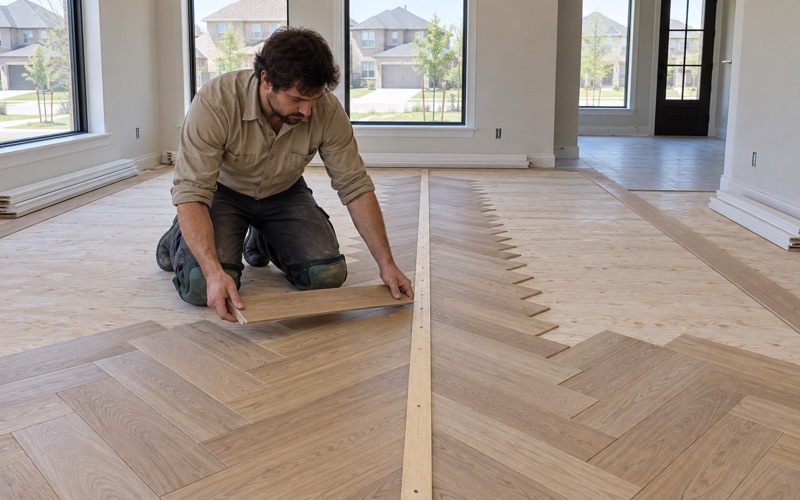
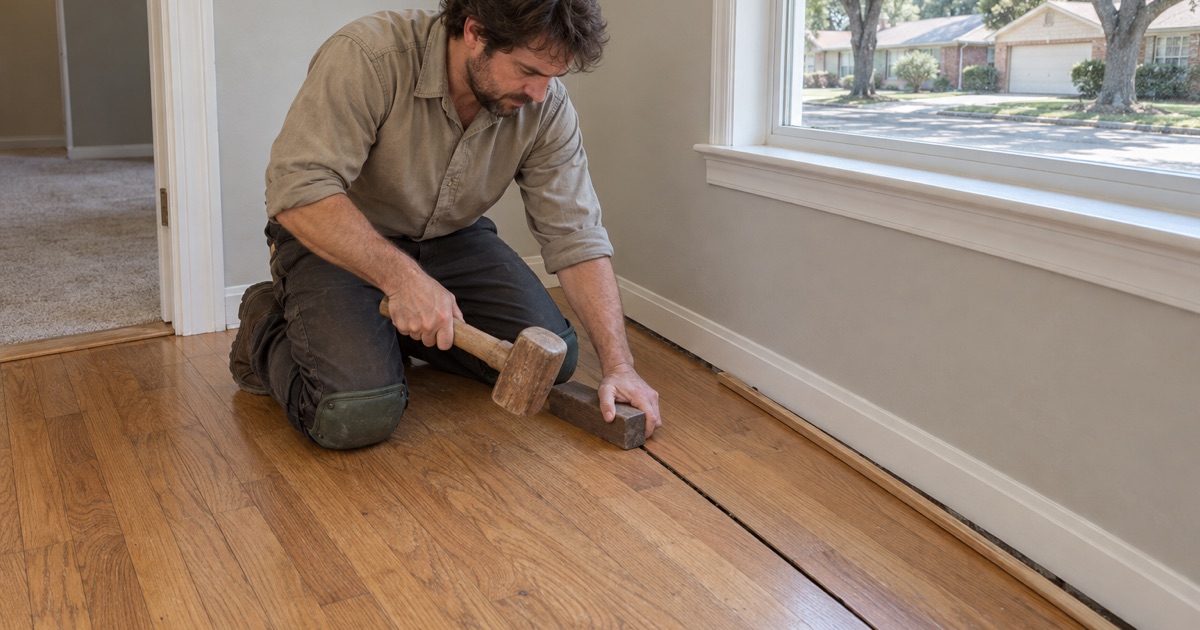
If a board has split at the tongue, or the finish and the wood around a pop have broken up, fastening it again only holds damaged material tightly. That board comes out. We replace it and weave in the new pieces so the end joints do not line up in a row, which is what makes a repair read as a patch from across the room; for a tight localized area a dutchman patch does the same job with less disturbance.
Then the replaced material has to sit level with everything around it. Overwood left standing proud of its neighbors shows under the next finish coat and wears differently from the day it is walked on. Species matters here too. Red oak and white oak at 1360 Janka blend and sand predictably; hickory at 1820 Janka and hard maple are less forgiving of a patch, and we will say which you have before we tell you what a repair will look like.
Re-securing a floor from above instead of replacing it
When there is no access from underneath, every repair has to be made through the finished face of the floor. That is a constraint on method, not a reason to replace a floor that is otherwise sound.
Working through the finished face
We locate the framing first, because a fastener driven into a subfloor panel that is itself loose has secured nothing. From there the board is drawn down and fastened through the face into solid material, the head set below the surface, then filled and blended. On a site-finished floor that repair disappears under the next coat. On a prefinished floor the fill is the finish, so we show you what the repair will look like before we make it rather than after.
Repair, then refinish, then replace
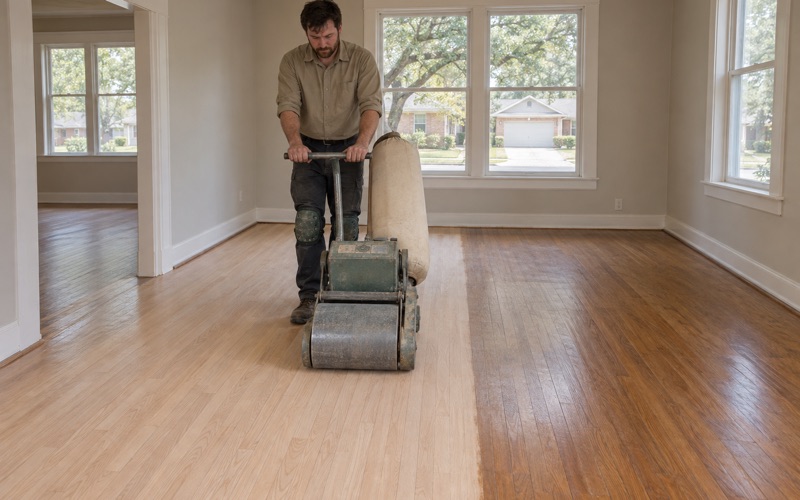
Once the floor is quiet and tight, the remaining question is whether it needs a full sand. Frequently it does not. A screen-and-recoat lays fresh waterborne polyurethane over a sound existing finish and costs a fraction of the alternative. When the wear has gone into the wood, we run a full sand through the 36-50-80 grit sequence with a drum sander, an edger and a buffer, under dustless containment that we set up and show you before the first machine starts.
One crew carries the job from the first repair to the final coat, and the sanding is never subcontracted out. Before the first coat goes down you get a written cure and occupancy schedule, including when furniture and pets come back, because cure time and dry time are not the same thing and the difference is what marks a new finish.
Sequence, and who signs it off
We schedule floor work after foundation repair and plumbing rather than ahead of it, so a new floor is not paying for somebody else’s timeline. Where another trade runs a line under or behind what we are installing, the inspection happens before anything covers it. Bedford’s local code amendments add an unauthorized cover-up fee for work concealed without first obtaining the required inspection, assessed under the city fee schedule, and the Inspections Division of the City of Bedford Development Department is the authority that signs the work off.
A companion amendment charges a re-inspection fee when the work is not ready at the appointed time or the house is locked when the inspector arrives. Both are easy to trigger on an occupied remodel and both are avoidable with a schedule everyone involved has actually seen, which is why we hand you one.
- 20+ Years in North Texas
- Dustless Sanding
- Free Written Estimates