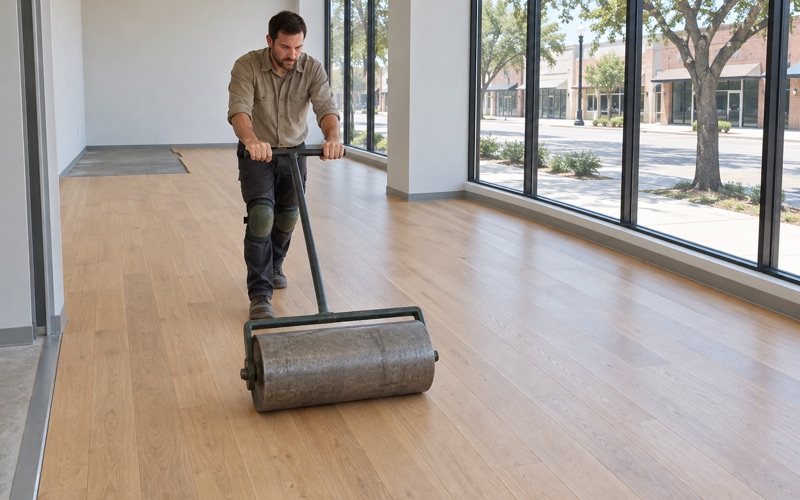
Grapevine Wood Flooring has handled subfloor repair in Carrollton for more than twenty years, and here the work almost always opens on the same question: how flat is the slab under the floor you already have. A wood floor is only ever as straight as the surface it is fastened or glued to, and no species, finish or installation method corrects a substrate that dips and rises beneath it. We measure that surface before we quote, not after the boards arrive.
The order matters because leveling is the one step that cannot be added later. Once a floor is down, a low spot becomes a hollow that sounds under a footstep and a high spot becomes an edge that catches, and both are fixed by pulling the floor back up. It comes up often in this city, and the reason is sitting in the housing stock itself.
We price repair, refinish and replacement in that sequence and name the cheapest option that will actually hold, which on a subfloor job usually means grinding and filling a slab rather than tearing out sound material. One crew does the preparation and the installation, so nobody inherits someone else’s flat work. What follows is how we read a Carrollton slab and what we do about what we find.
A slab poured in the 1970s or 1980s has had time to move
Carrollton’s housing stock sits heavily in two decades. The 1980s account for 15,462 units and the 1970s for another 9,688 — 25,150 of the city’s 54,365 housing units between the two cohorts, with 74.0% of everything here built in 1980 or later. A slab from either decade has carried a house for a long time, and most of the ones we put a straightedge across are no longer as flat as the day they were finished.
We are not here to explain why a particular slab sits the way it does; that is a different trade and a different report. Our work starts at the surface and ends at the final coat, which means what matters to us is the shape the slab holds today and whether a wood floor can be made to sit still on it. Keeping that line clear is also what keeps the estimate honest.
Of the 51,995 occupied units in the city, 30,442 are owner-occupied and 21,553 are rented — 58.6% of occupied units are lived in by the people who own them. That changes a lot of these conversations. An owner planning to stay is almost always better served by an extra day of slab preparation than by a cheaper installation that has to be lifted again.
The build year is worth confirming rather than assuming
Carrollton spans Dallas, Denton and Collin counties, so the parcel record for an address in the city comes from one of three different central appraisal districts depending on where in the city it sits. When a homeowner is not certain which decade the house belongs to, that record is where we look, because a slab from the 1970s and one poured two decades later are prepared differently even when they look identical under carpet. It takes a few minutes and it changes what we plan for.
The older and the oldest stock
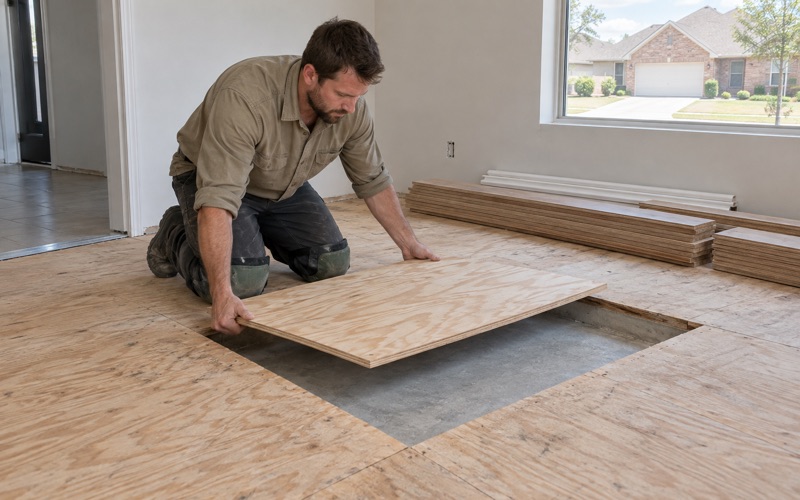
Not every house here comes from those two cohorts: 1,698 units predate 1960 and 333 predate 1950. The Carrollton Heights Historic District covers domestic architecture built between 1910 and 1960 — Craftsman bungalow, Prairie, Tudor and Colonial Revival, Ranch and post-war mid-century modern — and a house of that age is far more likely to sit on a wood subfloor over joists than on a slab. Those get a different set of measurements, and where original material has to come up, we salvage it, store it secured and reattach it rather than send it to the dumpster.
Looking for wood-flooring closer to Watauga? See Wood-Flooring in Watauga.
Measuring flatness before a single board goes down
Flatness is measured, not eyeballed. We run a long straightedge across the slab in a grid, mark every place where light shows underneath it and every place where it rocks, and get the whole picture on paper before anyone talks about material. A glue-down engineered installation and a floating floor have different appetites for what is under them, and the measurement is what tells us which one the room can actually support.
A written map, not a verbal impression
Every high spot and low spot goes onto a sketch of the room with its location and its depth, and that sketch is what the preparation is priced from. It also outlives the job, so if something is questioned later there is a record of what the slab looked like before anything was ground or poured. We would rather work from a drawing than from a memory.
Moisture is measured in the same visit
A slab can be perfectly flat and still be wrong for wood. We run an ASTM F2170 in-situ relative humidity test and record the number before an installation date is set — never after the pallets are already sitting in the living room — and we want the slab at or under 75 percent RH, or we want a vapor retarder in the assembly and a written reason for it. Leveling compound and adhesive both care about that reading, which is why it is taken alongside the flatness work rather than at the end of it.
Sequencing around the other trades
If foundation work or plumbing is planned for the house, the floor goes in after it and not before. We have opened up too many new installations that were put in ahead of somebody else’s schedule. Waiting costs a few weeks, and going first costs the floor.
Grinding high spots against filling low ones
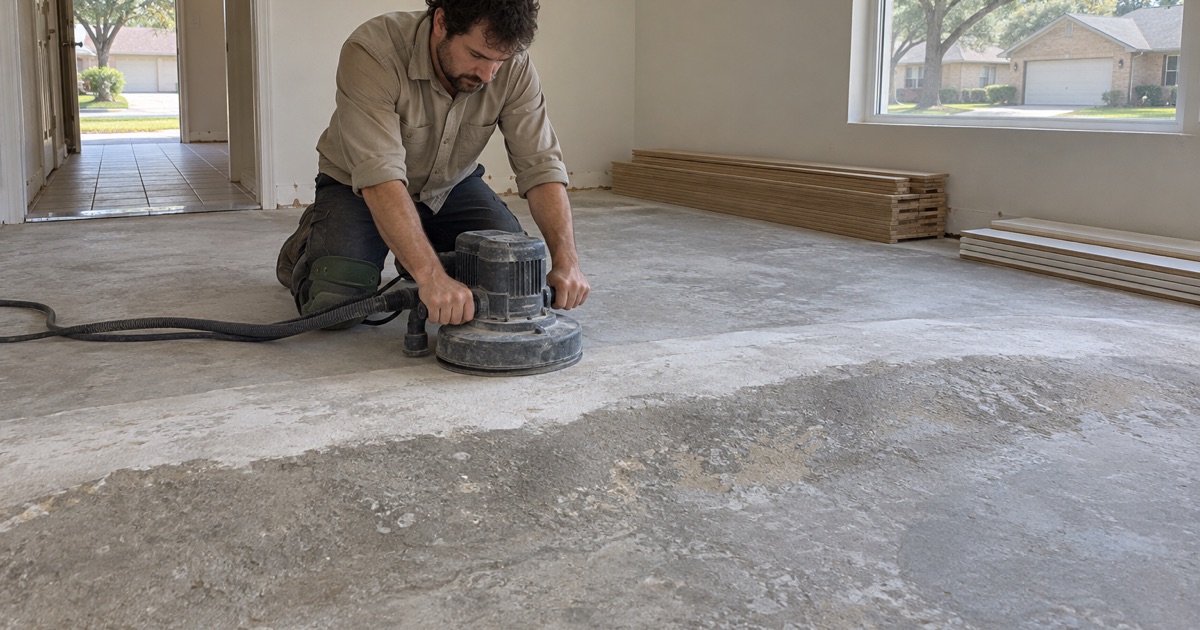
Leveling a slab is two separate operations, and the cheaper of them is usually grinding. A high spot is taken down with a grinder in an afternoon and costs little beyond the abrasive, while a low spot has to be filled with material that then has to cure before anything can go over it. When a room’s whole problem is a few ridges and a hump near a doorway, grinding alone can bring the floor into range for a fraction of what a poured underlayment would cost.
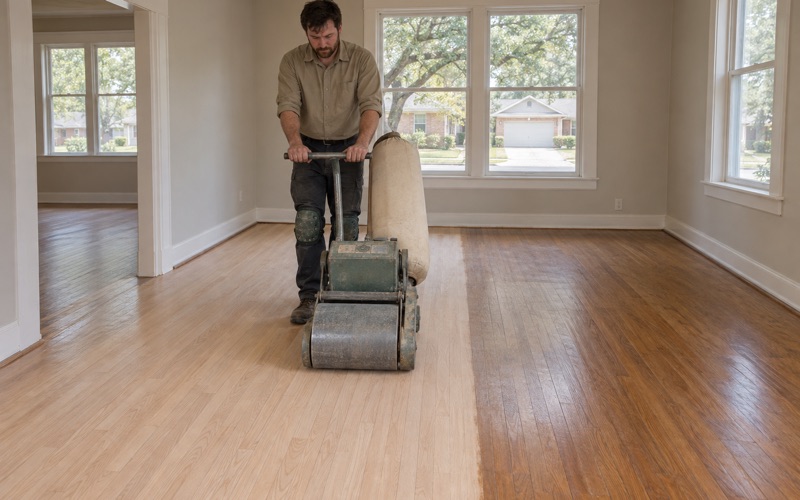
Grinding concrete makes dust, and it travels through a house faster than sanding dust does. Containment goes up before the first machine runs and we walk you through it, so you can see what has been sealed and where the air is being taken. It is the same arrangement we set up on every sanding job, and it is not an extra line at the end of the invoice.
Where self-leveling underlayment earns its place
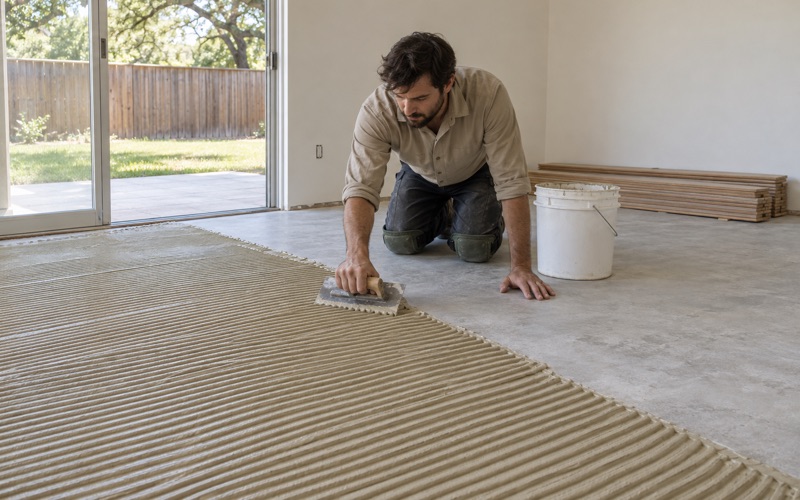
Self-leveling underlayment is the right answer when the low areas are broad and shallow rather than local — a room that dishes gently toward the middle, or a slab that sags along the length of a hallway. It is primed, poured and left to find its own level, and it produces the kind of continuous surface a glue-down installation can bond to properly. Poured after the high spots have been ground off, it also uses far less material than it would if we skipped that step.
Where it stops being the answer
Underlayment has limits, and pretending otherwise is how a floor fails quietly. Feathered down to nothing at the edges it can break away under traffic; poured too deep it becomes an expensive way to solve a problem grinding would have solved; poured over a dusty or previously sealed slab it can let go at the bond line altogether. It also raises the finished floor height, so thresholds, reducers and the transition to tile or carpet have to be planned before the first bag is mixed rather than improvised afterward.
Who signs off on what
Finish flooring laid over an existing subfloor generally falls under the IRC R105.2 finish-work exemption and is not permitted work. Where a job reaches structure, systems or occupancy, the City of Carrollton Building Inspection Department reviews it against the International Code series as adopted with local and North Texas regional amendments. We tell you which side of that line your job sits on before we start, and we do not treat an unpermitted job as permission to skip the preparation.
Why lippage turns up months after an installation
Lippage is a height difference between two adjacent boards that a bare foot finds immediately, and it is the most common reason we are called out to a floor somebody else installed. It almost never shows on day one. The floor looks right at handover, a season goes by, and then edges start standing proud along one wall or straight through the middle of a room.
The slab was never flat and the floor found out
A board bridging a low spot has nothing underneath it. Every footstep flexes it, the fastener or the adhesive line works, and eventually that board settles at a different height than its neighbor — overwood on a nail-down floor, a bond line failure on a glue-down. Nothing about the wood changed; the floor simply conformed to a surface nobody measured before covering it.
Fasteners and adhesive cannot make up the difference
A tighter fastener spacing schedule does not flatten a slab, and neither does a heavier bead of adhesive. Cleats and staples hold a board down to whatever is beneath it, so over an uneven substrate they hold it down to the unevenness. A floating floor expresses the same fault differently — as movement and hollow sound rather than lippage — but it comes from the same unmeasured surface.
What we control once the preparation is done
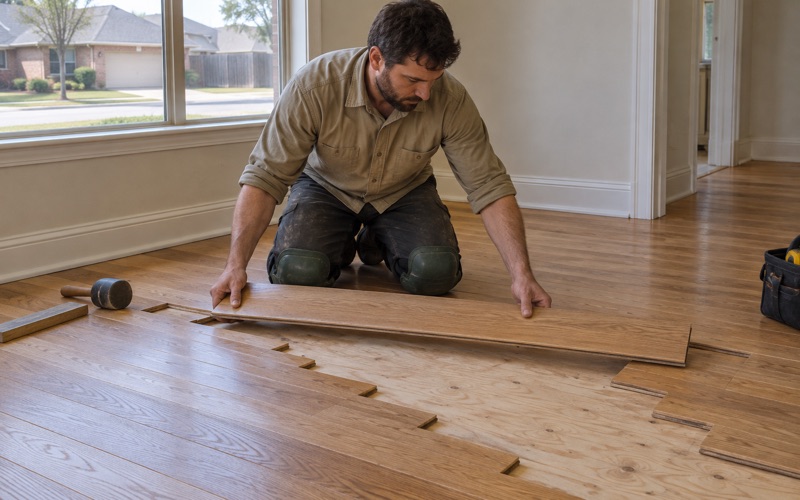
Wood is acclimated inside the house, in the room it is going into, never in the garage and never left on the truck overnight, so the boards reach the moisture content of the space they will live in. The expansion gap is set at the perimeter and kept clear at every vertical surface. One crew runs the job from tear-out to final coat with the sanding never subcontracted out, and a written cure and occupancy schedule is handed over before the first coat goes down, including when furniture and pets come back into the room.
Subfloor repair in Carrollton is, most of the time, a leveling job that happens before anyone sees a board of hardwood. It is also the part of the work that decides whether the finished floor is still quiet in five years. We would rather spend the extra day on the slab than come back for the floor.
- 20+ Years in North Texas
- Dustless Sanding
- Free Written Estimates