Grapevine Wood Flooring installs and refinishes wood flooring in Colleyville for people who are still living in the house while the work happens, and we have been doing it that way for more than 20 years. That one condition shapes nearly every decision on a job here: where the containment goes up, which rooms are cut first, and which day the furniture is allowed back.
Of the 9,072 occupied homes in the city, just 299 are renter-occupied. There is no vacant-unit turnaround market to speak of, so we are not planning around an empty house and a handover date. We are planning around school mornings, a dog, a home office on a call at nine, and a bedroom that has to be usable tonight.
That changes the scope rather than the price. Dust containment, room-by-room sequencing, pet and furniture logistics and a written cure schedule are part of the job from the quote forward, not an accommodation added later when somebody asks for one.
The client here is almost always the person living in the house
On an occupied job the homeowner is not a name on a work order, they are standing in the kitchen watching the first machine get carried in. So the questions we answer before we start are the ones a resident actually has: how long is my kitchen out of service, where do I park, and when can the dog come back off the neighbor’s porch.
What we confirm before a date goes on the calendar
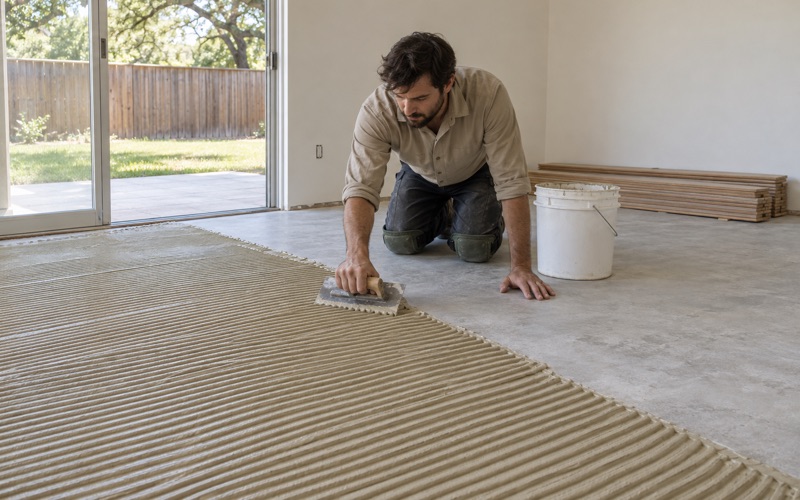
We test slab moisture and record the number before an installation date is set, not after a pallet of wood is already sitting in the house. On a slab-on-grade house that means an ASTM F2170 in-situ relative humidity test, and we want the slab at or under 75 percent RH before we commit to a start date. A number that comes back high is a scheduling problem in week one and a bond line failure in year two.
The wood then acclimates inside the house, in the room it is going into, with the HVAC running. Not in the garage, not on the truck, not stacked in a hallway that sits well off the temperature of the rest of the house. Equilibrium moisture content is the whole point of the exercise, and a garage does not have the same one your living room does.
Repair, refinish, replace, priced in that order
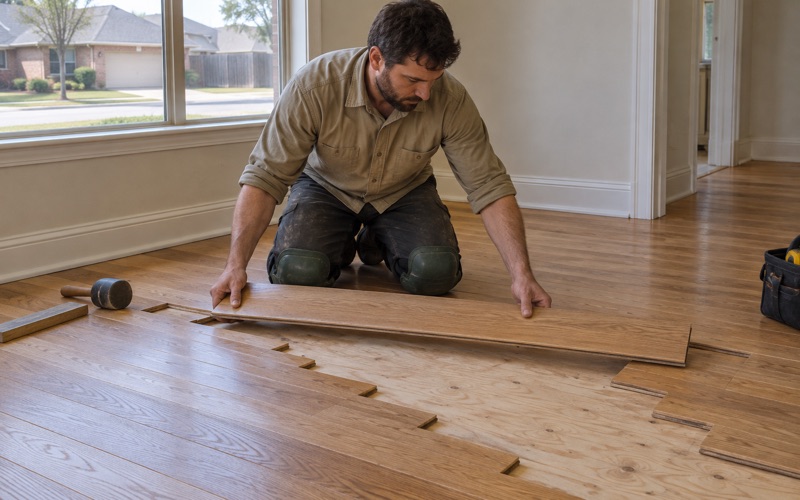
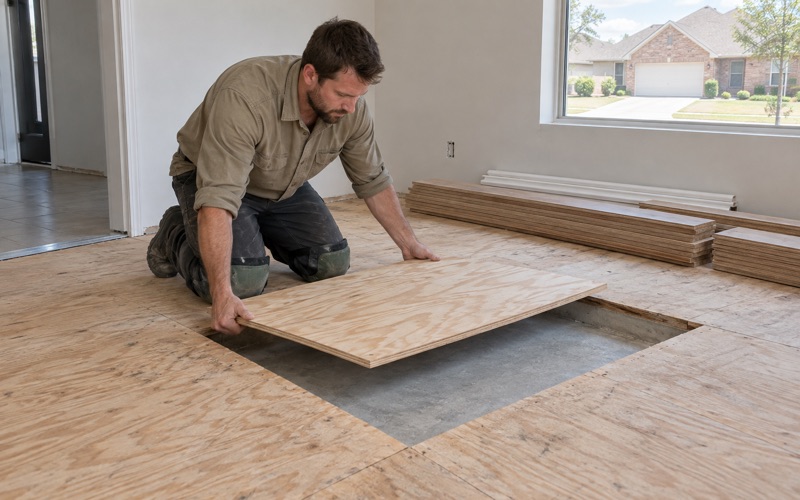
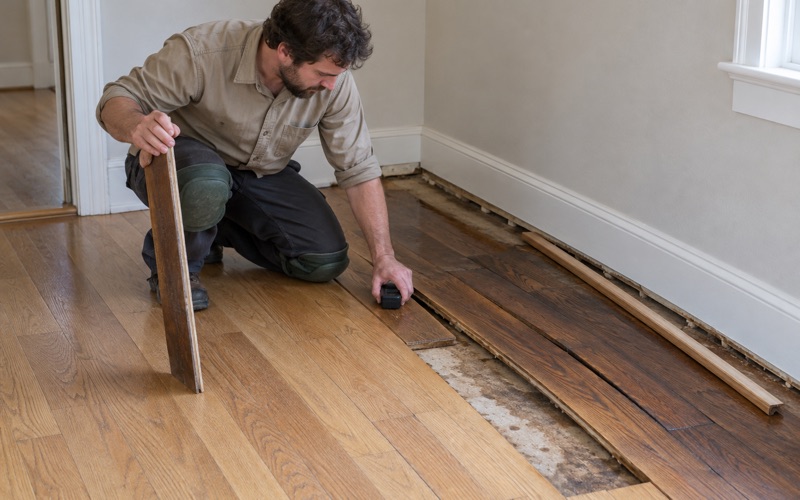
We price the cheaper option first whenever it is the right one. A board replacement with a weave-in at the edges, a screen-and-recoat over a finish that is dull but intact, or a full sand and refinish are three different jobs with three different price tags and three different amounts of time you spend out of the room.
On engineered flooring we measure wear layer thickness before we quote a refinish at all. Under roughly three millimeters there is nothing left to take off, and a drum sander on a two millimeter wear layer is a sand-through to the plywood core, not a refinish. That measurement is cheap, and it is the difference between a recoat and a replacement.
Work that has to happen before ours
We sequence the floor after foundation repair and after any plumbing work, not ahead of it. A finished floor that gets opened up later for a slab leak is a floor the homeowner paid for twice. Finish flooring itself sits under the IRC R105.2 finish-work exemption and is not a permit item, but the work that often precedes it is: the City of Colleyville Building Inspections department is the authority, and as of January 2025 the city was enforcing the 2018 International Codes and the 2020 National Electrical Code together with the North Central Texas Council of Governments regional amendments, with newer editions under discussion. If a trade is coming behind us, we would rather wait than sand twice.
Looking for wood-flooring closer to Coppell? See Coppell Wood-Flooring.
Containment, and what actually gets past it
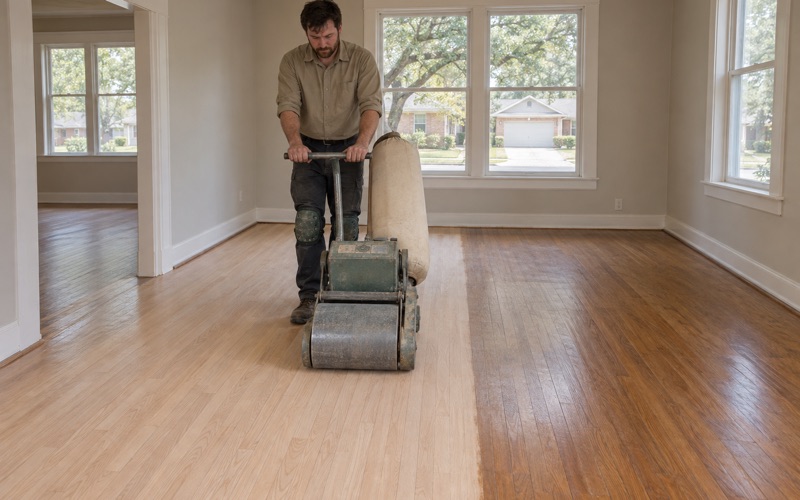
Dustless containment goes on every sanding job, and it is set up and walked through with you before the first machine runs. Not described in a paragraph of a proposal, not assembled after the fact when the great room already has a haze on the countertops. You see where the barriers land and where the air is going before anything gets turned on.
How it goes up
The work zone gets sealed off with barriers at every opening, supply and return registers in the zone get covered so the HVAC is not distributing what we are making, and the sanding equipment runs on vacuum collection. On a house that gets phased, the barrier moves with the phase, which means it goes up and comes down several times rather than once.
Where dust actually escapes
Honest answer: at the edges and at the doorway. The drum sander through a 36-50-80 grit sequence is the cleanest part of the operation because it is the part most directly on the vacuum. The edger in a corner, the buffer along a baseboard, and the moment a barrier is open while somebody carries a machine out is where fine dust gets into the rest of the house.
So containment is not the only control. Traffic discipline is the other half: one route in and out, shoe covers past the barrier, and the vacuum run before the barrier opens rather than after.
What containment does not do
Plastic does not stop noise and it does not stop finish odor. A sander is loud enough that a workday at home in the next room is not realistic, and odor from any coating carries through a house whether the dust does or not. Those two get handled on the calendar instead of at the barrier, which is why the phasing conversation and the containment conversation happen in the same visit.
Phasing a house that nobody is moving out of
A Colleyville house usually cannot be done in one pass, because there is nowhere for the family to go while it is. So we split it, and we tell you the split before we start rather than discovering it on day three.
Halves, and a path that stays open
The practical unit is half a house: living areas and the front of the plan in one phase, the bedroom wing in the other, with a route from the garage to a sleeping area open the entire time. The kitchen is usually the pressure point, because a family can eat around a closed dining room but not around a closed refrigerator, so it gets scheduled where the finish has the most room to cure before anyone needs it.
One long run across an open plan
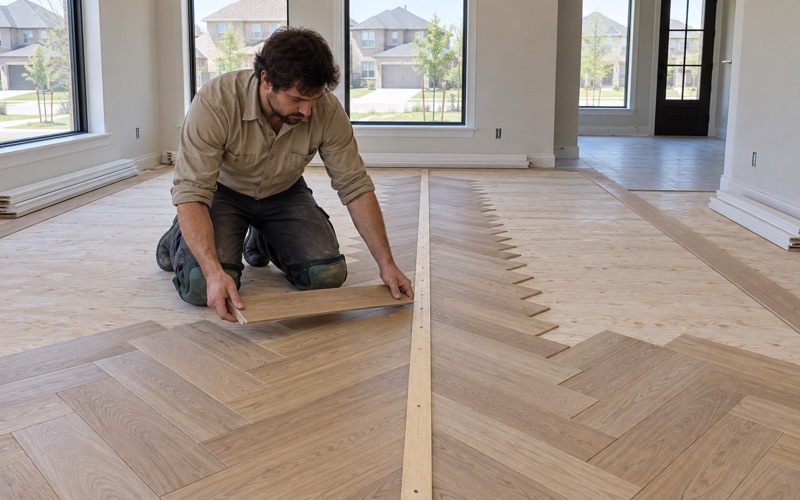
Colleyville development is low density and large lot, with a growth strategy targeting a maximum of 1.8 dwelling units per net acre, and the houses that come with that are wide and sprawling rather than compact and stacked. A whole-house wood floor here is one long continuous run crossing several rooms without a natural break.
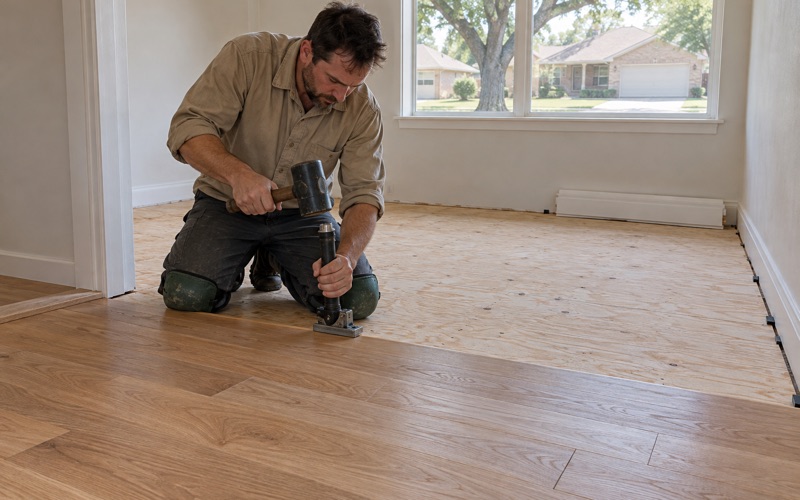
That makes three decisions matter more than they do in a small plan: how the run is racked so the seams stay random down a long uninterrupted line of sight, where the expansion gap is allowed at every perimeter and every fixed obstruction, and whether a transition is honest or a crutch. We would rather carry continuous flooring through a wide opening than drop a T-mold in the middle of a line of sight, but a reducer or a threshold at a real material change is not something to hide from either. NWFA installation guidelines drive the fastener spacing schedule underneath all of it.
The older cohort, and the last sand
The housing stock here is young overall. 84.44% of it is post-1980 and only 37 units predate 1960. But 1,143 units were built in the 1970s, and that cohort is approaching or past fifty years old. Original solid oak in a house of that age has often been sanded two or three times already, so we measure remaining thickness with the boards in front of us before we quote a refinish rather than assuming there is another one in there.
Entries and mudrooms in this city take a heavier beating than the rest of the plan. On the larger parcels, where horse keeping and semi-rural use persist, working boots, dogs and outdoor traffic land on the same patch of floor by the door every day. White oak at 1360 Janka in those spots, or hickory at 1820 Janka where the wear is genuinely relentless, outlasts a softer species that looks identical on a sample board.
Cure time against dry time, and when the furniture comes back
The question that decides whether an occupied job goes well is not when the finish is dry. It is when the finish is cured, and those are different dates.
Dry is not cured
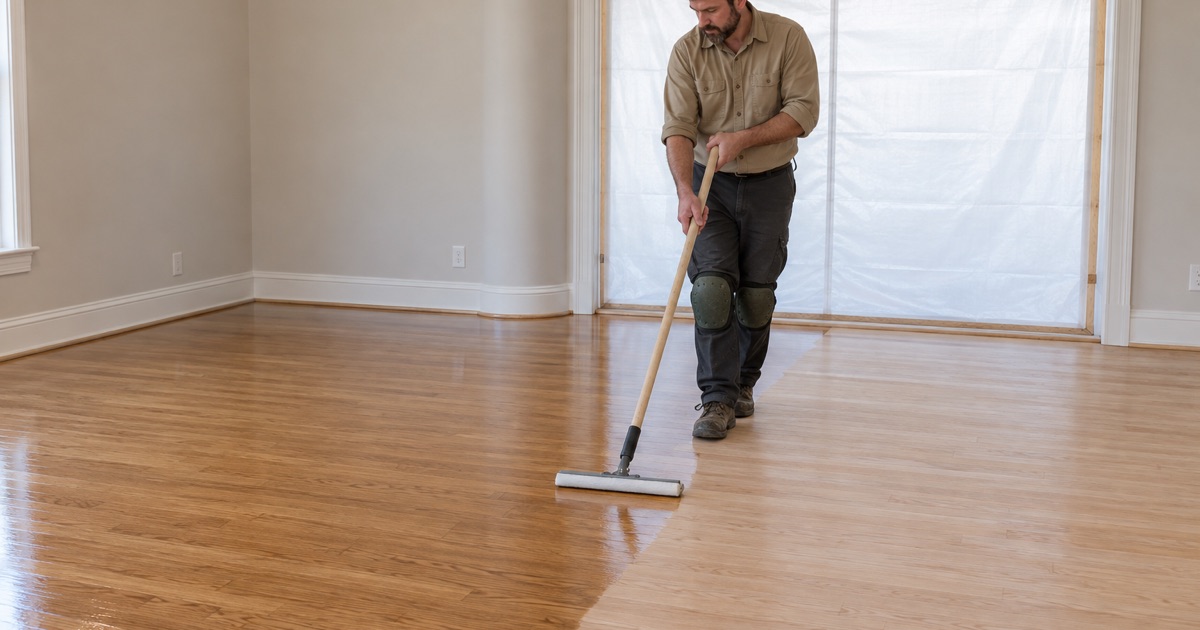
A waterborne polyurethane is dry to sock-foot traffic in hours and still soft for days afterward. An oil-modified polyurethane takes longer on both counts and carries more odor while it does. A hardwax oil behaves differently again and wants a specific maintenance routine rather than a recoat. We pick the coating around your occupancy window and tell you which of the three we are proposing and why, because the wrong one on a house full of people is a scuffed floor in week one.
The schedule is written down before the first coat
You get a written cure and occupancy schedule before the first coat goes down: when you can walk the floor, when pets come back, when furniture comes back, and when rugs go down. Rugs are the one people get wrong. A rug laid on a finish that has not finished curing traps solvent under it and prints its outline into the floor.
Furniture comes back on felt, lifted rather than slid, and appliances come back last. If a piece has to move within the phase, it moves once, to a room that is already released.
One crew, start to finish
The same crew does the tear-out, the sanding and the final coat. We do not subcontract the sanding out, which matters most on exactly this kind of job, where a stranger arriving on day four with no idea which door stays closed is how containment fails and how a phasing plan quietly stops being followed. The people who told you the plan on day one are the people carrying the buffer on day five.
- 20+ Years in North Texas
- Dustless Sanding
- Free Written Estimates