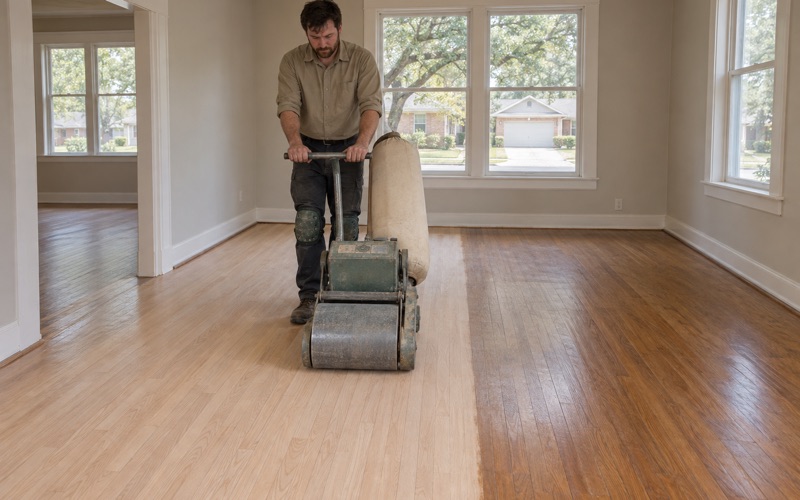
Grapevine Wood Flooring has been handling wood flooring in Coppell for more than twenty years, and the work here runs against the usual assumption. Age is normally the thing that limits a floor. In this city it is youth: the newest floors are often the ones with the least material left to sand.
Most of what we open up in Coppell homes is engineered flooring, which is a real hardwood face bonded to a plywood or composite core. Everything a sander can reach is that face, the wear layer, and it is a finite quantity measured in millimeters. It does not grow back, and every refinish spends a fixed share of it.
That is the number almost nobody checks before writing a quote. We measure the wear layer first, then price repair, refinishing and replacement in that order, and we name the cheapest of the three whenever it is genuinely the right one. A refinish quoted without that measurement is a guess about how much floor you still own.
Coppell’s newest floors have the least left to sand
Coppell sits in the northwest corner of Dallas County, a suburb of Dallas and a bedroom community in the Dallas-Fort Worth metroplex, with a population of 42,983 at the 2020 census and a small piece of its far northern edge reaching into Denton County. What matters for flooring is not where the city sits but when its houses went up.
Of the 16,028 housing units here, 93.3 percent were built in 1980 or later. The largest single decade is the 1990s at 5,733 units, with 4,821 from the 1980s behind it, then 2,120 built in the 2010s and 2,107 in the 2000s. That is a housing stock that arrived alongside engineered flooring rather than well before it, and 71.1 percent of those units, 11,387 of them, are single-family detached.
A stock that grew up with engineered flooring
Solid three-quarter-inch hardwood nailed over a wood subfloor carries roughly a quarter of an inch of usable material above the tongue, which is four or five full refinishes across a long life. A prefinished engineered plank glued down over a slab may carry two millimeters of hardwood above its core. The engineered floor frequently looks better on the day it is handed over and holds a fraction of the depth in reserve.
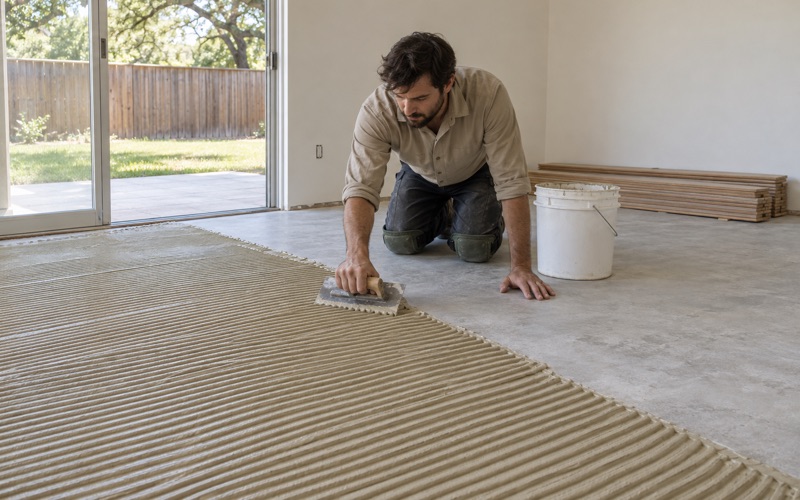
Neither construction is the wrong choice. Glue-down engineered flooring is a sound answer over slab-on-grade, and it is stable in a way a wide solid board is not. It simply has a different lifetime budget, and that budget is spent in sanding passes rather than in years.
Owning the floor long enough for it to matter
Of the 15,500 occupied units in Coppell, 68.8 percent are owner-occupied, 10,667 owner against 4,833 renter, and 10,127 of the owner-occupied units are single-family detached. Most of the people asking us about refinishing here intend to live with the answer for a decade or more.
That changes the arithmetic. How many refinishes a floor has left is not a technicality. It is the difference between a floor that can absorb another dog, another move and another kitchen remodel, and a floor that is on its final pass.
Looking for wood-flooring closer to Euless? See Wood-Flooring in Euless.
Finding the wear layer before anyone quotes a refinish
A wear layer takes about ten minutes to measure, and it has to be measured on the floor in question rather than assumed from a brand name. Specifications change between production runs, and a previous owner’s refinish has already spent part of whatever the plank started with.
A build year from the Dallas Central Appraisal District record narrows the era of product to expect, and that is useful for planning the visit. It is not a substitute for the reading itself. Two houses finished in the same year on the same street can carry wear layers that differ by a factor of three, because the flooring was a line item chosen separately from the house.
Where the edge of a board is already visible
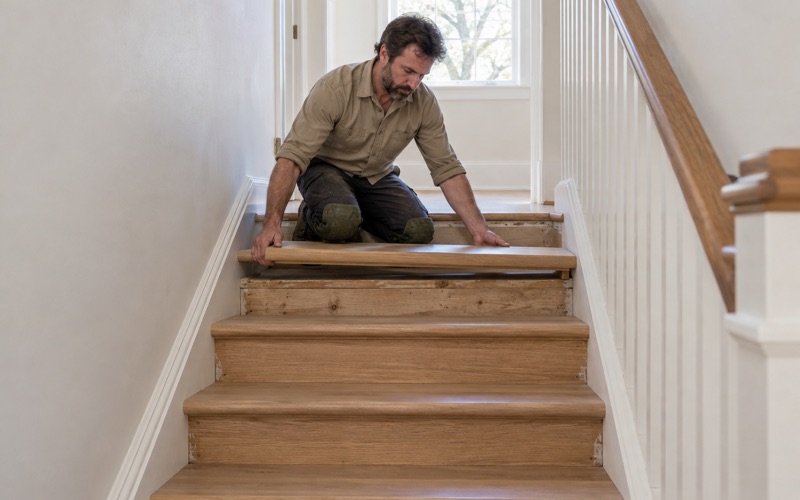
The cut edge of a plank shows the whole construction at once: face, core plies, backer. There is almost always one exposed somewhere. A floor vent is the usual place, since lifting the register exposes board ends cut clean through. Failing that, a reducer, a T-mold or a threshold at a doorway can come up without damage, or the nosing at the top of a stair flight.
Under magnification the hardwood face reads as continuous grain and the core below it as distinct plies running crossways. We take the reading at more than one point, because a rotary-peeled face is not perfectly even across a production run and one flattering measurement is not a floor.
What a previous refinish has already spent
A floor that has been sanded once is thinner than its specification sheet, and nothing about the house records that it happened. The tells are visible without tools: micro-bevels between boards gone shallow or disappeared entirely, finish sitting flush across joints that were originally beveled, and a band near the walls lighter than the field where an edger ran hardest.
Fine cracks running across the grain are the late warning. Those are lathe checks, opened up because the face has been taken close to its limit, and they mean the next pass is the one that goes through.
The measurement gets written down
We record what we measure and we quote against the record. If the reading says one pass is left, the quote says one pass is left, and the plan for spending it is set before anyone starts: dustless containment set up and shown to you before the first machine runs, and one crew from tear-out to final coat, with the sanding never subcontracted out to someone who did not take the reading.
Three millimeters, and what sits on either side of it
Three millimeters is the practical dividing line on engineered flooring. It is not a marketing figure. It is roughly what a full sanding sequence consumes once flatness, machine tolerance and a real operator working a real room are accounted for.
Under three millimeters
A two millimeter wear layer will not survive a 36-50-80 grit sequence under a drum sander. That aggressive first cut exists to take out cupping, overwood at the joints and a failed finish, and on a thin face it takes the face along with them. Below three millimeters we do not quote a sanding at all.
What is available instead is a screen-and-recoat, board replacement where the damage is local, or a full replacement priced honestly against those two. Saying so costs us the larger job on a fair number of Coppell floors, and it is still the only defensible answer.
Three to six millimeters and above
At three millimeters there is generally one full refinish available, which is worth spending deliberately rather than on a floor that merely looks tired. At six millimeters there are usually two, sometimes three if the later passes are taken with an orbital sander rather than a drum. Above six, a thick-sawn face behaves much like solid wood within the limits of its core and its fastening.
Hardness is not depth
Species changes how a floor wears, not how much of it can be removed. White oak at 1360 on the Janka scale and hickory at 1820 dent less readily than red oak or maple, so they arrive at a refinish later in life. A hickory face two millimeters thick still has two millimeters.
We keep those two questions apart when we quote, because a hard, handsome, wire-brushed plank with almost nothing under its finish is the most common way an owner gets surprised.
Sand-through, and when a recoat is the only option left
Sand-through is what happens when the machine reaches the core. It is permanent, it cannot be sanded out, and it is the most expensive outcome of quoting an engineered refinish without measuring first.
What sand-through looks like
It shows up first where the edger works hardest: the perimeter of a room, doorways, the tight side of a hallway. A patch of exposed core reads pale and flat, with plywood grain running crossways against the boards around it, and it will never take stain the way the face does.
Delamination is the other failure mode. A bond line lets go at the plank ends, and the face lifts, cups at the edges or sounds hollow underfoot. Neither condition is repairable by sanding further. The board comes out.
Replacing boards instead of the floor
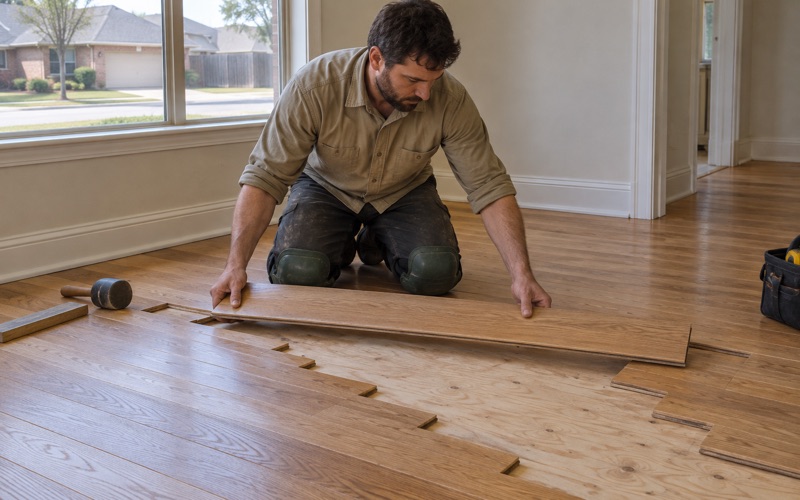
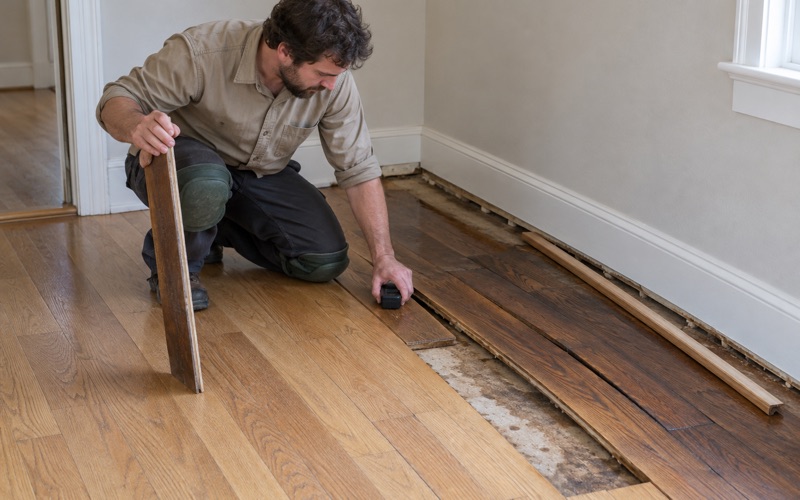
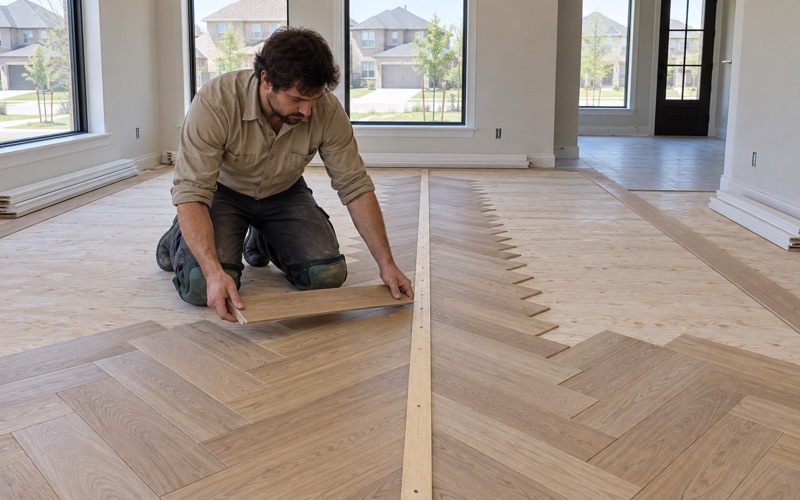
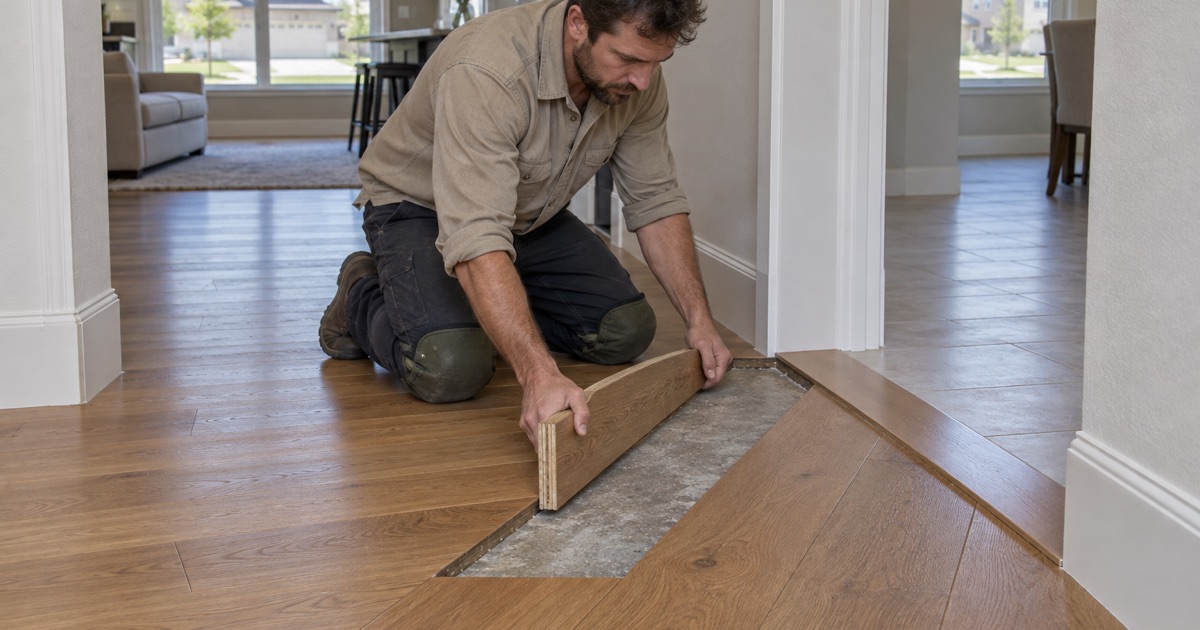
Where damage is contained, we replace boards and weave the new ones into the surrounding field so the repair does not read as a rectangle in the middle of a room. On a glue-down plank that means cutting out cleanly, dealing with the adhesive ridge left behind, and holding the expansion gap the whole run depends on.
Matching a prefinished plank is the hard part of that work, and it is worth being honest about before it starts. A site-finished floor is more forgiving, because the replacement boards are sanded and finished together with everything around them.
When a recoat is all that is left
A screen-and-recoat abrades the existing finish with a buffer and lays a fresh coat over it: waterborne polyurethane for a faster return to use, oil-modified polyurethane for a warmer tone that takes longer to come back. It restores sheen, hides fine scratching and costs a fraction of a sanding, and on a thin wear layer it is genuinely the right answer rather than a consolation.
Hardwax oil floors sit slightly apart in this. Because that finish penetrates the wood rather than forming a film across the top of it, a worn area can often be cleaned, re-oiled and blended into the surrounding boards without touching the rest of the room, and without spending any of the wear layer to do it.
What a recoat will not do is remove a gouge, lift a pet stain that has soaked into the wood, or flatten cupping, because none of those problems live in the finish. Knowing which of the two you are buying is most of the decision.
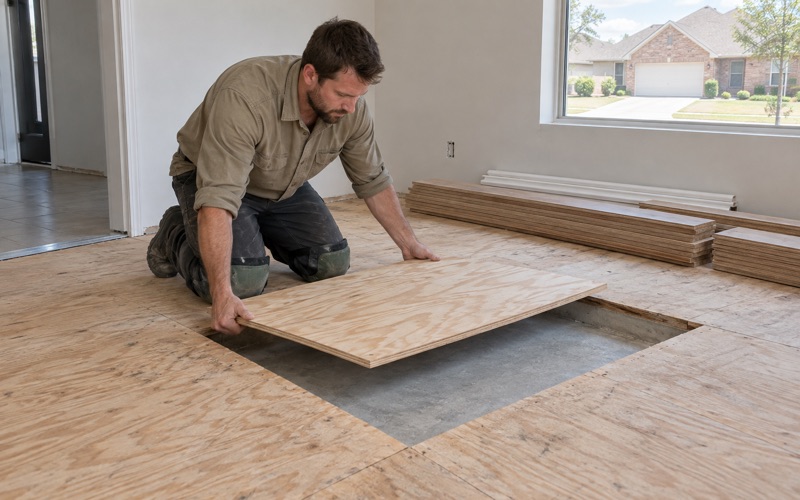
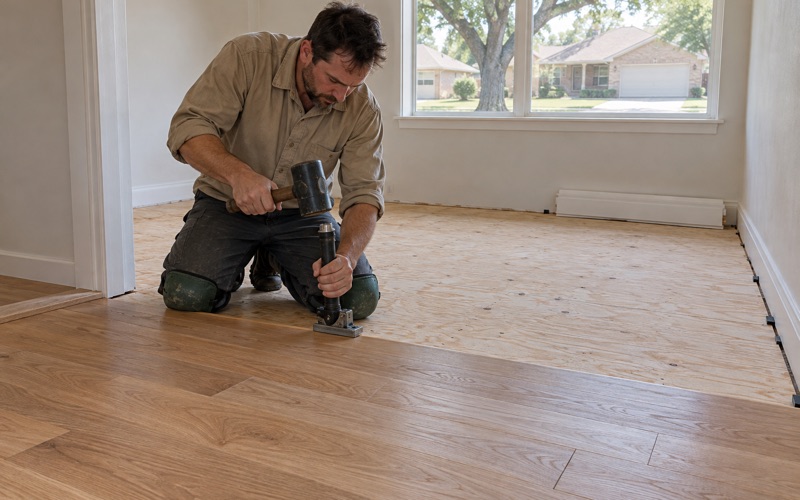
Cure time and dry time are also different things, and only one of them decides when the room is yours again. We hand over a written cure and occupancy schedule before the first coat goes down, covering when furniture comes back, when rugs can go down and when pets are allowed on the floor. Where a replacement is involved, the slab moisture reading is taken and recorded to a number before an installation date is set, and the wood acclimates inside the house, in the room it is going into, rather than in the garage or on the truck.
- 20+ Years in North Texas
- Dustless Sanding
- Free Written Estimates