Grapevine Wood Flooring installs, repairs and refinishes wood flooring in Euless, and after more than twenty years of doing this work we have learned that the question here is rarely which species looks best in a showroom. It is how many tenancies a floor has to get through before someone pays to replace it.
Most of the calls we take here come from landlords, property managers and complex owners rather than from a homeowner planning a remodel. That changes the shape of the whole job: the budget is set per unit, the schedule is measured against a lease start date, and the floor is specified to survive people who did not choose it. We quote it that way rather than pretending it is a kitchen renovation.
We still work for owners in Euless, and plenty of it. But whichever side of the market you are on, the same three numbers drive our recommendation: what the subfloor reads on a moisture meter, how much wear layer is actually left, and what the cheapest honest fix is.
Three in five Euless households rent
Euless has 23,899 occupied housing units, and 14,385 of them, 60.2 percent, are renter-occupied. Owner-occupied units make up the other 39.8 percent. That one ratio explains more about how flooring gets chosen here than anything else we could tell you about the city.
It shows up in the building stock too. Only 42.5 percent of housing units in the city are single-family detached, and 8,507 of those detached homes are lived in by their owners. Most of the rest is attached, stacked or rented, and most of it is not old: 67.7 percent of Euless housing went up in 1980 or later, with the 1980s alone accounting for 28.5 percent of units, the largest single decade.
A floor with a replacement cycle, not a lifespan
When the owner of a detached house asks us about wood flooring, the horizon is usually decades. When the owner of a rented unit asks, the honest horizon is tenancies. The floor has to look right at the start of each one, absorb whatever the next few years bring, and still be worth keeping rather than tearing out.
That is not a lower standard. It is a different one, and it rewards different choices: a harder species, a thicker wear layer, a finish that can be brought back with a screen-and-recoat instead of a full sand, and transition pieces sturdy enough that a mover’s dolly does not end the job.
Stacked units make flooring an acoustic decision
Because so much of this market is not detached, sound transmission between stacked units is a live constraint rather than a footnote. Hard surface in an upper unit is heard in the one below it, and underlayment belongs in the quote rather than in a conversation after the first complaint.
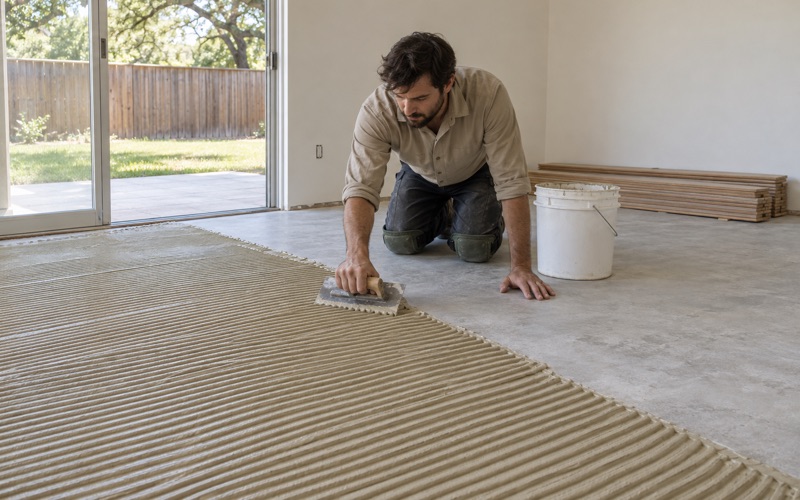
We price it as part of the assembly, not as an upgrade line. On a ground-floor unit over slab, a glue-down engineered installation is usually the quietest and most stable answer. On a framed upper floor, the pad or membrane under a floating floor is doing acoustic work as well as taking up minor subfloor variation, and the two jobs are not the same specification.
Looking for wood-flooring closer to Trophy Club? See Wood-Flooring Services in Trophy Club.
Specifying a floor that survives a turnover
Hardness is a number
Species hardness is measured rather than argued about. Red oak is the reference point most of the American market is built around, white oak sits at 1360 on the Janka hardness rating, and hickory at 1820; maple reads harder than it behaves once a finish sits on top of it.
For a unit that changes hands every couple of years we steer toward the harder end of that range, and toward grain and texture that hide a scratch rather than frame it. Wire-brushed and hand-scraped surfaces earn their keep in rented units for exactly that reason.
Wear layer decides whether you refinish or replace
On engineered flooring the wear layer settles the argument. A two millimeter wear layer is one light sand at best. Three millimeters is roughly where a real refinish becomes possible, and a six millimeter wear layer behaves much like solid wood for as long as anyone is likely to hold the building.
Under about three millimeters there is nothing left to take off, and running a drum sander through it means sand-through to the plywood core in the traffic lanes. So we measure the wear layer before we quote a refinish, not after the machines are already in the unit. If the number says the floor cannot be sanded, we say so and price the alternatives instead of selling a job that ends in a ruined floor.
Finish choice is a schedule choice
Waterborne polyurethane and oil-modified polyurethane both work. What separates them on a turnover is how quickly the unit comes back to you, and that difference is money. Cure time is not dry time: a floor can be walked on long before it can take furniture, rugs or a pet, and a finish still curing under an area rug is how a new floor gets marked in its first month.
That is why a written cure and occupancy schedule goes to you before the first coat goes down: when the floor can be walked, when furniture comes back, when pets are allowed on it. A lease start date is a real date, and the finish has to be chosen backward from it.
Wear against damage, and who pays for which
The line is a condition, not an opinion
Scratches in the traffic lanes, dulled finish at a doorway and light denting under table legs are wear. Gouges cut through the finish into bare wood, pet urine that has reached the subfloor, cupping or buckling from a leak that ran for weeks, and delamination on an engineered plank that was mopped like tile are damage. Those get different fixes and, usually, different payers.
Our part is to describe what is actually in front of us with a moisture meter reading rather than an adjective, so whoever has to make the call has something defensible to hold.
Documentation that survives a claim
When water is involved we document the rooms before we touch anything: photographs, moisture readings taken room by room, and a line-of-sight map showing where continuous flooring runs out of the wet room into dry ones. That map is what a matching argument turns on, and it is far easier to make while the floor is still down than afterward from memory.
Repair, refinish, replace, in that order
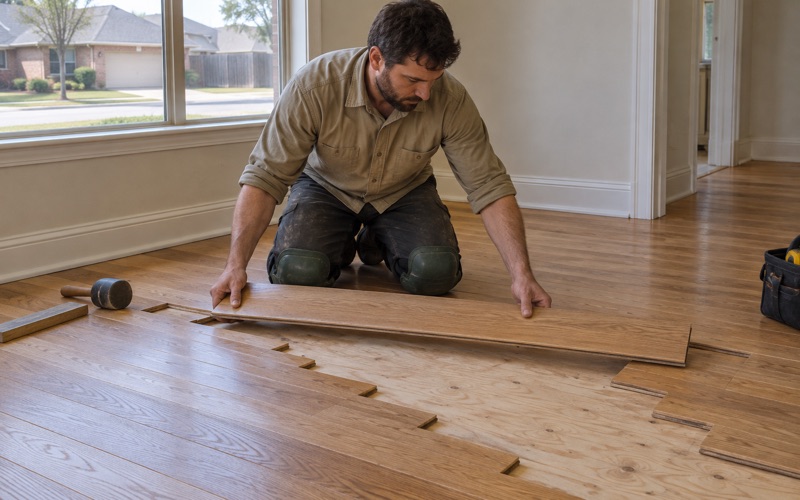
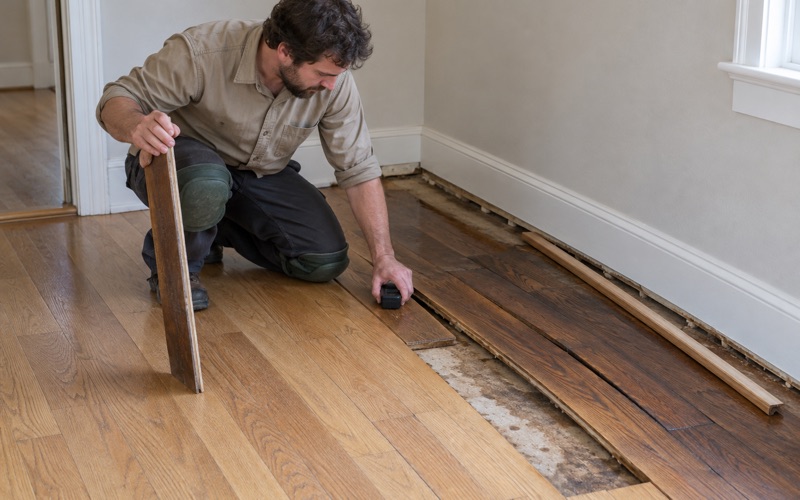
We price those three in that order and name the cheaper one first whenever it is the right one. A handful of ruined boards in a rented unit is usually board replacement, laced in so the repair does not read as a rectangle, or a dutchman patch where the damage is local and the surrounding boards are sound.
A tired but sound floor between tenancies is often a screen-and-recoat rather than a full sand, which costs less and gives back more of the wear layer’s remaining life. Full replacement is real and sometimes it is the only honest answer; it is simply the last one we reach for, and we would rather lose the larger invoice than sell it to you twice in five years.
What a make-ready has time for, and how it prices
The slab and the calendar
We test slab moisture to a recorded number before an installation date goes on the calendar, using an ASTM F2170 in-situ relative humidity test and looking for the slab at or under 75 percent relative humidity before any glue goes down. Running that test after the wood is already delivered is how a turnaround slips: either the material sits waiting in the unit, or it goes down over a slab that will push the floor apart later.
Wood acclimates inside the unit it is going into, in the rooms it will be installed in, never in a garage and never left on the truck overnight. On a make-ready that window is part of the turnaround you are quoting against, so we put it in the schedule instead of discovering it halfway through.
Working around the people already there
Airport shift work is common in Euless, and in an occupied building that compresses the hours a crew can make noise and dust without generating complaints. We plan the loud stages around it rather than starting a drum sander at whatever hour suits us.
Dustless containment goes up on every sanding job and we show you the setup before the first machine runs. In a stacked building that is not a courtesy to the unit being worked on; it is what keeps the neighbors out of the property manager’s inbox. Multigenerational households are a real share of this market as well, which means heavier and more continuous traffic than an occupancy count would predict, and a finish that renews easily beats one that looks perfect for a year.
Scope and price by the unit
Turnover work prices by the unit rather than by the house, and the way to keep that number stable is a repeatable scope: the same species, the same finish and the same trim profiles across a building, so a future repair is a weave-in rather than a hunt for a discontinued product.
It also means we quote from the unit in front of us. We will not put a per-unit figure on a building we have not walked, because unit types differ and the subfloor under them differs more. What we will do is walk every type once and give you a number per type you can plan a year of turnovers around.
Code, and the order the trades go in
Euless adopted the 2021 International Residential Code by reference, and permit applications received on or after October 11, 2022 are considered under that code set, per Ordinance No. 2323. Finish flooring is usually finish work, but a make-ready that opens up into subfloor repair or plumbing may not stay that way, and the city requires a contractor registration on file with the building inspection department, applied for in writing with the prescribed fees. It is a fair question to ask of anyone bidding your building.
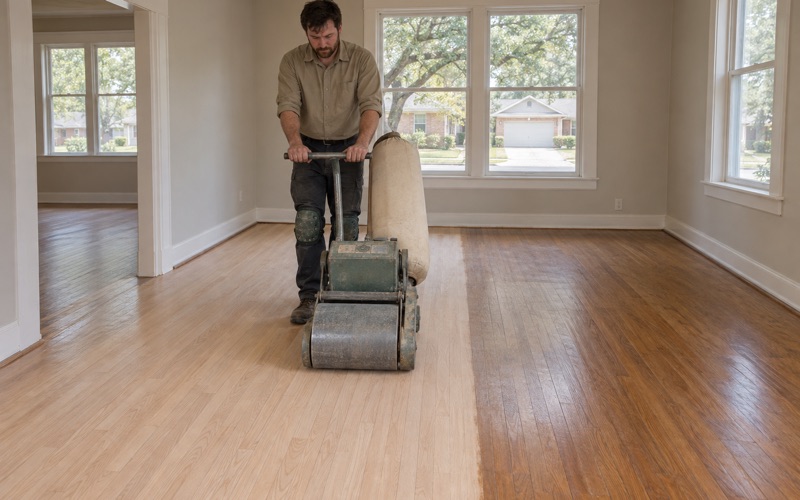
One crew runs the job from tear-out to final coat and the sanding is never subcontracted out. On a turnover that matters more than it sounds: the person who read the moisture meter is the person running the 36-50-80 grit sequence and the edger, and the handoff that usually costs a day never happens.
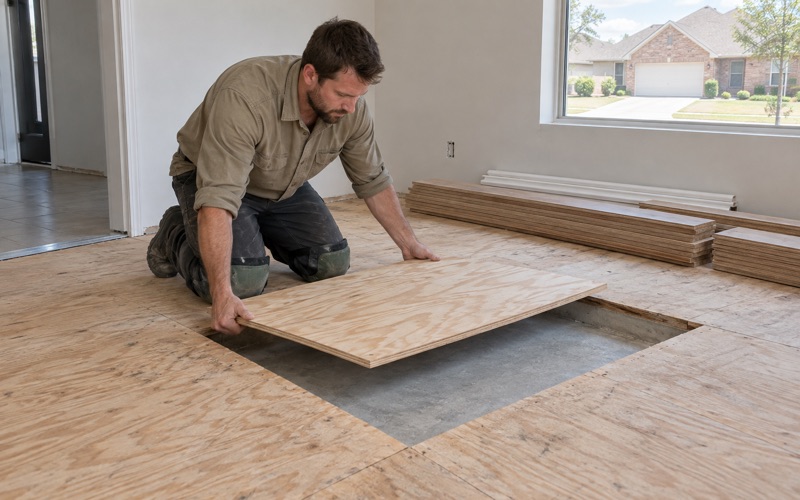
We also sequence our work after foundation repair and plumbing rather than ahead of it. A floor installed before the slab work is finished is a floor paid for twice, and on a rented unit the second bill arrives in the middle of somebody’s lease.
- 20+ Years in North Texas
- Dustless Sanding
- Free Written Estimates