Grapevine Wood Flooring has handled hardwood floor repair in Grapevine, TX for more than 20 years, serving surrounding cities including Southlake, Colleyville, Coppell, Euless, Trophy Club. Repair is the part of this trade where a homeowner is most likely to be sold more work than the problem calls for, because a full replacement is easier to quote than a careful patch and blend. We price repair, refinish and replace in that order and name the cheaper option first whenever it genuinely solves the problem.
It also matters that a repair begins with a diagnosis rather than a product. A cupped board, a hollow plank and a squeak are not three defects with three fixes; they are three symptoms, and each can have several causes sitting underneath it. We take moisture readings, look under the floor where there is access, and identify the source before anyone starts lifting boards.
Because this city’s housing runs from 1890s framed floors near the old townsite through the large 1980s subdivision stock to post-tension slab construction from the last fifteen years, the right repair changes from address to address. Cut nails over floor joists and a glue-down engineered plank on a 2015 slab have almost nothing in common beyond the word flooring.
Common Hardwood Floor Problems in North Texas Houses
Cupping, Crowning and Buckling
Cupping shows as board edges standing higher than their centers and means the underside is wetter than the top. Crowning is the opposite profile and often follows sanding a cupped floor before it had dried out. Buckling is a floor lifted clear of the subfloor by compression, usually where there was no adequate expansion gap. All three are moisture and movement events, so we find the source, let the floor stabilize, and only then decide what sanding or board work it needs.
Seasonal Gaps and Gaps That Never Close
A wood floor shrinks in dry months and swells back in humid ones, so some gapping between boards through a North Texas winter is normal behavior rather than a defect. What is not normal is a gap that stays open year round, one wide enough to catch a coin, or gapping concentrated in a single area while the rest of the room is tight. We take moisture meter readings across the room and compare them before recommending filling or board replacement.
Squeaks, Creaks and Movement Underfoot
Every squeak is a piece of wood moving against something else, and finding which two things are moving is most of the work. Over a crawl space we can usually correct it from underneath with shims and structural screws, leaving the finished floor untouched. Upstairs the fix is from above, through the flooring into the joist, and we plan fastener locations so they can be concealed in a board seam or filled and finished invisibly.
Repairing Damaged Boards
Board Replacement and Sourcing a Match
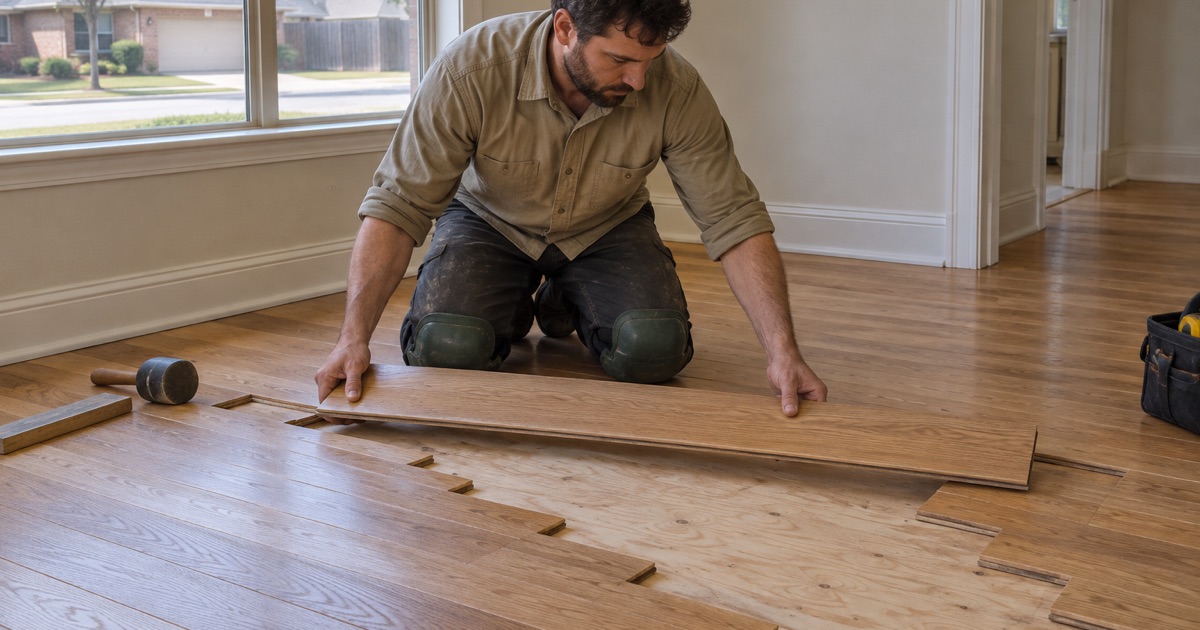
A board replacement removes damaged boards and sets new ones into the same openings, with the tongue cut away on the last piece so it can drop in. The difficulty is rarely the carpentry; it is the material. Species, cut, board width and thickness all have to line up, and on older floors we salvage from a closet or a hidden area rather than accepting a near miss. Where the whole area will be sanded, the finish match is made in the room.
Weave-Ins and Lacing New Wood Into the Field
When a repair area meets the untouched floor in a straight line, the eye finds it immediately no matter how good the color match is. A weave-in, also called lacing, staggers the new boards into the existing field over a distance so there is no continuous seam to see. It costs more labor and more material than a square patch, and it is the difference between a repair that disappears and one that is obvious from the doorway.
Dutchman Patches for Partial Damage
Where only part of a board is damaged, a full replacement can mean disturbing several sound neighbors to get it out. A dutchman patch lets in a smaller piece of matching wood, cut and fitted into the damaged section with the grain running true, then leveled and finished with the surrounding floor. It is the right answer for a gouge, a burn or a localized stain in the middle of an otherwise healthy board.
Glue-Down, Nail-Down and Loose Floors
Hollow Spots and Bond Line Failure
A hollow sound underfoot on a glue-down floor is the board telling you it is no longer attached to the slab. We map the affected area with a tap test, then test the slab with an in-situ relative humidity test before repairing anything, because re-gluing planks over a slab that is still driving moisture upward simply schedules the same failure again. Repairs extend to the boundary of the failure, not to the boundary of the complaint.
Delamination and Overwood at the Seams
Delamination is the wear layer separating from the core of an engineered board, which shows as lifting, flaking or a papery edge and cannot be repaired in place. Overwood is one board sitting proud of its neighbor at a seam, usually from a subfloor that was never flat enough or a fastening schedule that was too loose. Overwood can sometimes be sanded flat on a site-finished floor; on a prefinished floor it means board work.
Refastening a Nail-Down Floor
On a nail-down floor, loose or ticking boards usually mean the cleats or staples were spaced too far apart, driven at the wrong angle, or set into a subfloor that had already moved. We re-secure through the tongue where a board can be lifted, or face-fasten and fill where it cannot, following a proper fastener spacing schedule rather than adding one nail at the noisy spot and calling it done.
Finish Repairs and Knowing When to Stop Repairing
Spot Repairs, Screen-and-Recoat and Full Sand
A finish problem in one area can sometimes be abraded and recoated locally, though the repair is only invisible if the surrounding finish is the same age and system. Where wear is general but has not reached the wood, a screen-and-recoat across the room is faster and far cheaper than sanding. Once there is bare gray wood in the traffic lanes, only a full 36-50-80 grit sand will produce an even result.
Black Stains, Pet Damage and What Will Not Sand Out
Dark staining along board edges is water that reached the wood and sat there; a black pet stain is urine that has penetrated into the fibers and reacted. Light marks sand out readily. Deep black usually does not, because the discoloration goes further into the board than a sander can safely follow. We sand a test area before quoting a whole-floor refinish so nobody pays for a sand that leaves the stains behind.
When Repair Stops Being the Cheaper Answer
Repair wins when the damage is localized, the material can be matched, and the floor has sanding life left. It stops winning when damage is scattered across several rooms, when the wear layer is too thin to blend a patch into, or when each repair simply reveals the next weak area. At that point we say so plainly and price the replacement, rather than taking three visits to arrive at the same conclusion.
- 20+ Years in North Texas
- Dustless Sanding
- Free Written Estimates