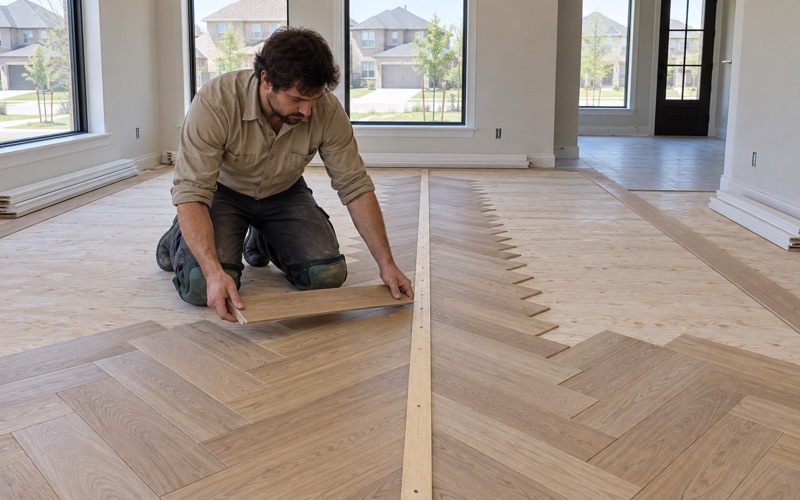
Grapevine Wood Flooring installs, repairs and refinishes wood flooring in Justin, and after more than twenty years of this work we can tell you that the hardest variable on a job here is rarely the wood. It is the house the wood is going into. A large share of the homes in town are new enough that the structure is still giving up the water it took on while it was being built.
So a Justin installation starts with a number instead of a date. Slab moisture is tested and written down before an installation date is set, not after a pallet of white oak is already sitting in the living room. If the reading is not where it needs to be, the schedule moves rather than the standard.
That order of operations costs a little patience at the front of a project and saves a callback in January. What follows is what we measure, what we measure it against, and why a floor that was rushed into a new house tends to announce itself during its first heating season.
A fifth of Justin has gone up since 2020, and it is still drying

Justin sits in Denton County as an outer ring suburb of Fort Worth, and its population was 4,409 at the 2020 census. The housing holding those residents is young by any measure. Of the 1,842 occupied units in town, 416 were built in 2020 or later, which is 22.6% of everything standing.
That single figure changes the shape of a flooring job here. A floor going into a house built in the last few years is not being fastened into a settled, dried-out structure; it is being fastened into one that is still finishing something the builder started. We plan around that rather than assume it resolved itself.
The growth is concentrated, not scattered
The modal decade for housing here is the 2010s, at 536 units, with the 2020s close behind. Timberbrook, the master-planned community in Justin, was planned at about 1,000 homes at build-out and was roughly 60% complete as of summer 2025, with a 1,550-home addition behind it that includes land for a new Northwest ISD campus.
So a large share of the calls we take in this town are either a first real floor in a recent house or a replacement of a builder-grade floor that did not last. Both are installations into recent construction. Both begin with the same measurement.
Very little middle-aged stock in between
Only 114 units in Justin date from the 1990s, so the usual middle band of aging builder-grade flooring is thin here. Refinish-versus-replace conversations tend to split cleanly rather than land in the gray middle.
Ownership shapes the job mix as well. 83.71% of occupied units are owner-occupied, 1,542 owner households against 300 renter households, and 91.86% of units are single-family detached — so the work here is whole-floor decisions made on taste and condition, not turnover patching against a lease date.
A house that has not finished drying out
Concrete carries water long after it is hard enough to walk on. A slab-on-grade poured for a new house keeps releasing that moisture upward well past the point where the finish trades show up to work over it. Drywall mud, paint and tile grout each add their own water to a building that is by then closed up.
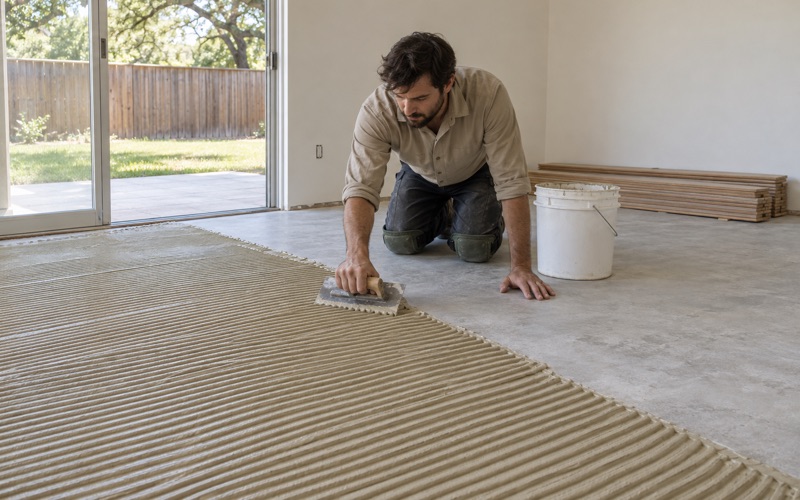
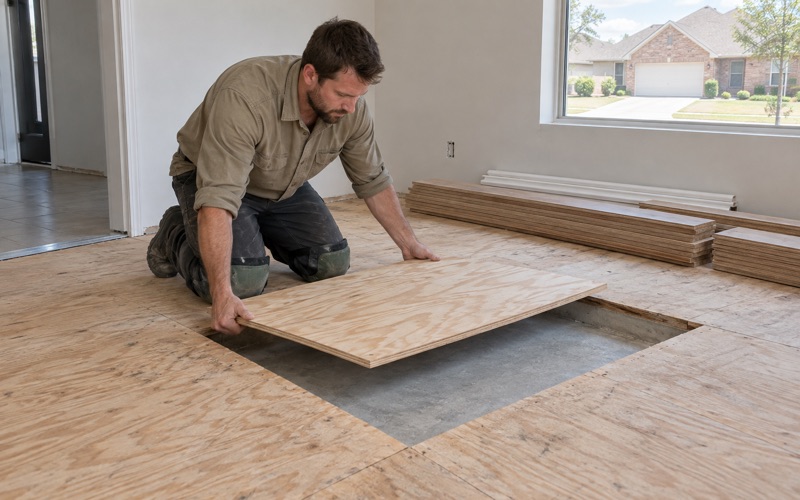
Wood is the material that keeps score. A floor laid over a slab that is still giving up water will take some of it on, whether the installation is glue-down engineered, a floating floor over a vapor retarder, or nail-down over plywood sleepers. The failure does not show up on the day of the install, which is exactly what makes it expensive.
Why a calendar date is not the test
We do not set an installation date and then find out what the slab is doing. The slab is tested to a recorded number first, and that number is what releases the schedule.
The two tests worth knowing by name are the ASTM F2170 in-situ relative humidity test, which puts probes down into the slab itself, and the calcium chloride test, which measures what comes off the surface. Manufacturers commonly want a slab at or under 75 percent RH before a glue-down engineered installation. On stock as new as much of Justin’s, that is a genuine go/no-go rather than a formality we sign off on.
Sequencing around the other trades
We schedule the floor after the trades that can still put water into the building. Plumbing work in particular belongs ahead of the floor rather than behind it, because a floor that goes down early ends up paying for someone else’s schedule.
On a house still under construction that ordering is usually easy to arrange, since everyone involved is already thinking in sequence. On an owner-driven remodel in a house that is only a few years old, it is a conversation we generally have to start ourselves.
Looking for wood-flooring closer to University Park? See Wood-Flooring in University Park.
Acclimating wood on site, in the room it is going into
Acclimation is not storage. The point is to let the boards reach the moisture content they will actually live at, in the conditions they will actually live in, before anything is fastened down permanently.
That is why the wood comes inside the house and into the room it is destined for, never the garage and never left overnight on the truck. A garage is not the same environment as a conditioned living room, and boards that equalized to the garage arrive in the room already wrong.
Measured, not scheduled
We will not quote an acclimation period as a number of days, because a number of days is not the thing being measured. The wood is ready when its moisture content and the subfloor’s are close enough to one another, read with a moisture meter on the actual boards and the actual subfloor, in several places rather than one.
A house that has been under climate control for a good while can get there quickly. A house whose HVAC has only just been switched on may not. Two deliveries of the same white oak can behave differently for no reason more exotic than what the building was doing the month before.
The conditions have to be running
Acclimation only means something if the house is being held near the temperature and humidity it will be lived in at. A building still being finished, with doors propped open and the system off, is not conditioning anything, and wood sitting in it is simply waiting.
We would rather wait for real conditions than install into a guess. It is a short delay measured against a floor that has to come back up.
Equilibrium moisture content, and what it is measured against
Equilibrium moisture content is the level a piece of wood settles at when it stops exchanging moisture with the air around it. It is not a fixed property of a species. Change the air and the wood follows, which is the entire reason an installation needs a moisture procedure rather than a rule of thumb.
The reading that matters most is not the flooring’s on its own. It is the gap between the flooring and the subfloor it is being fastened to, because that difference is what drives movement after the last board goes down.
Reading the subfloor, not just the boards
A plywood subfloor gets metered the same way the flooring does, in multiple spots instead of one convenient corner. Wide boards are less forgiving of a gap between those two readings than narrow strip flooring is, so a wide-plank order is a reason to be stricter rather than more relaxed.
Where a slab is involved, the slab test stands in for that subfloor reading. Self-leveling underlayment poured to flatten a floor is one more thing that arrived wet and has to be accounted for before anything covers it.
Expansion gaps exist because wood moves
Even a correctly acclimated floor moves with the seasons. The expansion gap at the walls, the fastener spacing schedule and the choice between cleats and staples on a nail-down are all ways of planning for that movement instead of pretending it will not happen. NWFA installation guidelines give those decisions a common baseline, which is useful when a homeowner wants to know why we did something a particular way.
Why the first winter shows the mistake
Justin lies in NWS public forecast zone TXZ103, covering Denton County, and the seasonal pattern there is unremarkable: humid stretches, then a heated and much drier house once winter sets in. Unremarkable is still enough to expose a floor installed at the wrong moisture content.
A floor that went down too wet gives that water up as soon as the heat comes on. Boards shrink and gaps open along every seam at once. A floor that went down too dry does the reverse in its first humid stretch, with edges rising into a cup and, in a bad case, boards buckling away from the subfloor.
What the symptoms actually tell us
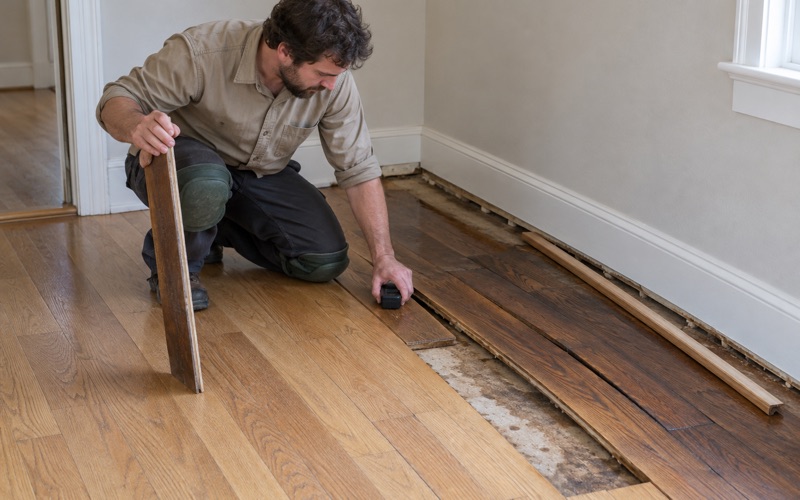
Cupping, crowning and buckling each point somewhere specific. We would rather diagnose from the pattern and from fresh meter readings than from the calendar, because a floor that failed for a moisture reason and a floor that failed at its fasteners can look much the same in a photograph and need different work.
On engineered flooring we measure the wear layer before quoting a refinish, since under about three millimeters there is nothing left to sand and the honest answer is replacement. Repair, refinish and replace are priced in that order, and the cheaper option gets named first whenever it is the right one.
Coating, cure, and the hours we are allowed to work
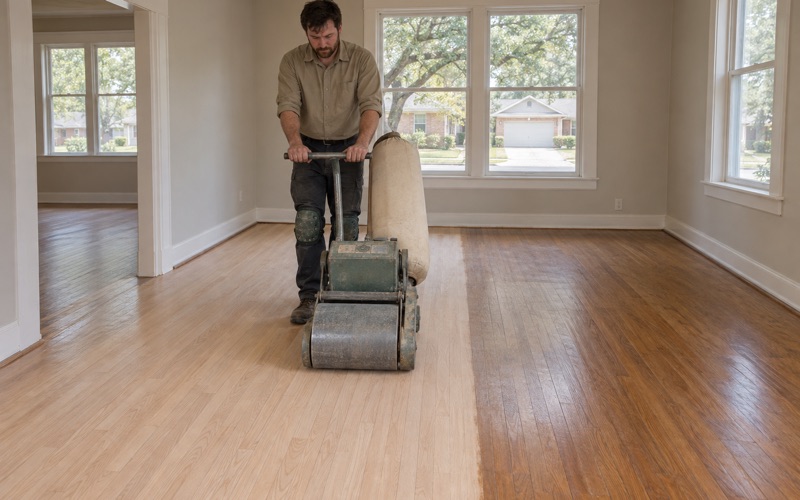
A site-finished floor needs its sanding sequence and then its finish schedule, and cure time is not the same thing as dry time. The City of Justin permits construction work on weekdays from 7:00 a.m. to 6:00 p.m. and Saturdays from 8:00 a.m. to 6:00 p.m., with no Sunday work allowed, so a coating schedule here cannot quietly borrow a Sunday to make up a lost day. We would rather build that into the plan than discover it midway through a finish.
You get a written cure and occupancy schedule before the first coat goes down, including when furniture and pets come back onto the floor. Dustless containment is set up and shown to you before any machine runs. One crew carries the job from tear-out to final coat, and the sanding is never subcontracted out.
- 20+ Years in North Texas
- Dustless Sanding
- Free Written Estimates