Grapevine Wood Flooring has handled wood flooring in Keller for more than twenty years, and the call that comes in most often from this city is not about a new install. It is a homeowner standing over a floor that has gone dull and gray in the traffic lanes, asking whether it can be brought back or has to come out.
That question has a real answer, and it is closer to a measurement than a matter of taste. What the floor is made of, how thick the wearable material still is, and how far the damage has already traveled past the finish decide it between them.
We price repair, refinishing and replacement in that order, and the cheapest of the three is named first any time it is genuinely the right one. That habit matters more in Keller than in most of the places we work, because of when this city’s housing was built.
Keller’s biggest cohort is at its first real decision
Of the 16,892 housing units in Keller, 4,944 were built between 2000 and 2009. At 29.3 percent that is the largest single decade in the city, ahead of the 4,032 units from the 1990s and the 3,163 from the 1980s. Those 2000s floors are now somewhere between sixteen and twenty-five years old.
That age band is where a floor stops being background and turns into a decision. Builder-grade engineered plank with a thin wear layer, early prefinished solid and first-generation laminate all reach the end of their serviceable life somewhere inside it. The finish fails first; the wood underneath it fails second, and the second stage is the one that closes options.
Nothing about that timing is a rule, and we will not tell anyone their floor is due because a certain number of years have gone by. Two houses finished the same season can be a decade apart in wear depending on entry mats, pets, sun exposure and whether the floor has been cleaned with standing water. The traffic lanes are the honest indicator, not the build date.
Old enough to need it, young enough that the decision is still open
A first refinish is not an item on a maintenance calendar. It is a response to a condition, and the condition is wear straight through the factory finish in the lanes people actually walk: the run in from the garage, the pivot at the kitchen island, the turn at the bottom of the stairs. The same floor two rooms over can still look close to new.
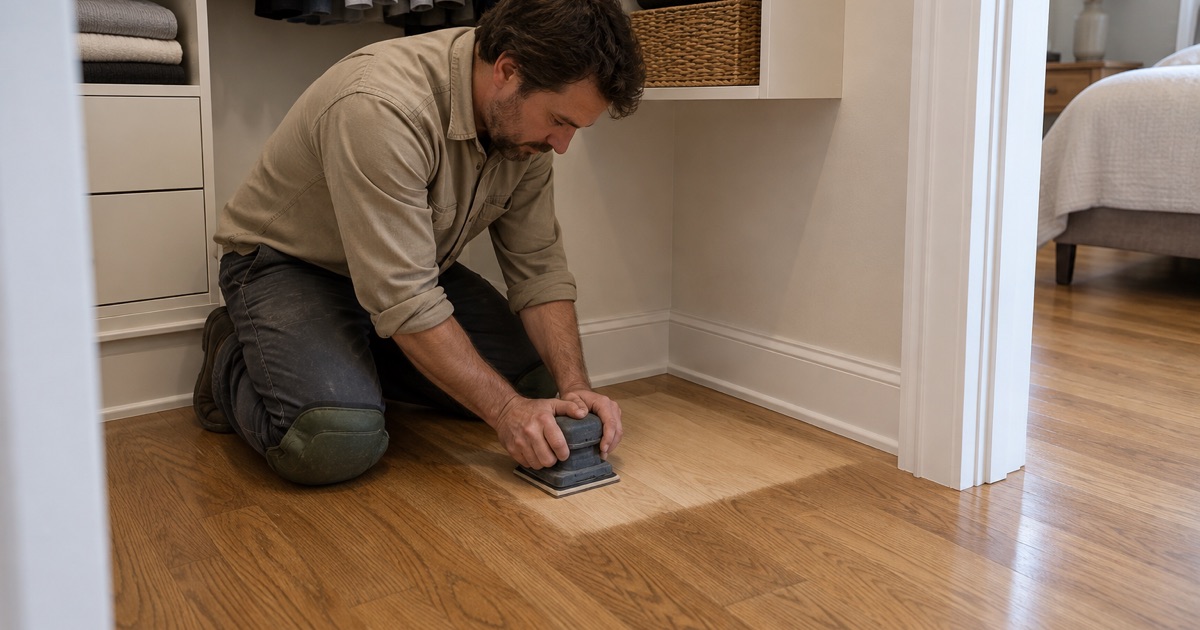
While the finish is the only thing that has failed, nearly everything is reversible. Sanding and refinishing, or in the right case a screen-and-recoat, resets the surface and costs the floor a fraction of a millimeter of material. Once bare wood has been walked on and cleaned with water for a season or two, the repair moves out of the finish and into the boards themselves, and boards are neither cheap nor quick to match.
Who is usually making this call here
Most of the occupied housing in Keller is owner-occupied, 13,742 of 16,462 units, and 88.32 percent of all units in the city are single-family detached. Owners who intend to stay in the house are the ones who get the most out of catching a floor at this stage, because they are the ones who will be living on the result years from now rather than handing the question to somebody else’s inspector.
Looking for wood-flooring closer to Hurst? See Wood-Flooring in Hurst.
Finding out what is under there before anyone quotes
A price written off a photograph is a guess. Before we quote anything in Keller we establish what the floor actually is, solid or engineered, site-finished or prefinished, nailed, glued down or floating, because those answers change the whole scope of the work and two of them decide whether a refinish is even available.
Wear layer thickness is a measurement, not a judgment
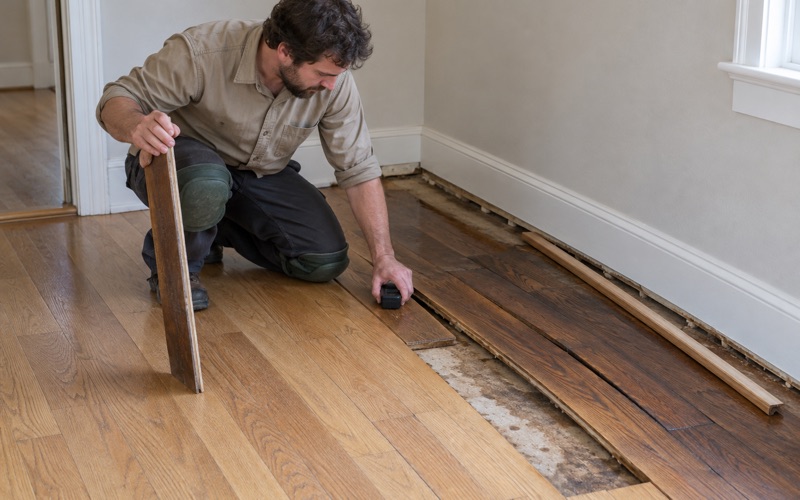
On engineered flooring the first number that matters is wear layer thickness. A six millimeter wear layer behaves much like solid wood and has several sandings left in it. A three millimeter wear layer has one careful pass. Under roughly three millimeters there is nothing left to sand, and running a drum sander over a two millimeter wear layer produces sand-through to the plywood core, which is a permanent defect rather than a cosmetic one.
So we measure it before we quote a refinish, never afterward. Lathe checks in the veneer, overwood at the seams and delamination along a bond line get looked at in the same visit, because each of those pushes the job toward board replacement, a weave-in or a dutchman patch instead of a straight sanding.
What the slab underneath allows
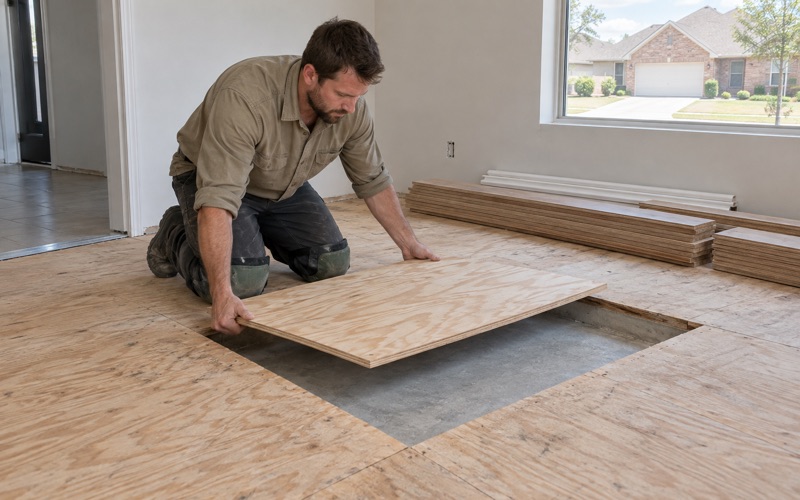
The roughly 4,200 Keller units built before 1990 are generally conventionally reinforced slab, where plywood sleepers and fastened subfloor assemblies are workable. Most of what went up after that is post-tension slab, and on a post-tension slab nothing gets fastened through the concrete until the tendon layout has been located. Getting that wrong one time is expensive enough to pay for the care taken every other time.
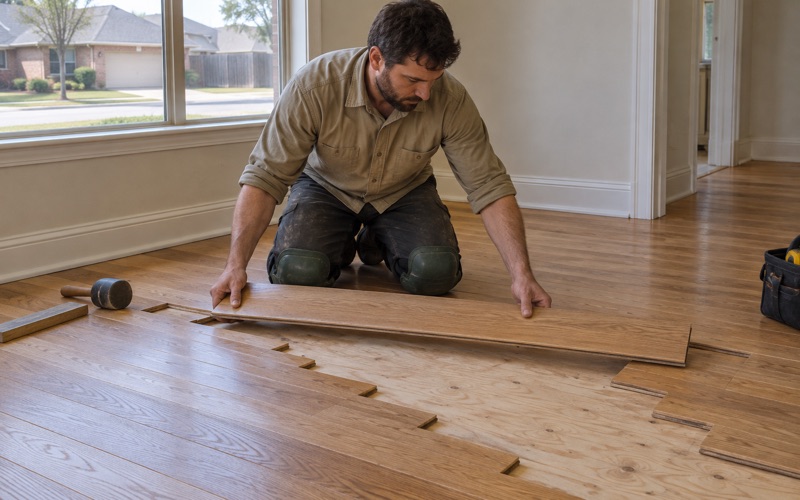
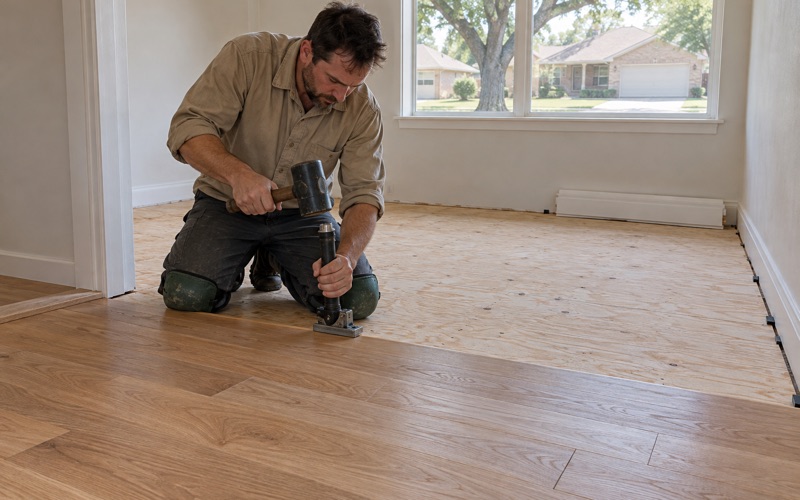
Where a nail-down assembly is in play the fastening schedule is its own decision. Cleats and staples hold differently, crown width and fastener gauge have to suit the plank, and a spacing schedule that was correct for narrow strip flooring is wrong for wide plank. Wide boards move more across their width, and an expansion gap sized for the previous floor is one of the more common reasons a new one buckles later.
Only 132 housing units in the entire city predate 1960, so framed floor systems over a crawl space are uncommon here even in Old Town Keller, where street names from the original forty-acre townsite survive. The overwhelming majority of floors we open in this city sit on concrete, which makes slab moisture the governing condition on anything new going down.
The moisture number comes before the install date
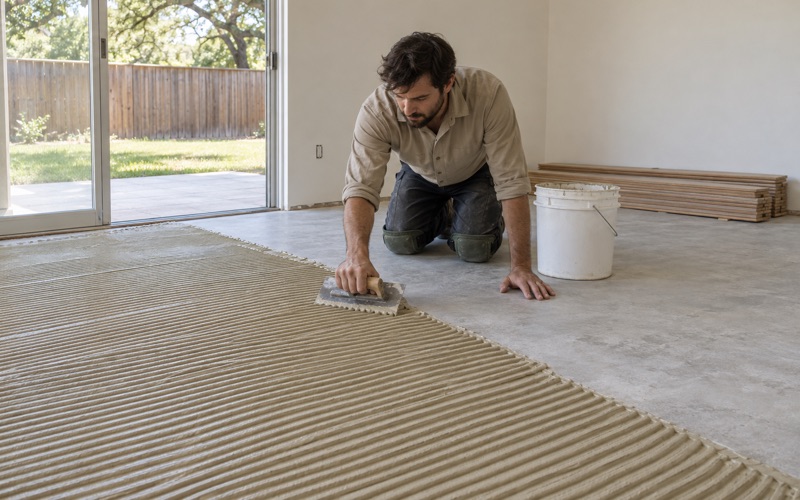
Where the answer turns out to be replacement rather than refinishing, we run an ASTM F2170 in-situ relative humidity test and record the reading before an installation date is set. A slab at or under 75 percent RH is the threshold most manufacturers write into their warranties; above it, the job needs a vapor retarder strategy or more drying time. Booking the calendar first and testing later is how a glue-down engineered installation ends in bond line failure a year in. The wood itself then acclimates inside the house, in the room it is going into, not in the garage and not on the truck.
Refinishing solid against recoating engineered
The two floors can look identical underfoot and take completely different work. Telling a customer which one they own, and what that means for cost, is most of the value of the first visit.
What a full sand can and cannot undo
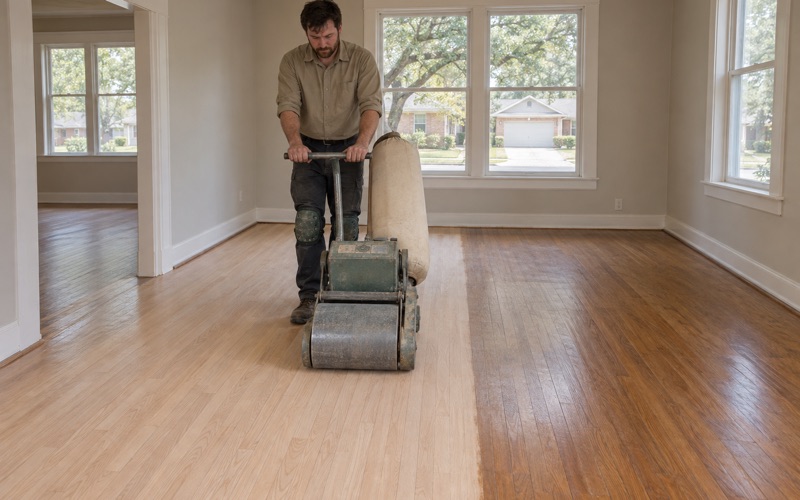
Solid wood, whether that is red oak, maple, or white oak at 1360 Janka, takes a 36-50-80 grit sequence with a drum sander for the field, an edger at the perimeter and a buffer before coating. That sequence removes the old finish, the traffic pattern and shallow pet damage in one pass, and it can be repeated over the life of the floor. Hickory at 1820 Janka is harder on equipment and on grit, but the principle does not change.
What a sand cannot undo is movement. Cupping and crowning come from a moisture differential across the board, and sanding a cupped floor flat before that differential has resolved produces a floor that crowns later. We measure with a moisture meter and wait for the floor to settle rather than sand to a deadline.
Screen-and-recoat, and when it is the honest answer
If the wear has not gone through the finish, abrading the existing coating and putting a fresh coat over it is the cheaper and less invasive route, and it leaves every future option intact. It is the option we name first whenever the floor supports it, including on engineered plank where the wear layer is too thin for anything else.
Finish choice follows the household rather than fashion. Waterborne polyurethane is the fast-return option, oil-modified polyurethane ambers over time and is slower to cure, and hardwax oil is the one that can be spot-repaired without recoating a whole room. Every one of them has a cure time that is longer than its dry time, and confusing the two is how a brand new floor picks up furniture dents in week one. We hand over a written cure and occupancy schedule before the first coat goes down, including when pets and furniture come back.
The cost of waiting, and who signs the work off
Reversible now, replaced later
The difference between this year and five years from now is rarely the price of the finish. It is whether the floor still has enough material above the tongue, or enough wear layer above the core, to be worked at all. A floor that could have been recoated becomes a floor that has to be sanded; a floor that could have been sanded becomes a floor that has to come out, and coming out is the one decision nothing walks back.
Waiting also widens the repair list. Gapping that opened seasonally gets walked on and rounds over at the edges, so the boards no longer close cleanly. Water that sat at a dishwasher or a refrigerator line stops being a finish problem and becomes a subfloor problem, and on a slab that means grinding, self-leveling underlayment and a longer schedule than anyone wanted.
Registration, code and the order the trades go in
Keller requires general contractors, contractors of the major trades and contractors holding state licenses to register with the city before starting any work, and to provide liability insurance or a surety bond of $300,000 per occurrence. Any homeowner in Tarrant County can verify a company’s registration with City of Keller Building Inspections before hiring rather than taking a claim on faith.
Keller adopted the 2021 International Residential Code effective February 25, 2022, along with the 2021 International Codes, the 2018 International Energy Conservation Code and the 2021 International Fire Code with appendices. Finish flooring work generally falls outside permit requirements, but subfloor and structural repairs discovered underneath a failing floor do not, and we would rather raise that on the first visit than in the middle of a tear-out.
Sequence matters as much as permits. We schedule floors after foundation work and after any plumbing repair under the slab, never in front of them, so that a new floor is not paying for another trade’s calendar. Dustless containment goes up and gets shown to you before the first machine runs, and one crew carries the job from tear-out to final coat, with the sanding never subcontracted out.
- 20+ Years in North Texas
- Dustless Sanding
- Free Written Estimates