Grapevine Wood Flooring has been doing wood flooring in Lake Dallas for more than twenty years, and a good share of what we are called out to look at here is small. A few boards swollen by the patio door, a hallway worn through in the traffic lane, a stair nosing that has worked loose. Those are worth doing, and they are also the jobs where the price a homeowner has in mind and the price a flooring crew has to charge sit furthest apart.
The reason is not square footage. Below a certain size, the cost of a repair stops tracking the area of floor being touched and starts tracking the fixed cost of getting there at all — the drive, the machines coming off the truck, the containment going up, a can of finish being opened. That threshold is what a minimum charge describes, and in a town this size it is usually what decides whether a small repair makes sense.
We would rather walk through that arithmetic with you than quote around it. What follows is how small work gets priced here, how a two-board job can be made to pay for itself, and where the honest answer is that a repair is no longer the cheaper option.
In a town this size, the minimum is the real number
A minimum charge is not a penalty for asking about a small job. It is the point where the price stops being about the floor and starts being about the visit, and knowing where that point sits is what lets you decide well.
The part of the price that never gets smaller
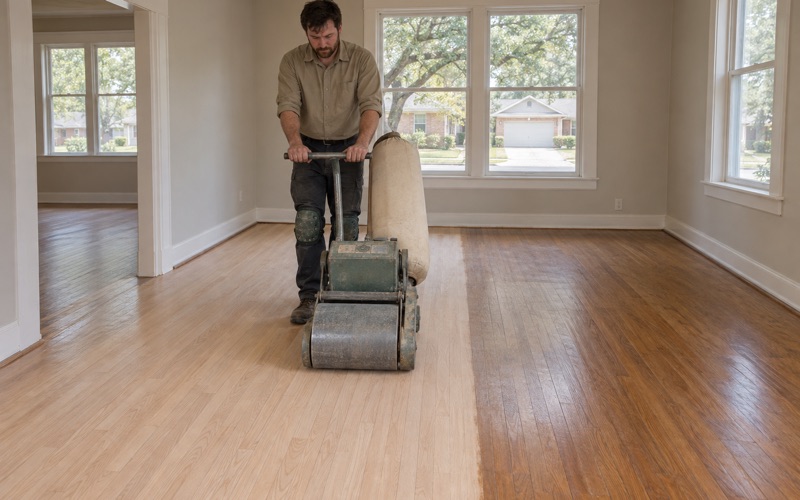
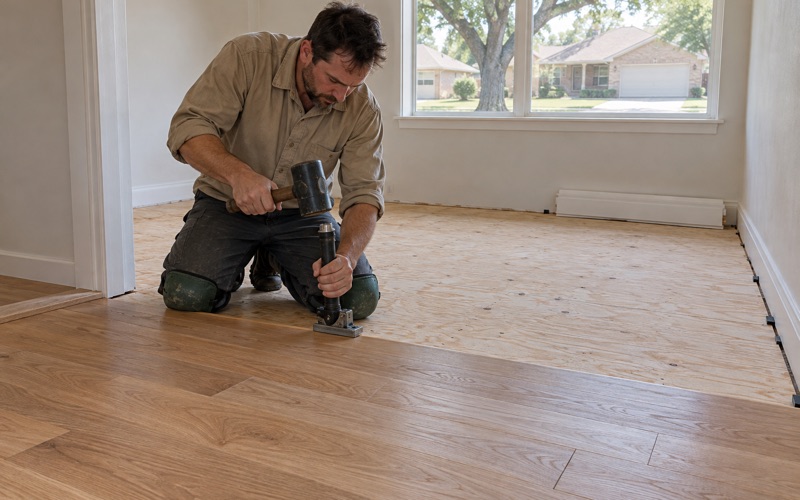
A repair arrives as a crew and a truckload: a drum sander for the field, an edger for the perimeter, a buffer for the blend, and the dust containment that goes up on every sanding job we run. We set that containment and show it to you before the first machine runs, on a four-square-foot patch exactly as on a whole first floor. Neither does the finish scale down — once a can of waterborne polyurethane or oil-modified polyurethane is opened for a blend coat, it is spent whether the area under it is a threshold or a living room.
That is the shape of the whole problem. A real cost is incurred in full against a very small amount of floor, and no amount of quoting per square foot makes it smaller.
Why a two-board repair costs more than two boards
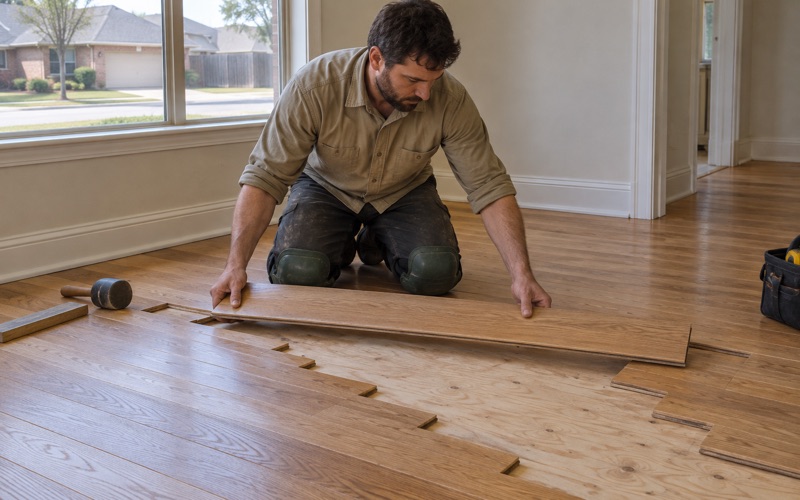
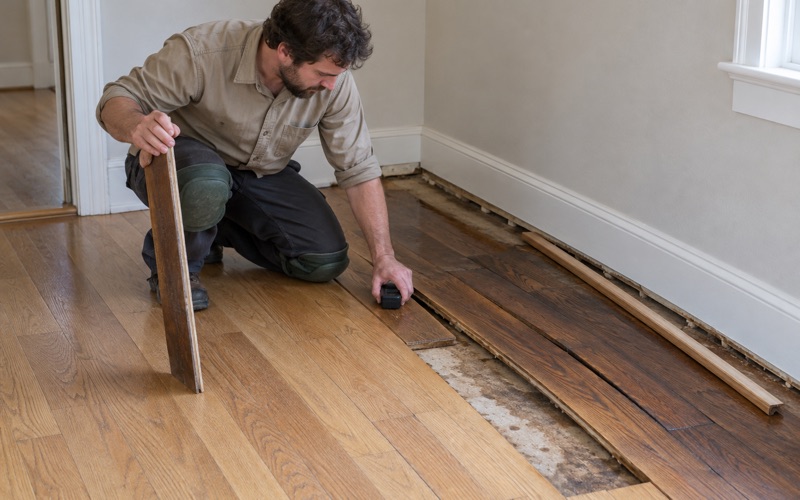
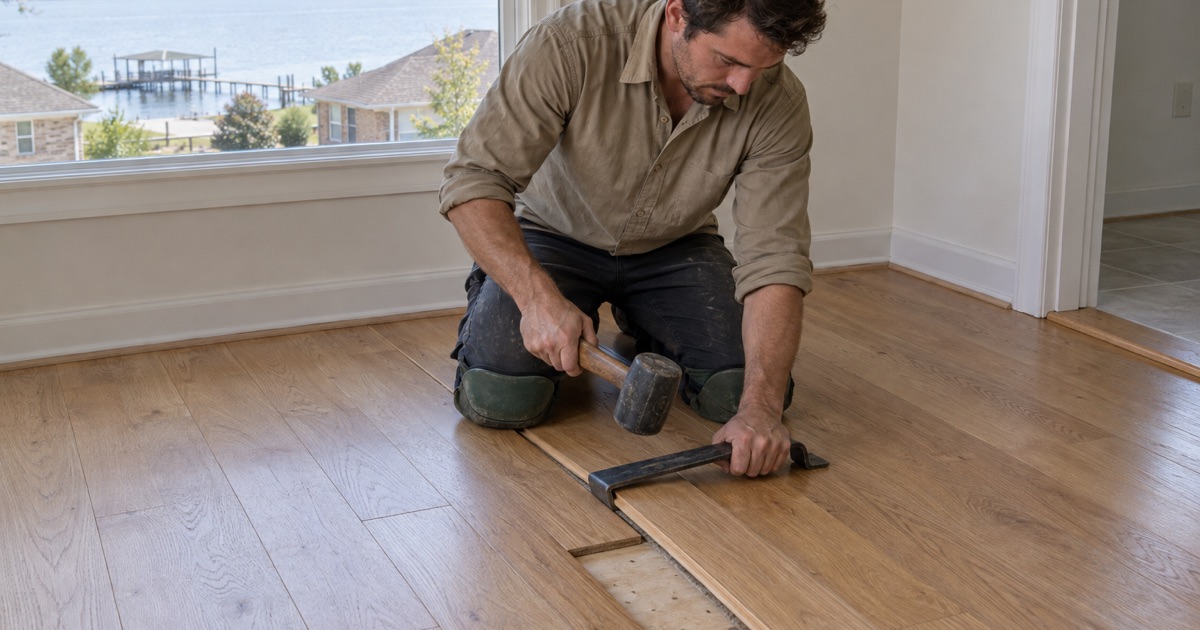
When we quote board replacement, most of what we are quoting is removal and reintegration rather than material. Tongue-and-groove strip flooring does not lift out; the damaged boards get cut free, the tongue is split off each replacement piece, and the new boards are woven into the surrounding courses so the end joints stagger the way the rest of the field does.
That lacing is the labor, and so is what follows it. The patch is sanded flush through a 36-50-80 grit sequence and blended at the edges, because a replacement left sitting proud reads as overwood underfoot. A weave-in done properly disappears; one rushed to save an hour is visible from the doorway for as long as the floor is down.
What 3,294 housing units does to a schedule
Lake Dallas holds 3,294 housing units in all, spread across four decades rather than piled into a single building boom. The largest cohort, 1,073 units or 32.6 percent, went up between 2000 and 2009, with the rest distributed through the 1970s, 1980s, 1990s and 2010s. Owner-occupancy runs at 69.2 percent of the 3,112 occupied units.
For a flooring crew that spread has a practical consequence. There is no one era of construction here that keeps us on the same streets week after week, so a small repair can rarely ride along on a trip we were already making. Mobilization has to be carried by the job in front of us, which is why batching is worth talking about.
Looking for wood-flooring closer to Haltom City? See Wood-Flooring Services in Haltom City.
Batching small work into one visit
The most effective thing anyone can do about a minimum charge is to stop treating each small problem as its own project. Several repairs under one mobilization cost far less than the same repairs spread across three visits.
One setup, several repairs
If the patio-door boards are cupping, the hallway needs a screen-and-recoat and a stair tread has gone loose, those are three tasks sharing one drive, one containment setup and one finish schedule. We would rather see all of it in a single walk-through and price it as one visit than come back twice at full freight.
That is also why we ask what else is bothering you about the floors. It is not an upsell — it is the one lever that moves the per-repair number in a town this size.
Turnover floors and shared-wall buildings
Of the 3,112 occupied units here, 958 are renter-occupied, so flooring specified between tenants — durability and price ahead of finish character — is a standing category of work rather than an occasional request. A manager with several units turning over in the same month is the clearest batching case there is, and we price it that way.
Not all of the stock is detached. Of the 3,294 units, 2,188 are single-family detached, leaving 1,106 in other structure types, and those carry conditions detached work does not: sound transmission through a shared assembly, and association rules on underlayment and permitted hard-surface flooring. We ask about both before specifying a glue-down engineered or floating floor, because a rule discovered afterward is an expensive surprise.
Sequencing behind the other trades
The other way one small job turns into three is by going in too early. We sequence flooring after foundation work and after plumbing rather than ahead of them, so the floor is not paying for someone else’s schedule, and we will say so plainly if a repair should wait.
Wood acclimates inside the house, in the room it is going into — never in the garage, never left on the truck. On a small batch that costs a few days at the front end, and it is the difference between a repair that stays flush and one that cups its way back onto our list.
When a spot repair stops being worth doing
There is a point on every floor where patching stops being the cheaper option, and it is not always where people expect. We would rather name it early than take the repair money and have the same conversation in a year.
Engineered floors and the wear layer
Before we quote a refinish on engineered flooring, we measure the wear layer, because that measurement decides whether a refinish is possible at all. A two millimeter wear layer will not survive an aggressive sanding, a three millimeter wear layer is roughly where the arithmetic turns marginal, and a six millimeter wear layer behaves much more like solid wood.
Below about three millimeters there is nothing left to take off, and pushing a drum sander through it means sand-through to the plywood core — a defect that cannot be repaired, only replaced. On those floors the real options are a screen-and-recoat, board replacement, or planning for replacement, and we will tell you which one you actually have.
Matching, and the line of sight
A patch is only as good as its match, and matching gets harder as the repaired area grows. Species and cut matter — red oak and white oak at 1360 Janka take stain differently, and hickory at 1820 Janka is a different animal again under the sander. So does whether the floor was site-finished or prefinished, since a prefinished board carries a factory bevel and a factory sheen the field cannot be talked into.
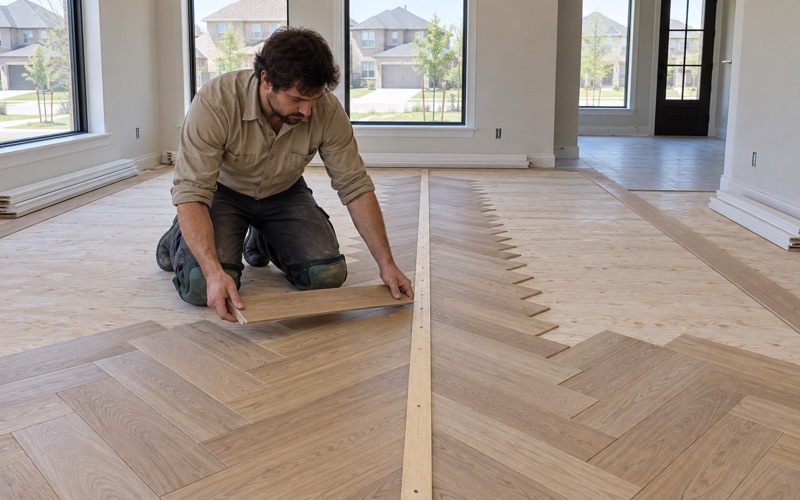
Once the repair spans a line of sight — one continuous run of flooring visible from a single vantage point — the sensible unit of work is usually that whole run. Sanding and refinishing a room end to end removes the match problem entirely, and it is frequently cheaper than a large weave-in that still shows.
Repair, refinish, replace — in that order
We price those three in that sequence and name the cheaper one first whenever it is genuinely the right answer. A repair that holds beats a refinish, a refinish beats a replacement, and there is no version of this where we lead with the biggest number available.
What changes the ranking is durability, not preference. Once a floor shows cupping across several rooms, a bond line failure under engineered material, or fasteners that have lost the subfloor, a patch is buying months rather than years, and we say so rather than let you find out later.
Getting a straight answer before anyone drives out
Nobody should have to schedule a site visit to learn roughly what a small repair costs. We do most of the triage on the phone, and we are direct about it when a number is going to disappoint.
What we need from you first
Photographs of the damaged area, a wider shot showing the room and the light, and a rough measurement of the affected section will usually get you a realistic range. If you know whether the floor is solid or engineered, site-finished or prefinished, tell us; if you do not, a close photo of a board edge at a threshold or reducer usually settles it.
We also ask what caused it. A supply line, a slow leak under a dishwasher and ordinary wear leave similar-looking damage and lead to different scopes, and on a water event we document room by room — photographs, moisture meter readings and a line-of-sight map — so there is a file to work from if a claim is involved.
Permits, and who signs off in Lake Dallas
Floor covering is finish work, and the residential code’s finish-work exemption at R105.2 is why an ordinary repair or refinish does not involve the city. When a job crosses into structural work — a failed subfloor section, joists needing attention — that is construction inside the city limits, permitted through City of Lake Dallas Development Services, and every building permit requires a final inspection.
Two local details are worth knowing before you plan around a date. The city does not employ an in-house inspector; inspections are scheduled and carried out by Bureau Veritas under contract, which returns the reports to the city. Where a plan review is required it can take up to ten business days, so a structural repair is a scheduling question as much as a pricing one.
What you get in writing before a coat goes down
Before the first coat you get a written cure and occupancy schedule: when you can walk on the floor, when furniture comes back, and when pets come back. Dry time and cure time are not the same thing, and most of the finish complaints we are asked to fix began with someone treating them as though they were.
One crew does the work from tear-out to final coat, and the sanding is never subcontracted out. That matters most on small jobs, where there is no room in the budget for a handoff and no second visit to correct a blend that came back wrong.
Lake Dallas is one of the four Lake Cities, and its name came from the original name of the lake that Lewisville Lake later absorbed. The original townsite holds the only pre-1960 housing in the city — 61 units, 40 of them from the 1940s — and those are the addresses where original solid strip flooring, pier-and-beam framing and non-standard joist spacing are genuinely plausible rather than assumed. On a house of that age we open a small area and look before quoting anything.
- 20+ Years in North Texas
- Dustless Sanding
- Free Written Estimates