Grapevine Wood Flooring has handled wood-flooring in Lantana for more than twenty years, and nearly every floor we are called to here is a prefinished one. The boards arrived already coated, already eased at the edge, and already carrying a finish harder than anything that can be brushed on inside an occupied house. That one difference decides what can be repaired, what has to be replaced, and what a refinish is actually worth paying for.
A factory finish also does not age the way a site-finished floor does. It thins in the traffic lanes while the edge of every board quietly fills with grit, so the floor looks tired long before the coating is anywhere near worn through. Most of the floors we are asked to look at here sit in exactly that middle stage: not damaged, not original-looking either.
We price repair, then refinishing, then replacement, and we name the cheaper option first whenever it is the right one. On a factory floor that order matters more than usual, because the middle option is the one that sometimes does not exist at all.
One decade of builder-installed floors, one specification
97.0% of Lantana’s 3,942 housing units were built in 2000 or later, and 2,338 of them, 59.3%, went up between 2000 and 2009. Another 1,454 units, 36.9%, followed between 2010 and 2019. For a flooring crew that is not trivia: the houses we walk into share an age, a construction method and a flooring specification within a fairly narrow range.
The consequence is practical. The dominant job here is the first full replacement or refinish of original product, not the third pass over a floor that has been sanded twice already. Floors installed across one decade reach the end of their finish life across roughly one decade too, and we are often the first company to touch that floor since it was laid.
What prefinished changes about everything downstream
Prefinished boards are coated, cured and boxed before they ever reach the house, which is why the finish is tougher than a site-applied coat and why it stops dead at the edge of each board. Site-finished flooring is sanded flat and coated as one continuous surface, so the finish bridges every joint and the floor reads as a single plane. Those are two different products that happen to look alike in a photograph.
The joint is the tell. A factory board is milled with a small eased edge, the micro-bevel, so that slight height differences between boards never have to be sanded out on site. It is a sensible manufacturing decision and it works, but it leaves a shallow groove running the full length of every seam.
An owner-occupied stock makes it a ten-year decision
93.8% of the 3,942 occupied units here are owner-occupied, 3,698 of them against 244 rented. That changes what a floor estimate is for. An owner is deciding what the floor should look like for the next decade rather than what will survive a turnover, which is why we measure and test on the estimate visit instead of quoting from the doorway.
Looking for wood-flooring closer to Farmers Branch? See Farmers Branch Wood-Flooring.
Where a factory floor shows its age first
Not in the middle of the boards. It shows in the bevels, at the thresholds, and in the first few feet inside every exterior door, and it shows up as a darkening line well before it shows up as a worn patch.
Grit collects in the grooves and stays there
Every micro-bevel is a narrow trench the length of a board. Grit tracked in from a driveway or a yard drops into it, gets ground finer underfoot, and packs into a dense gray line that the eye reads as a dirty floor. Multiply that by every seam in a room and the whole floor looks dull even where the coating is completely intact.
This is the most common thing we are called about on wood-flooring in Lantana, and it is usually misdiagnosed as worn finish. A close look down the traffic lane, with a moisture meter on the boards while we are there, most often finds a coating with real life left in it and bevels that are simply full.
Why cleaning does not fix it
A mop rides across the tops of the boards and never reaches the bottom of a bevel. Wet cleaning makes the problem worse over time, because water carries fine grit and cleaner residue down into the groove and leaves both behind when it evaporates. Steam does the same thing with more force and adds heat to a glue line that was not designed to take it.
Packed bevels can be cleared, by hand and slowly, on a floor that is otherwise sound. What they cannot be is polished away, and any restorer product promising to do it is filling the groove rather than emptying it.
Why a prefinished board cannot be spot-sanded
A sander does not know where the repair ends
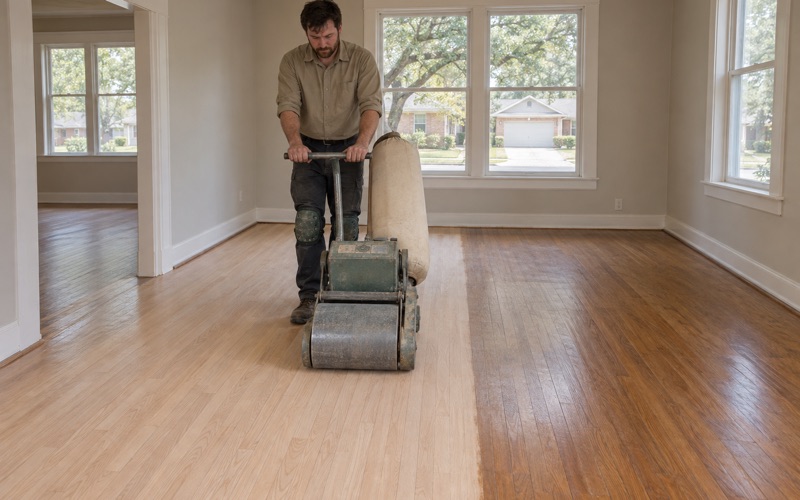
A drum sander, an edger and a buffer flatten whatever they touch. Sanding one damaged board cuts the factory coating off it completely and erases its micro-bevels, and the machine has to run out onto the neighboring boards to avoid leaving a dish in the floor. What is left is a bare, flat patch in the middle of a beveled, coated field, and no amount of matched coating puts the bevel back.
So we do not sell a spot-sand on a factory floor. The honest choices are a board-level repair or sanding the entire floor with a proper 36-50-80 grit sequence and finishing it on site, which turns it into a different product than the one that was installed.
The wear layer decides whether sanding is available at all
On engineered flooring the sandable material is only the veneer above the core, and we measure it before we quote a refinish rather than after the machines are already in the house. Under roughly a three millimeter wear layer there is very little to work with; at a two millimeter wear layer a full sand risks sand-through to the plywood core and the lathe checks that come with it. A six millimeter wear layer is a different conversation entirely.
Measuring means lifting a board at a threshold or a floor vent and reading the actual veneer, not taking a number off a brochure. We would rather learn at the estimate that a floor has one sand left in it than discover it at the edger.
Screen-and-recoat, and what it will not do
A screen-and-recoat abrades the existing surface and lays a fresh coat over it without cutting into the wood. On a site-finished floor that is the standard mid-life service, and either waterborne polyurethane or oil-modified polyurethane can go down over a sound existing coat. On a prefinished floor it is conditional, because many factory coatings are hard enough and additive-rich enough that a new coat will not bond to them.
When adhesion fails it rarely fails immediately. Bond line failure shows up months later as peeling in the traffic lanes, so we test adhesion in an out-of-the-way area before committing a whole floor to a recoat, and we say no when the test says no.
Repair, recoat or replace on a factory finish
Board replacement, and when to stop repairing
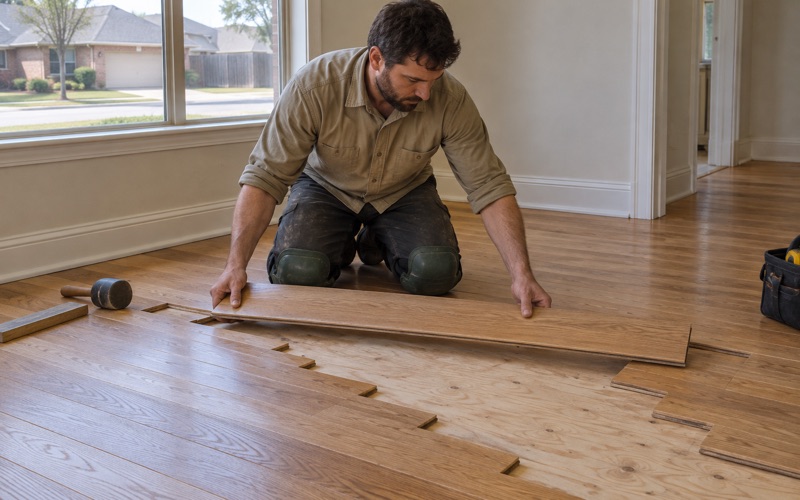
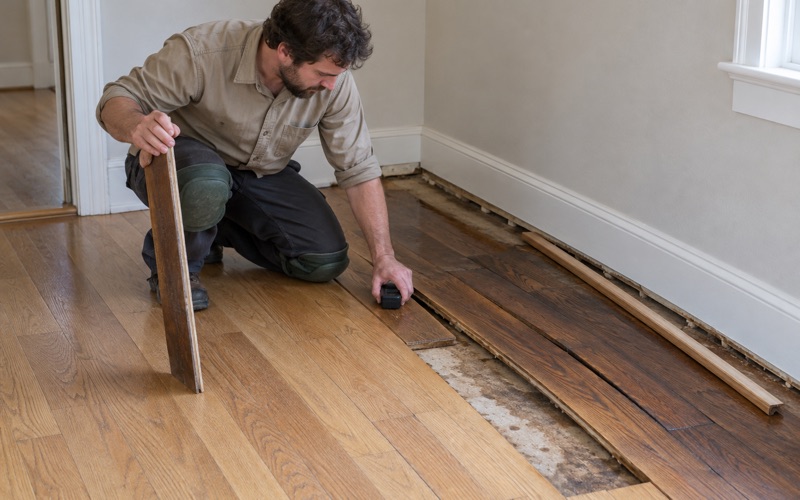
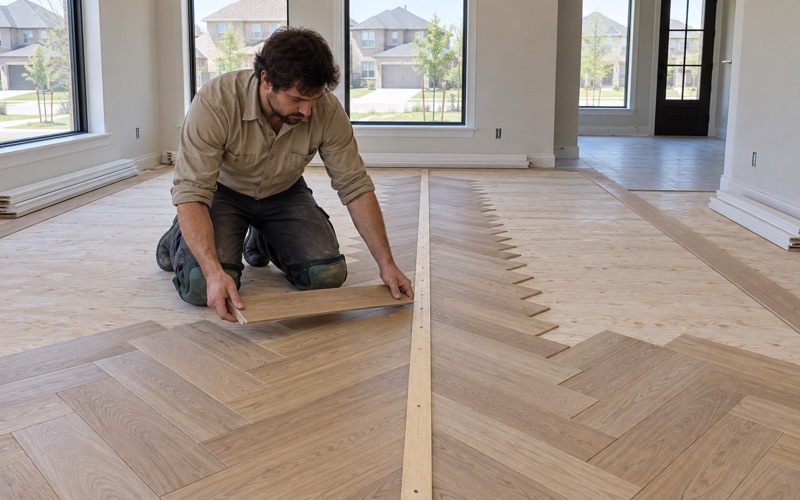
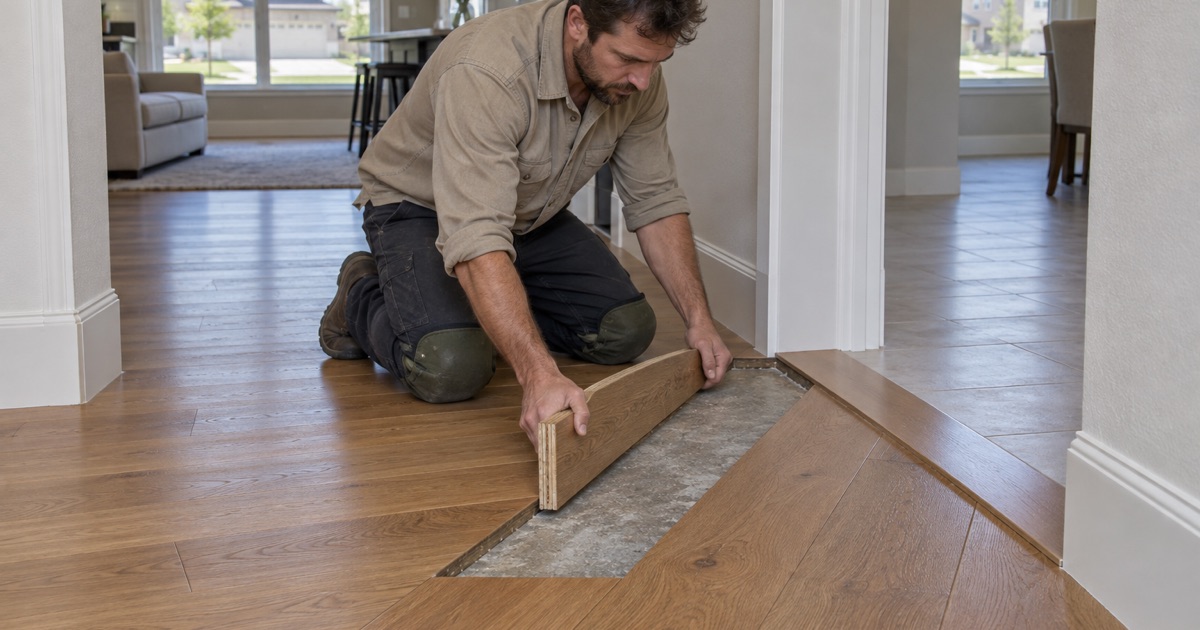
On a prefinished floor the repair is the board, not the finish. We cut the damaged board out, take it up without disturbing the tongue-and-groove of its neighbors, and set a replacement that carries its own factory edge so the bevel pattern across the room stays unbroken. Done as a weave-in that staggers new boards into the field rather than leaving a rectangle, the repair stops being something the eye lands on.
Matching is the hard part and we say so before we start. Species and wear both matter here, since a red oak floor and a white oak floor take color differently, and hickory at 1820 Janka has not dented the way white oak at 1360 Janka has, so a board pulled from inside a closet is often a better match than anything currently on a shelf.
Water damage across a run of boards, delamination, cupping that never came back flat, or a finish genuinely worn through in the lanes all point past repair. When the cause is water, we document it room by room with photographs, moisture readings and a line-of-sight map, so the claim file holds something better than one summary paragraph.
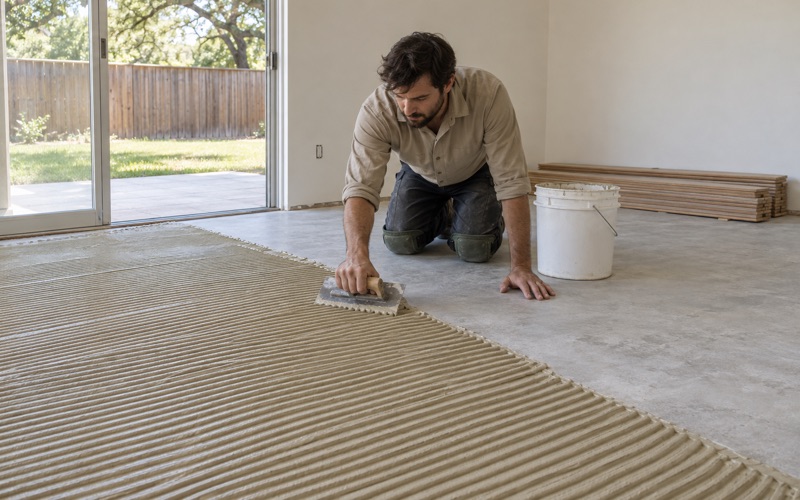
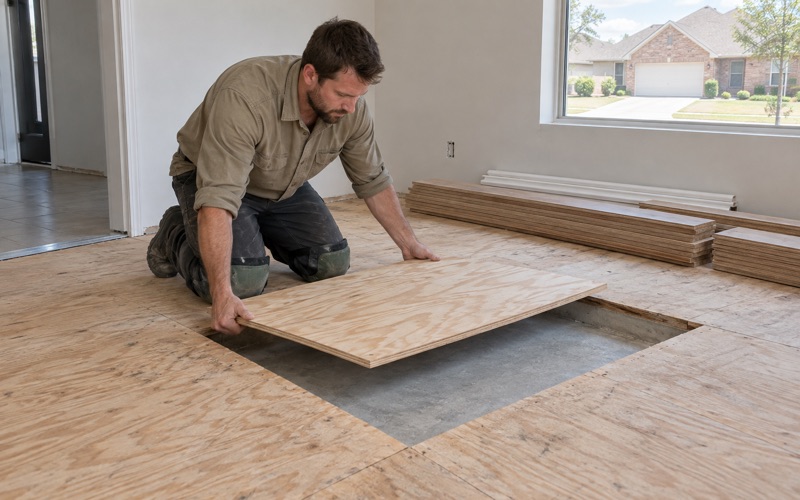
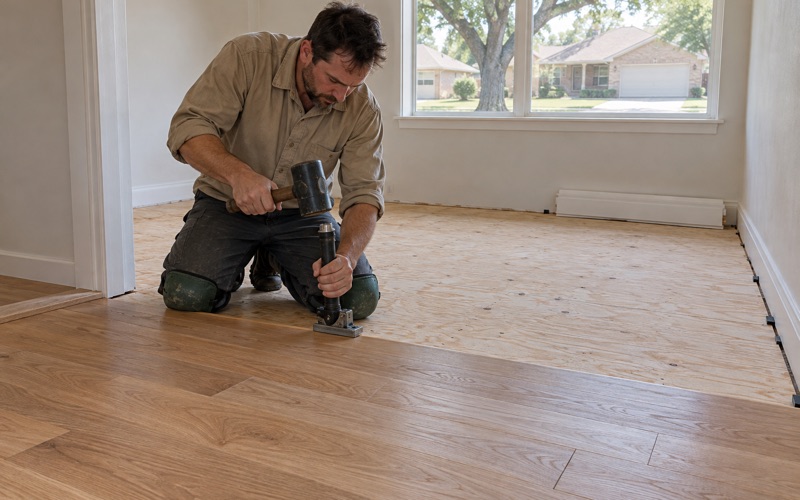
New flooring over a slab starts with a moisture number, recorded, before an installation date goes on the calendar. An ASTM F2170 in-situ relative humidity test tells us whether the slab is at or under 75 percent RH and whether a vapor retarder belongs in the assembly, and the wood then acclimates inside the house, in the room it is going into, never in the garage or on the truck.
Permits, standards and house rules
Lantana sits in unincorporated Denton County, so the residential construction standards that apply come from the county. A Denton County Commissioners Court resolution adopted January 26, 2010 under Texas Local Government Code chapter 233, subchapter F sets them, and it reaches remodeling only when an addition increases the square footage or value of an existing home by more than 50 percent. An interior floor replacement does not approach that threshold, while any development activity in unincorporated Denton County does require a Development Permit from Denton County Development Services.
The rules that shape a flooring job day to day are the Lantana Community Association’s: work hours, dumpster placement, where a crew parks and how material is staged. We read them before scheduling rather than after a complaint, because a stop-work morning costs the floor more than it costs us.
What you get in writing before we start
One crew does the work from tear-out to final coat, and the sanding is never subcontracted out. Dustless containment is built and shown to you before the first machine runs, not described to you afterward.
Before the first coat goes down you also get a written cure and occupancy schedule. Dry time and cure time are not the same thing, and the gap between them is the week that decides whether a new finish survives its first year, so the schedule says when you can walk on the floor, when the furniture comes back, and when the pets do.
- 20+ Years in North Texas
- Dustless Sanding
- Free Written Estimates