Grapevine Wood Flooring has spent more than twenty years on hardwood floor repair in Lewisville, and the calls that bring us out here usually start with a leak nobody watched begin. A dishwasher fitting weeps, a refrigerator line seeps behind a cabinet, a washer hose gives up an inch at a time, and the wood floor is the part of the house that eventually reports it.
By the time it does, the question is no longer whether the floor moved. It is how far the water traveled under it, how long it sat there, and whether the boards and the subfloor beneath them can be brought back instead of torn out. That interval between the first drop and the first phone call is the variable that decides repair against replacement, and it is the reason two floors with identical damage on the surface get two different quotes.
We price the work in one order and we do not shuffle it: repair first, refinish second, replace last, with the cheaper answer named first whenever it is the right one. Anything a claim file might need gets recorded while the evidence is still on the floor rather than reconstructed later.
Renters are the majority here, and that shifts when a leak is found
Lewisville has 51,915 occupied housing units, and 27,874 of them are renter households against 24,041 owner households. At 46.31 percent owner-occupied, this is a city where most floors are lived on by someone other than the person who will pay to fix them, and that single fact changes the arithmetic of water damage more than any material choice does.
A longer chain between the damp spot and the trade
An owner who notices a soft board under the dishwasher calls a plumber that afternoon. In a rented house the same soft board goes to a leasing office, gets scheduled, gets looked at, gets a plumber, and only then gets a flooring company. Every link in that chain is reasonable on its own, and the water is under the floor for the whole of it.
We are not in the business of deciding who should have caught it sooner. Our work starts at what the floor has already done, which is why the first thing we do on a late-discovery job is read the subfloor rather than quote the finish.
What we can say is what the delay does to the job itself. An extra week under the boards is often the difference between lifting a handful of them and lifting a room, and the same week can turn a straightforward sanding into a subfloor replacement with new flooring on top of it. That is not a judgment about anyone in the chain; it is how wood behaves against time.
A large share of the work is in attached units
Single-family detached homes are 45.99 percent of the housing stock, 24,942 units of 54,237, so a great deal of flooring work in Lewisville happens in condos, townhomes and attached units where an association has a say in what goes back down. Sound transmission between stacked units is a live constraint, not a formality.
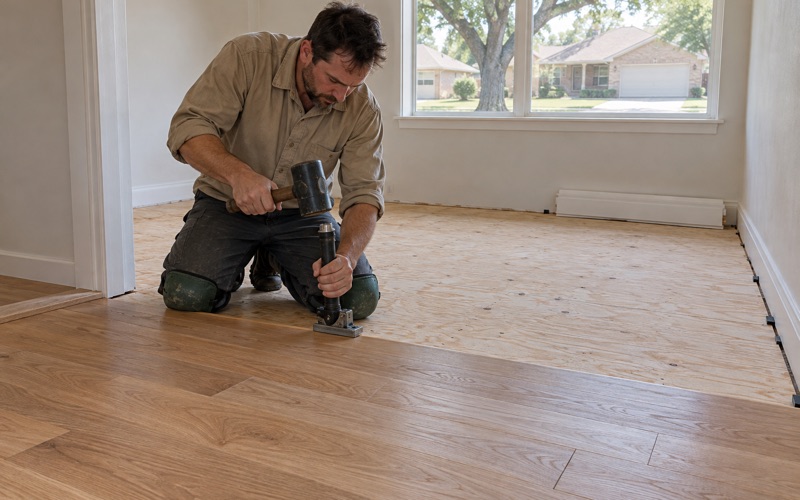
An association commonly specifies an acoustic underlayment rating before hard-surface flooring may replace carpet on an upper floor, and that specification sets the build-up height before anyone has chosen a species. Height decides the transitions, the reducer and T-mold work and the door clearances, so on those jobs we settle the underlayment question first and let the wood follow it.
Looking for wood-flooring closer to Roanoke? See Wood-Flooring in Roanoke.
What an extra week under a floor actually costs
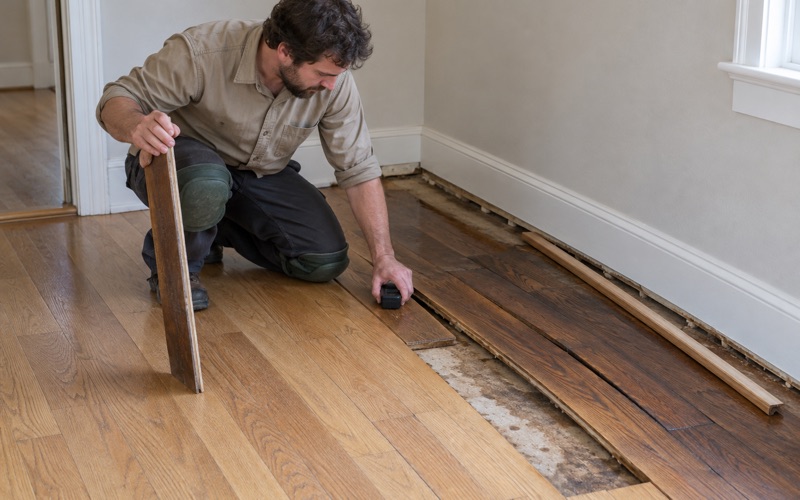
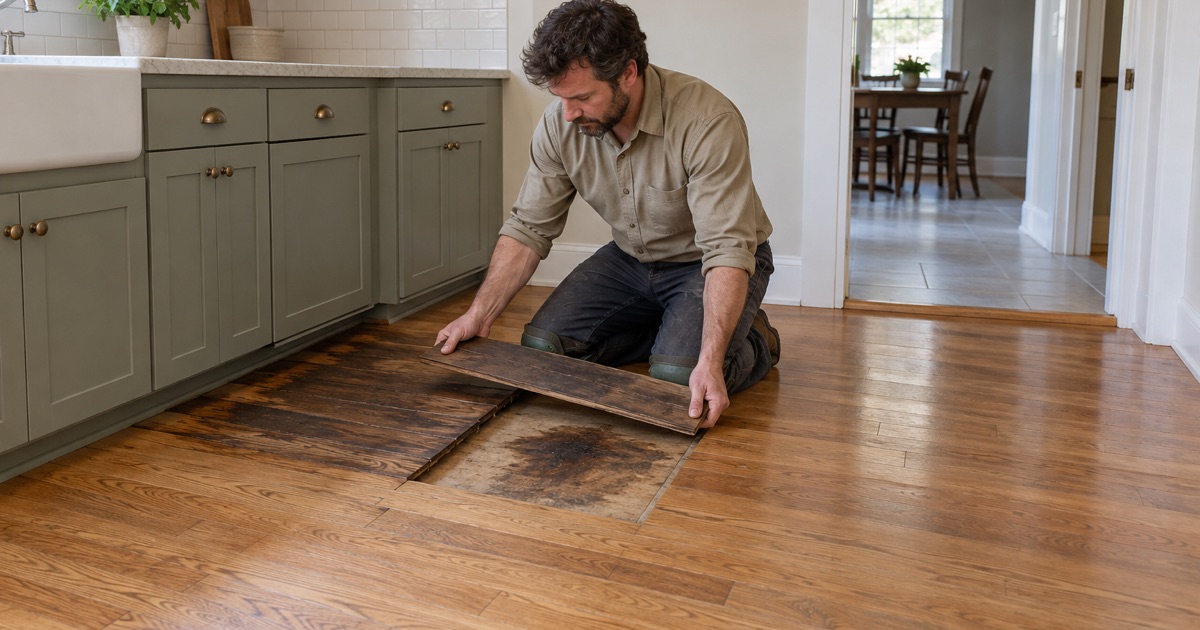
Wood takes water through its edges and its underside faster than through a finished face, so the early signs are dimensional rather than cosmetic. Boards cup as the bottoms swell, the expansion gap at the walls closes up, cleats or staples begin to work loose from the subfloor, and a nail-down floor that has nowhere left to grow will buckle off the substrate in a run.
A floor caught in the first days is usually a drying problem. A floor caught weeks later is a subfloor problem wearing a hardwood cover, and the cost difference is mostly in what is underneath.
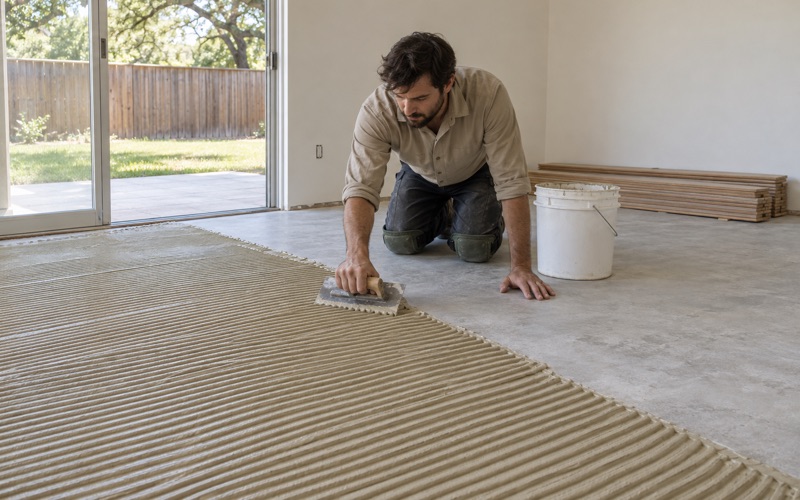
Drying equipment set on top of a floor pulls moisture out of the face, which is the surface that needed it least. Under a glue-down engineered installation the adhesive holds water against the slab, and under a nail-down floor the plywood swells at its seams and stays that way. A floor that reads dry at the top is not evidence that the assembly beneath it is dry.
Solid and engineered fail differently
Solid tongue-and-groove has material to give. A sand-and-refinish is available as long as the boards are flat and fastened, and the wear a 36-50-80 grit sequence removes is a fraction of what is there.
Engineered flooring fails at the glue instead. Saturation shows up as bond line failure, delamination at the edges and lathe checks opening in the face veneer, and none of that is repaired by sanding.
We measure wear layer thickness before quoting any refinish on engineered material, because under about three millimeters there is nothing left to take off and a drum sander finds the plywood core. A two millimeter wear layer is a replacement conversation; a six millimeter one is a floor with sandings still in it. Given that 85.70 percent of Lewisville housing units were built in 1980 or later and 2,146 date from 2020 or later, telling solid from engineered is often the first decision we make on site.
Documenting it while the evidence is still there
Water damage gets documented room by room: photographs, moisture meter readings written down as numbers, and a line-of-sight map showing which spaces read as continuous flooring from one another. That map matters because continuous flooring and the Texas matching policy are what a carrier weighs when a damaged area cannot be matched to an undamaged one, and an ITEL report or an Xactimate line item is only as good as the field record behind it.
What any particular policy does with a slow leak is between you and your carrier. Gradual-leak exclusions and Coverage A terms vary, we do not read them for you, and we do not tell anyone what will be paid. We make sure the file is complete enough to be argued either way.
Reading a subfloor that has already dried once
A floor found late has often already dried on its own. The cupping flattens, the boards crown slightly where the tops were sanded or worn, seams sit proud as overwood, and the floor squeaks at transitions. It looks like a floor with an age problem, and underneath it there is still a plywood or slab problem.
We want a number, not a look
A moisture meter on the boards and on the subfloor tells us whether the assembly has come back to its equilibrium moisture content or merely dried at the top. On slab construction we run an in-situ relative humidity test to ASTM F2170, want the slab at or under 75 percent RH, and use a calcium chloride test where the situation calls for it. Those numbers are recorded before an installation date is set, never after the wood is already sitting in the house.
Lewisville sits in National Weather Service forecast zone TXZ103, the Denton County public zone served by the Fort Worth and Dallas forecast office, and the indoor swing between a humid spring and a dry winter is what solid hardwood has to live with once it is down. That is why our material acclimates inside the house, in the room it is going into, and never in the garage or on the truck.
The older end of the stock
Only 1.05 percent of housing units here predate 1950 and 2.50 percent predate 1960, so older floors are the exception rather than the rule. Homes in and around Old Town Lewisville sit on that older end. Old Town is the original commercial core, two rows of roughly hundred-year-old structures on Main Street, with the first buildings dating to the 1860s and the first brick buildings to just before 1900.
On that end of the city a conventionally reinforced slab is more likely than a post-tension one, which changes what we can fasten plywood sleepers to and whether a moisture reading is coming off a slab with no vapor retarder beneath it. Pre-1978 housing also brings the EPA RRP lead-safe rule into any work that disturbs painted base and casing. Where a repair stops being finish work and starts being structure, that is a conversation with City of Lewisville Building Services, and we would rather ask than assume.
Repairing after water against replacing after water
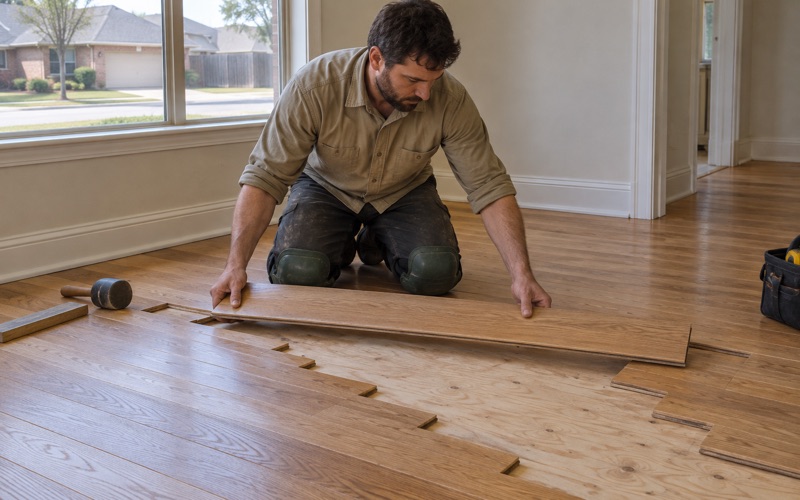
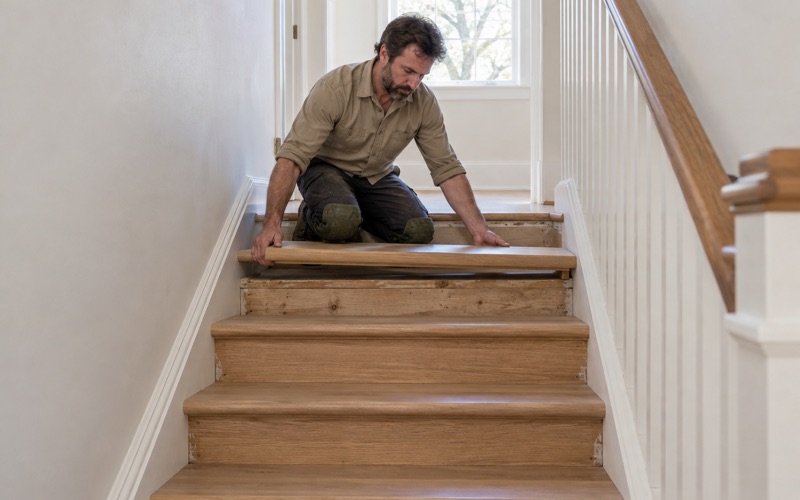
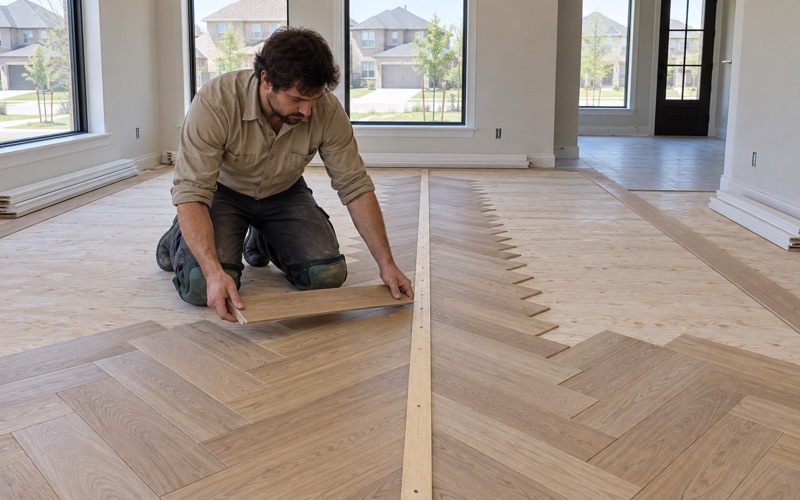
Most late-discovery floors we see in Lewisville are repairable, and the repair is a carpentry problem before it is a finishing one. Damaged boards come out, replacements are woven in so the joints lace into the existing field rather than ending in a rectangle, and a tight localized area is handled as a dutchman patch. Matching is grain and color as much as species: red oak and white oak at 1360 Janka take stain differently, and hickory at 1820 Janka reads nothing like either.
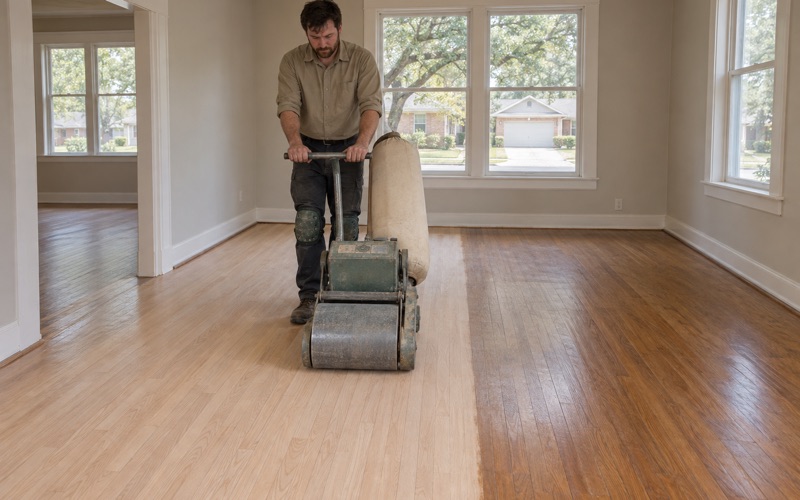
Once the field is sound, the floor is sanded flat through the grit sequence with a drum sander, an edger and a buffer, or given a screen-and-recoat where only the finish was lost. Waterborne polyurethane and oil-modified polyurethane both work; they differ in color, in smell and in schedule, and we tell you which we are using and why.
When replacement is genuinely the right call
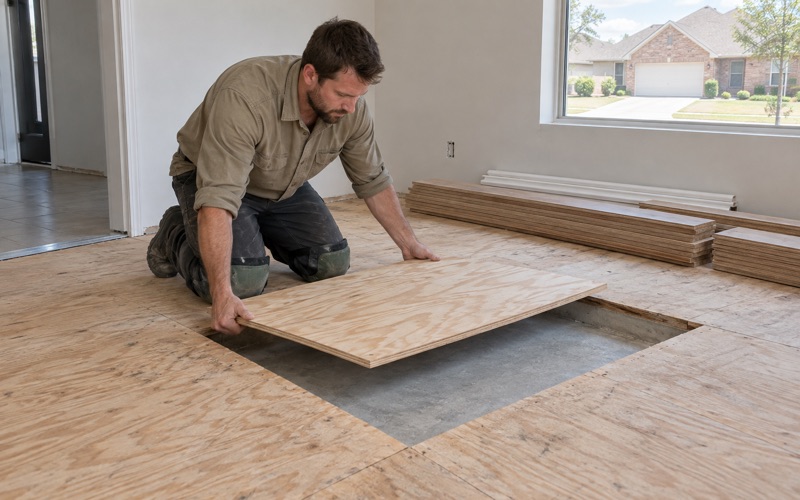
Some floors are past it. A subfloor that has gone soft or delaminated, an engineered product with a thin wear layer, buckling across a whole field, or a floor already sanded to its last cut is a replacement, and we will say so on the first visit rather than sell a repair that fails in a year.
We also sequence the floor after the plumbing repair and after any foundation work, not ahead of them. A new floor installed over an unresolved leak is the same job twice, and the second one is not free.
What you get before the first machine runs
Dustless containment is set up and shown to you before any sanding starts, and one crew carries the job from tear-out to final coat with the sanding never subcontracted out. You get a written cure and occupancy schedule before the first coat goes down, including the difference between dry time and cure time and when pets and furniture come back.
Where a repair falls inside a historic district, existing material is salvaged, stored secured and reattached rather than thrown in the dumpster and replaced. Old boards that came out of a floor once are usually the best match that floor will ever get.
- 20+ Years in North Texas
- Dustless Sanding
- Free Written Estimates