Grapevine Wood Flooring has spent more than twenty years on wood flooring in Providence Village and the rest of Denton County, and the first useful thing we do inside a house here is establish what is actually on the floor. Almost nothing in this town is solid three-quarter-inch hardwood, and a number written before that question is settled is a guess wearing the clothes of a quote.
What the existing floor is made of decides everything downstream. It decides whether the surface can be sanded at all, whether a damaged board can be swapped or the run has to come out, what the prep costs before a single new plank is set, and whether the honest recommendation is a light recoat or a replacement. Two houses on the same block, with floors that photograph identically, can land on opposite sides of that line.
So this page is about identification. We go through what tends to be down in homes here, how we sort one product from another without tearing anything out, and why that single answer reshapes both the scope and the price.
Almost nothing in Providence Village is solid wood
Zero of the town’s 2,859 housing units were built before 1990. Of those units, 2,827 — 98.88% — went up in 2000 or later: 1,482 in the 2000s, 987 in the 2010s and 358 in 2020 or later. Only 32 units date from the 1990s at all.
A housing profile that young pushes an entire category of work to the margins. Restoration of the kind older stock generates is rare here — original strip oak sleeping under wall-to-wall carpet, a pier-and-beam crawl space, cutback adhesive left behind by a tear-out from the 1970s. Those are the surprises an older neighborhood hands us, and they surface far less often here.
What fills the schedule instead is a narrower, more predictable set of jobs. The bulk of what we quote in town is a carpet-to-hardwood upgrade in a living area or a stair hall, a decision about an original floor that has reached the end of its useful surface, or water damage that has to be documented before it is repaired.
The twenty-year cohort
The largest cohort, built in the 2000s, has now passed the twenty-year mark, and it drives most of our calls. A floor installed at original construction has taken two decades of traffic through the same entry path, and by then the finish is usually gone in the lanes and intact under the furniture. Whether that surface can be brought back or has to be replaced is not a matter of taste; it is a matter of how much material is left above the core.
Slab-on-grade sets the ground rules
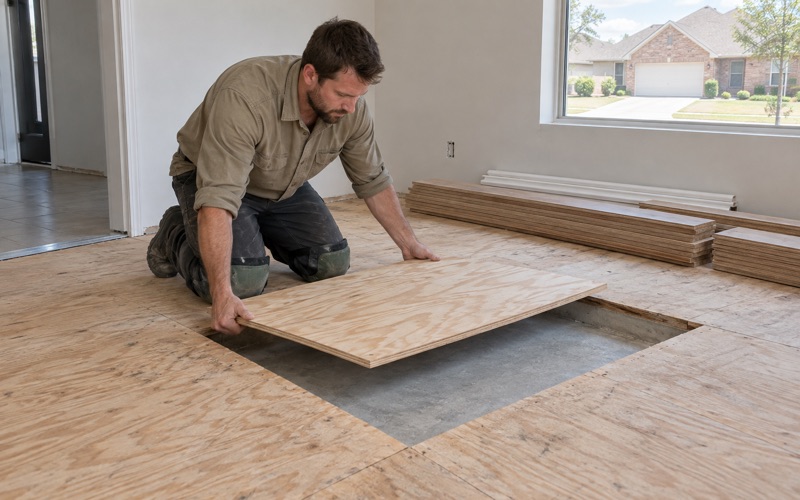
Most of what we work on here sits on a slab-on-grade foundation, and a post-tension slab cannot take a fastener until the tendons are located. That rules out a nail-down installation over plywood sleepers as a default approach, which in an older market is often the easy answer, and it pushes the work toward a glue-down engineered installation or a floating floor over an appropriate underlayment.
Once fasteners are off the table, prep becomes the whole conversation. Slab flatness, a vapor retarder, and a quantitative moisture reading stop being line items and become the thing the installation is built on. We test slab moisture to a recorded number and hold that number before an installation date is set, rather than discovering it with pallets of wood already in the garage.
Looking for wood-flooring closer to White Settlement? See Wood-Flooring in White Settlement.
Engineered, laminate, luxury vinyl plank or bamboo
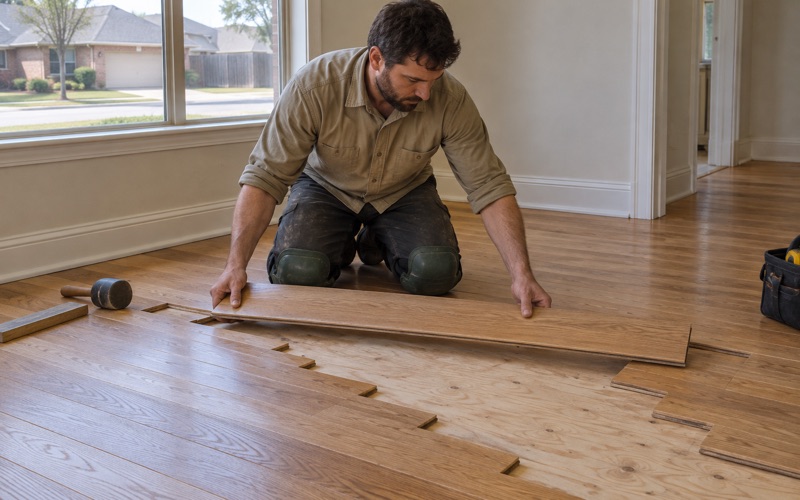
Four products cover most of what we find underfoot in this town. An engineered plank is a real hardwood wear layer over a plywood or fiberboard core, joined tongue-and-groove, and it behaves like wood because the top of it is wood. The species matters the way it does in any solid floor — red oak and maple show wear differently from white oak at 1360 Janka, and hickory at 1820 Janka takes a dog’s traffic better than either. What separates one engineered floor from another is not the species, though; it is how thick that top layer is.
Laminate is not wood in any layer that shows: it is a printed decorative sheet over a dense fiberboard core under a clear wear coat. Luxury vinyl plank is printed as well, over a flexible or rigid polymer core, and it is the product most likely to be sitting in a wet area of a house this age. Bamboo is a grass, usually strand-woven, and it is hard enough to be mistaken for a dense hardwood by feel alone.
Reading an edge without lifting a board
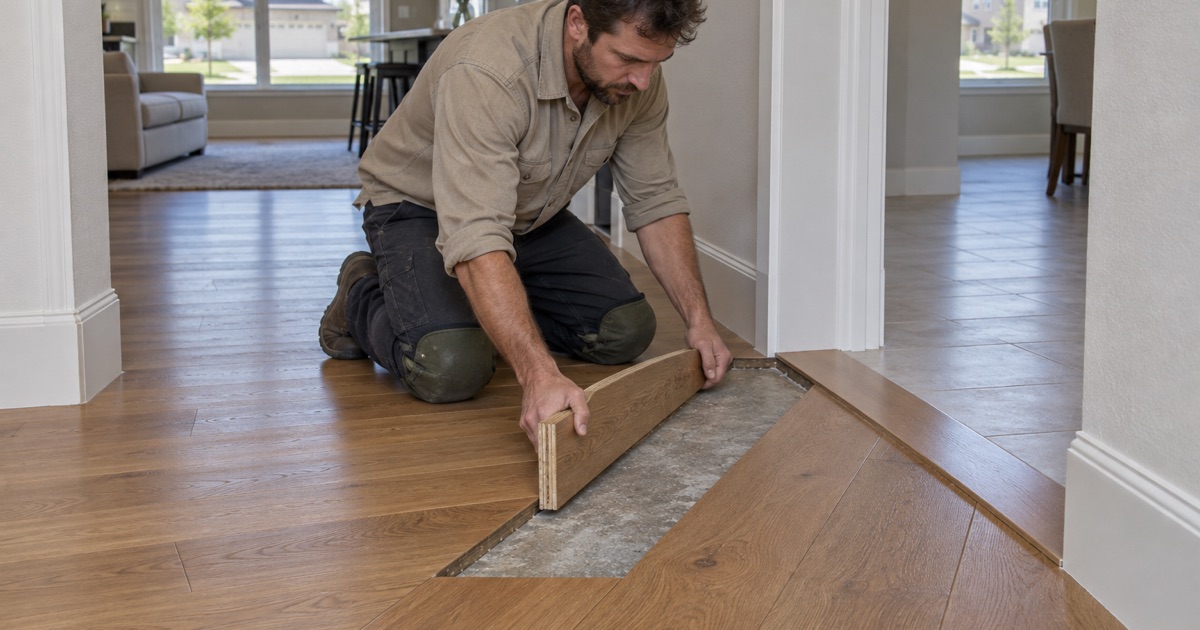
We start at a floor vent, a threshold, or wherever a reducer or T-mold meets tile, because those are the places the edge of a plank is already exposed. An engineered board shows a laminated stack in section, with a distinct top layer over a cross-banded core. A laminate or vinyl edge shows a uniform core with no grain running through it, and on laminate the bevel often reveals the printed sheet stopping cleanly at the surface.
Grain repetition is the other tell. Real wood, engineered included, carries lathe checks and figure that never repeat exactly; a printed floor repeats its pattern across a room if you look for the same knot twice. Sound and weight help too, and a moisture meter reads a wood surface differently from a polymer one, which usually settles the question on the spot.
Which of these can be refinished, and which cannot
Laminate, luxury vinyl plank and most floating bamboo cannot be sanded and refinished at all. There is nothing above the core to remove, and the only repairs available are board replacement and a careful weave-in so the swap does not read as a patch. That is not a limitation we can price around; it is what the product is.
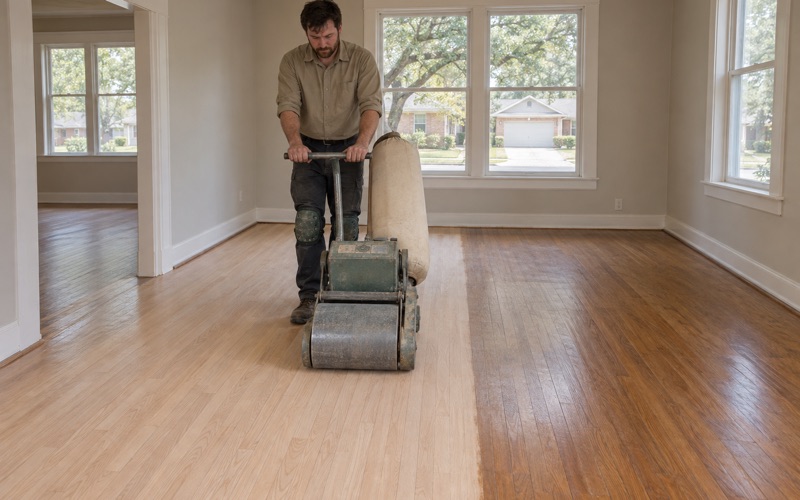
Engineered flooring can sometimes be refinished, and the answer is a measurement rather than an opinion. A six millimeter wear layer will take a full sand with a drum sander, an edger at the perimeter and a 36-50-80 grit sequence, with a buffer or an orbital sander closing it out. A three millimeter wear layer will take one careful pass and no more. Below about three millimeters there is nothing left to sand, and pushing it produces a sand-through to the plywood core that cannot be undone.
We measure the wear layer before we quote a refinish
On any engineered floor we measure the wear layer at an exposed edge before a refinish price is written, because a two millimeter wear layer and a six millimeter wear layer look identical from standing height and lead to opposite recommendations. We also look for what a sander will make worse: delamination at a board end, bond line failure where the top layer has let go of the core, and overwood at the seams from an install that was never flat.
We price repair, refinish and replace in that order, and we name the cheaper option first whenever it is the right one. On a floor with finish wear but no bare wood, a screen-and-recoat is often the whole job, and it costs a fraction of a full sand. Saying so in the first visit is the point of the visit.
When replacement is the honest answer
Sometimes the measurement comes back and the answer is that the floor is finished. A thin wear layer that has already been sanded once, widespread delamination, or water damage that has cupped boards past the point a sand will flatten all point the same direction. We would rather say that plainly than sell a refinish that looks good briefly and then telegraphs the core.
When replacement is the call, we document it the way it needs to be documented. On water losses we record the damage room by room with photographs, moisture readings and a line-of-sight map, because a claim file is easier to settle when continuous flooring and the spread of the loss are shown rather than argued.
Why the answer changes the quote entirely
A refinish and a replacement are not the same job with different numbers on the bottom line. A refinish is a sanding sequence, dust containment and a finish schedule. A replacement is a tear-out, a slab brought to flatness, a moisture management decision, a new installation method, transitions and trim, and a cure schedule that governs when the house is usable again.
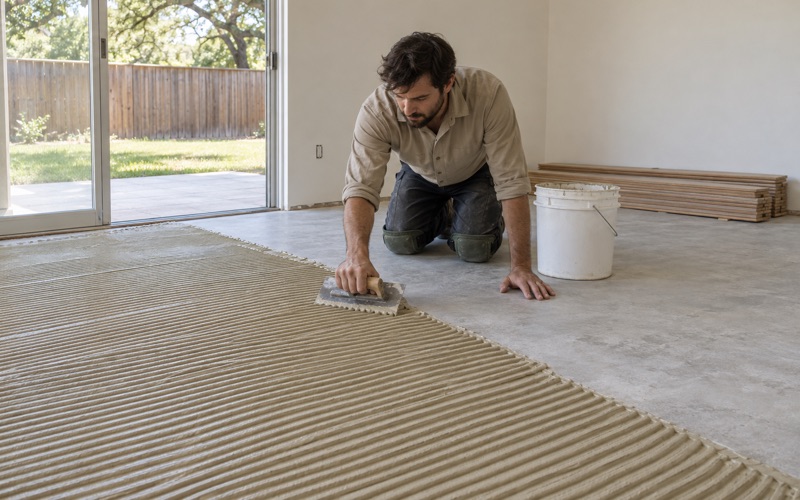
Prep is where the two diverge most. A glue-down engineered installation needs a slab flat enough for full adhesive contact, which often means self-leveling underlayment in sections, and it needs a slab moisture result we are willing to put in writing — an ASTM F2170 in-situ relative humidity test, with the slab at or under 75 percent relative humidity before adhesive goes down. A floating floor over an underlayment tolerates a little more, but it still needs an expansion gap at every wall and vertical obstruction.
Transitions, clearances and acclimation
Because floor plans and subfloor build-ups here tend to repeat from one street to the next, the height questions are often predictable once we have solved them on one house. A new floor that is thicker than the old one changes door clearance, stair nosing and every threshold, reducer and T-mold where it meets tile or carpet, and those details are easier to plan than to discover.
Providence Village sits in National Weather Service public forecast zone TXZ103, Denton County, under the Fort Worth/Dallas weather forecast office, and the indoor humidity swing across a year here is what drives acclimation. We acclimate wood inside the house, in the room it is going into, rather than in the garage or on the truck, so the material reaches something near its equilibrium moisture content before it is fastened or glued. Skipping that is how a floor cups in its first summer.
Who signs off on the work in this town
Providence Village has its own building inspector, a position established by ordinance with the inspector appointed by the town manager, and it has adopted the 2018 edition of the International Residential Code with the recommended regional amendments. Residential permit submittals require digital plans on a USB drive and valid contractor registration, and the town states that 18% of contractors working here incur a red tag fee for not obtaining a permit. Confirming registration status before a start date is scheduled is worth the phone call.
The Providence Homeowners Association governs a different set of questions. With 99.44% of the housing stock single-family detached, the sound-transmission rules that control hard-surface flooring in stacked units rarely come into play here, so the association’s interest tends to be in what is visible from outside — exterior thresholds, porch surfaces and entry details rather than what is underfoot in a living room.
What we hold ourselves to on site
One crew runs the job from tear-out to final coat, and the sanding is never subcontracted out. Dustless containment is set up and shown to you before the first machine runs, not described after the fact. Before the first coat goes down you get a written cure and occupancy schedule that separates dry time from cure time and says when pets and furniture come back.
We also sequence the floor after foundation work and plumbing rather than ahead of it. A new floor installed in front of someone else’s schedule is a floor that pays for their delay, and on a slab house that bill arrives quickly.
- 20+ Years in North Texas
- Dustless Sanding
- Free Written Estimates