
Grapevine Wood Flooring installs solid hardwood flooring throughout Grapevine, TX, and after more than 20 years working on everything from 1890s framed floors near the old townsite to post-tension slabs in the newest subdivisions, we treat the solid-or-engineered question as a substrate question rather than a taste one. Where there is a wood subfloor to fasten into, solid hardwood is very hard to beat on longevity.
Its advantage is simple and it compounds over decades: the board is wood all the way down to the tongue, so it can be sanded and refinished repeatedly rather than replaced. That is why original solid floors survive in this city’s pre-1960 housing, 651 units of it, while newer floor coverings in the same houses have been changed several times over.
Its constraint is equally simple. Solid wood responds to moisture across its full thickness, so it needs a substrate that is not feeding it moisture and a house that stays conditioned. Over the slab-on-grade construction that dominates housing built here since 1980, solid wood means building a wood subfloor first and accepting the added height, or choosing engineered instead. We will tell you which of those your house is asking for.
Solid Hardwood Over a Wood Subfloor
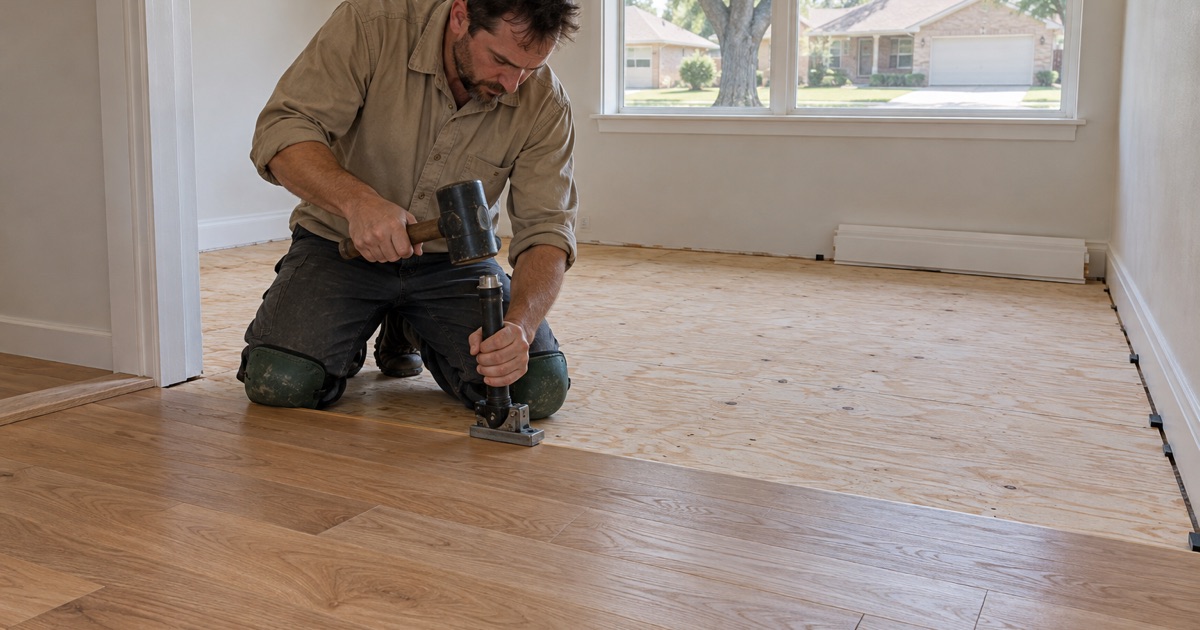
Nail-Down Installation, Cleats and Staples
Solid flooring is fastened through the tongue at an angle so the fasteners disappear under the next board. Cleats are L-shaped and have a little give, which many installers prefer for solid wood because the floor can move slightly without the fastener fighting it. Staples hold tighter initially and suit some subfloor and product combinations. We select between them for the thickness and the substrate rather than using whatever is in the gun.
Fastener Gauge, Crown Width and Spacing
The holding power of a nail-down floor comes from the right fastener at the right interval, not from more fasteners. Gauge and crown width are matched to the board thickness so the fastener seats in the nail pocket without splitting the tongue, and a fastener spacing schedule sets the interval along each board and the distance from every end joint. Wide boards get a tightened schedule, because more width means more force at each seam.
Where Solid Wood Belongs in a Slab City
More than eight in ten housing units here were built in 1980 or later and sit on slab, so solid hardwood generally lands in one of three places: upstairs over a plywood subfloor, in the older raised-floor housing in and around the historic districts, or over a sleeper or plywood system built up on a slab. We identify which applies before quoting, because that decision changes both the price and the finished floor height.
Choosing a Species and a Grade
White Oak, Red Oak, Hickory and Maple
White oak at 1360 Janka has become the default here for good reasons: it takes daily traffic, accepts stain evenly, and its neutral cast works under natural and gray-washed tones alike. Red oak is comparable in hardness with a warmer pink undertone that fights cool stains. Hickory at 1820 Janka is the dent-resistance choice and carries strong color variation. Maple is hard and pale, and needs careful preparation to stain evenly.
Grade, Character and How Much Variation You Want
Grade describes appearance rather than strength. A clear or select grade is uniform, with minimal knots and color variation, and reads formal. A character or rustic grade includes knots, mineral streaking and wider color range, which suits a wide plank or hand-scraped look and hides wear better. We put sample boards down in your own light before you commit, because grade is the decision people most often regret from a catalog.
Board Width, Cut and Thickness
Standard strip flooring sits around two and a quarter inches, plank formats run from three inches upward, and each step wider increases seasonal movement across the face. How the board was cut matters too: plainsawn is the common and most economical cut and moves most, while quartersawn and rift sawn are more stable and show a straighter grain. Thickness determines how many refinishes the floor has in it.
Site-Finished Solid Floors
Sanding and Finishing in Place
A site-finished floor is installed raw, then sanded flat through a 36-50-80 grit sequence, stained if you want color, and coated in the room. The result is a continuous surface with no bevel at the seams, and any minor variation between boards is sanded out rather than left as a ridge. It also means the stain and sheen decisions are made on your actual floor, under your own lighting.
A Lifetime of Refinishes
Because the board is solid to the tongue, each full sand takes only a thin slice of the available thickness. That is what allows a solid floor to be brought back several times across its life rather than replaced. We measure the remaining thickness at a floor vent or a threshold before quoting any refinish, so the recommendation reflects how much life is genuinely left rather than a rule of thumb.
Matching and Extending an Existing Solid Floor
When a solid floor is being extended into a new room or repaired after damage, the reliable approach is to weave new boards into the existing field so no continuous seam appears, then sand and finish the whole area as one. That makes the color in the room rather than trying to order it. It is the main reason site-finished floors are so much easier to live with over twenty years than prefinished ones.
- 20+ Years in North Texas
- Dustless Sanding
- Free Written Estimates