Grapevine Wood Flooring has installed, repaired and refinished wood flooring in Southlake for more than twenty years, and the question that comes up here more than any other is whether an existing floor can be recoated or has to go back to bare wood. It sounds like a budget question. It is really a chemistry question.
The answer lives in the coating already on the boards: what it is, what has been mopped onto it since, and whether a new finish will bond to it or sit on top of it and peel. A build year is a clue. It is not an answer, and a floor treated as though it were usually pays for that assumption twice.
So we test first, on the floor in front of us, and we price repair, refinishing and replacement in that order, with the cheaper honest option named first. What follows is why that one question comes up so constantly in this particular city.
Nearly half the city’s floors went in during one decade
Southlake’s housing stock is unusually concentrated in time. Of 9,612 housing units, 4,327 of them, 45.0 percent, were built between 1990 and 1999, and 94.75 percent of all units were built in 1980 or later. Only 326 units, 3.4 percent, date to the 1970s.
That concentration tracks the city’s own growth. The population was 7,158 in 1990, roughly 20,000 by 1998 and 21,519 at the 2000 census, reaching 31,265 at the 2020 census. The 130-acre Southlake Town Square tract was bought in March 1996 and its first phase opened in 1999, so the commercial center and a large share of the housing went up inside the same window.
One decade, one set of methods
94.31 percent of the city’s units are single-family detached, and 8,421 of those are owner-occupied single-family detached houses. When that much of a city is built by the same builders in the same handful of years, the floors repeat: the same species, the same strip widths, the same fastener schedules and, more to the point, the same finish systems from house to house across whole subdivisions.
That repetition is useful to us and dangerous to trust. It tells us what to look for on a Southlake floor before we walk in the door. It does not tell us what is actually on the boards in one particular house, and the gap between those two statements is the whole subject of this page.
Looking for wood-flooring closer to Colleyville? See Wood-Flooring Services in Colleyville.
What went down on 1990s site-finished oak
The dominant floor in this cohort is site-finished red or white oak strip, white oak sitting at 1360 on the Janka hardness scale and red oak just below it, installed raw, sanded in place and finished after it was down. Through that decade the coating that usually went over it was oil-modified polyurethane: a sealer coat and two topcoats, ambering steadily toward a warm gold as the years pass.
Prefinished solid and early engineered flooring are in the mix too, particularly in later rooms and additions. Those carry a factory finish with aluminum oxide in it, and it behaves nothing like a site-applied coating under a buffer.
Why the finish decides the job, not the wood
Oak is oak. A 1990s oak floor in sound structural condition has decades of service left in it, and the boards are rarely what limits the work. What limits it is the coating sitting on top of them and whether anything new will stick to that.
Reading a floor before we touch it
A good deal can be read off a floor on a first visit. Sheen says roughly how much traffic a coating has taken. A warm amber cast under a rug, against cooler wood where the sun reaches, says a finish has ambered with age rather than been stained that color. Wear through the coating at pivot points, in front of a sink or at the turn of a hall, is usually where bare wood shows up first.
On engineered material we look hard at the board edges, where fine lathe checks in a rotary-cut face and any lifting at the top ply say more about what is possible than the surface does. None of this replaces a test. It tells us which test to run, and what a realistic outcome looks like, before anyone signs anything.
Twenty-five years of maintenance is part of the surface
Between the original finish and any new coat sits everything that has been mopped onto the floor since. Acrylic waxes, oil soaps and silicone polishes leave a film that a fresh coat beads off rather than bonds to, and that film is invisible from standing height. It is the most common single reason a recoat fails, and it has nothing to do with the age of the polyurethane underneath it.
Whether an old finish will take a new coat
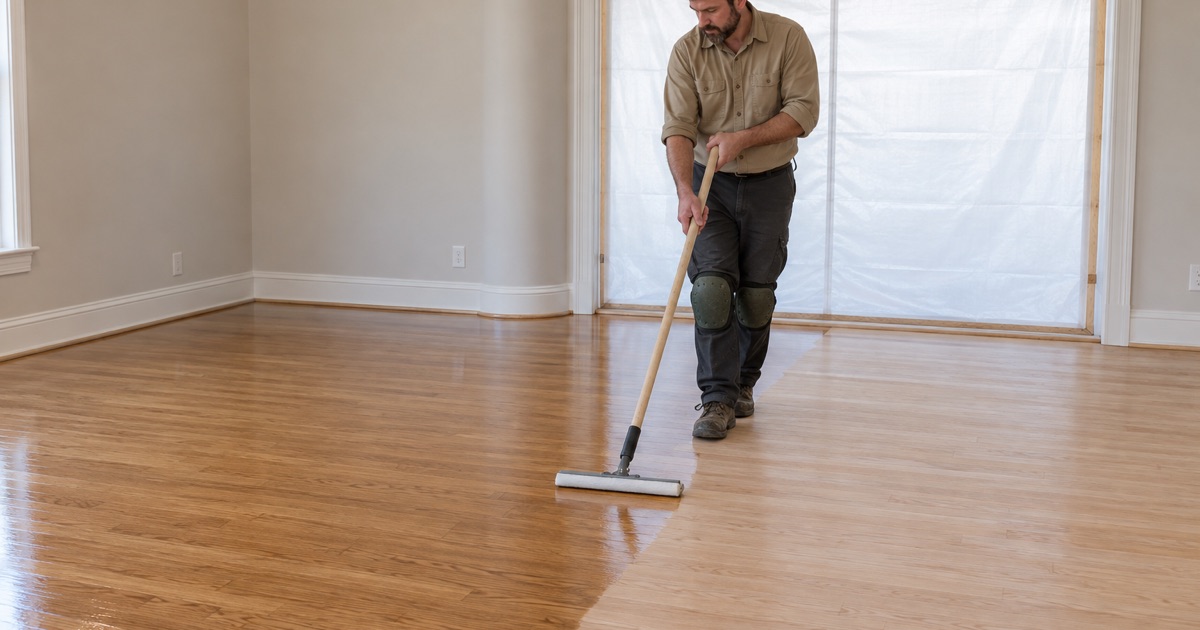
A screen-and-recoat is the cheaper, faster, less invasive option, and when it works it is plainly the right call. We abrade the existing finish with a buffer and screen, vacuum and tack the floor, and lay one or two new coats over it. The floor keeps its color and its patina, the house stays livable through the work, and nobody sands away wood that did not need to go anywhere.
It works only if the new coat bonds to the old one. When it does not, the result is a bond line failure: the new film peels in sheets under a chair leg or lifts along a threshold months later, and the repair at that point is a full sand, the job the recoat was meant to avoid, now with a failed coat sitting on top of it.
What a recoat does and does not fix
A recoat renews the wearing surface. It does not remove a scratch that went through the old finish into the wood, it does not lighten or darken the floor, and it will not flatten cupping or overwood at the joints, because none of that lives in the coating. Expecting those results from a recoat is how an owner ends up disappointed by work that was done correctly.
What it does buy is time, at a fraction of the disruption: fewer machines, less dust, and a floor that goes back into service far sooner than a floor taken to bare wood. On a sound 1990s oak floor with a healthy coating, a recoat every several years is the cheapest way to postpone a full sand indefinitely.
Testing a bond instead of assuming one
We do not settle this from a build year. We test it on the actual floor, in an out-of-the-way area such as a closet, under a toe kick or a corner of a pantry, by abrading a patch, coating it, letting it cure rather than merely dry, and then checking adhesion on the cured patch. Cure time and dry time are not the same number, and an adhesion check on a coating that is dry to the touch but not yet cured tells you nothing worth knowing.
If the patch holds, we quote the recoat. If it peels, we say so, and we have spent a few days learning that instead of spending your money finding it out across eighteen hundred square feet of finished floor.
Engineered floors get measured, not estimated
Where the floor is engineered, the bond question comes second to the wear layer. We measure wear layer thickness before we quote any refinish, because under about three millimeters there is nothing left to sand. A drum sander takes off more than that, and the outcome is sand-through to the plywood core with delamination opening at the board edges. A two millimeter wear layer is a recoat or a replacement conversation; a six millimeter one behaves much like solid wood.
When the recoat window has already closed
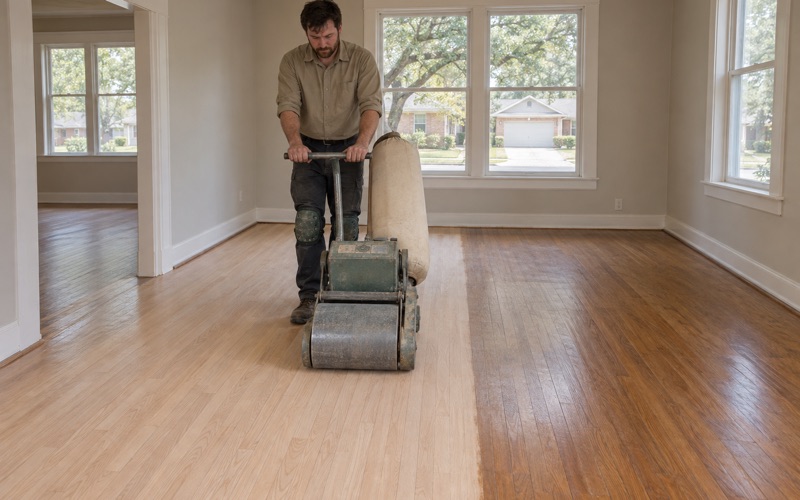
Sometimes the answer is a full sand and there is no honest way around it: the coating is worn through to bare wood in the traffic lanes, pets or water have gotten past it, or the adhesion patch failed outright. That job runs a 36-50-80 grit sequence with a drum sander in the field and an edger at the perimeter, a buffer to blend the cuts, then sealer and finish.
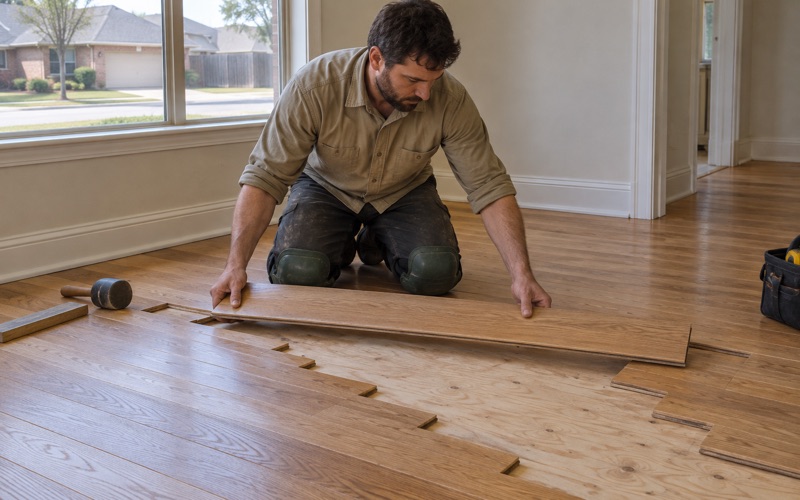
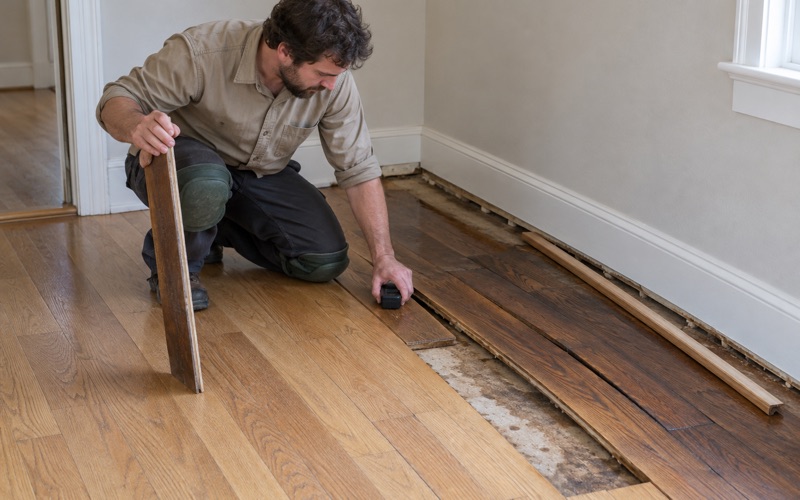
Damaged boards come out first. Board replacement and dutchman patches are laced into the existing field and sanded flat with it, so there is no overwood where new material meets old. We price repair, refinishing and replacement in that order and name the cheaper option first whenever it is the right one, because replacing a floor that needed eleven boards and a recoat is not a service to anyone.
Choosing the finish that goes back down
Waterborne polyurethane stays close to the raw color of the wood and moves through its cure schedule quickly, which matters in an occupied house. Oil-modified polyurethane ambers, the way the original 1990s coatings did, and asks for more time between coats. Hardwax oil sits in the wood rather than on it and can be spot-repaired in a single area without recoating a whole room.
The federal AIM rule at 40 CFR 59 Subpart D caps the volatile content of these coatings, varnish among them at 450 grams per liter, which is part of why a finish sold today does not behave like one brushed on in 1994.
Slabs, fasteners and a recorded moisture number
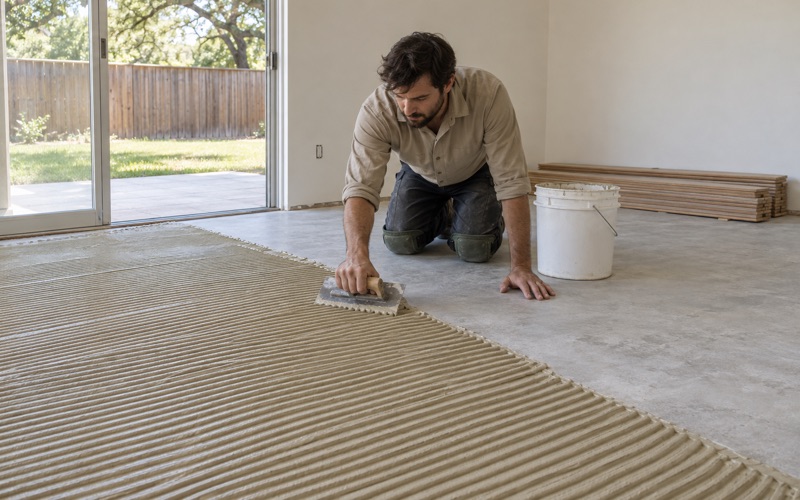
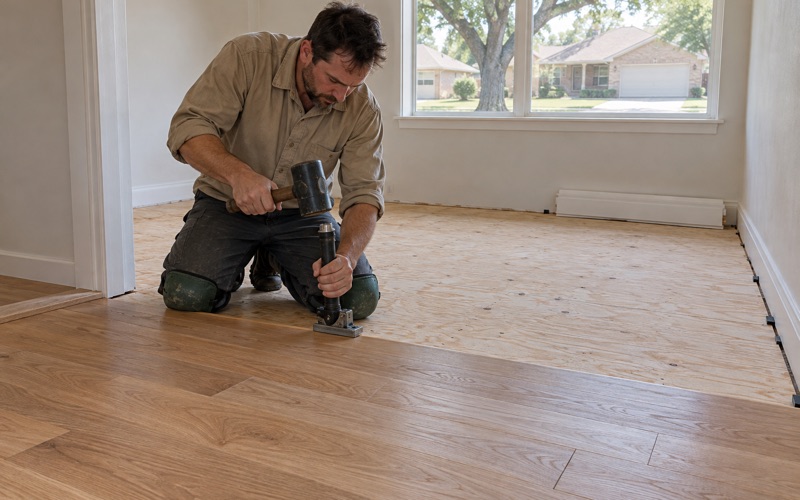
Most of this housing sits on slab-on-grade, and a large share of those are post-tension slabs. Glue-down and floating installations sidestep the tendon question entirely; anything fastened through a sleeper system over one of those slabs needs the tendon plan or a scan before a single fastener goes in. On new installations we test slab moisture with an ASTM F2170 in-situ relative humidity probe and record the number, at or under 75 percent RH before an installation date is set, not after the wood is already stacked in the house. The wood then acclimates inside the room it is going into, never in the garage and never left on the truck.
Living in the house while the work happens
94.56 percent of Southlake’s occupied units are owner-occupied, so nearly every floor we touch here belongs to someone sleeping in the house that night. Dustless containment goes up on every sanding job and we walk you through it before the first machine runs. One crew does the work from tear-out to final coat, and the sanding is never subcontracted out. Before the first coat goes down you get a written cure and occupancy schedule: which rooms come back when, and when furniture and pets return to them.
Who signs off on the work
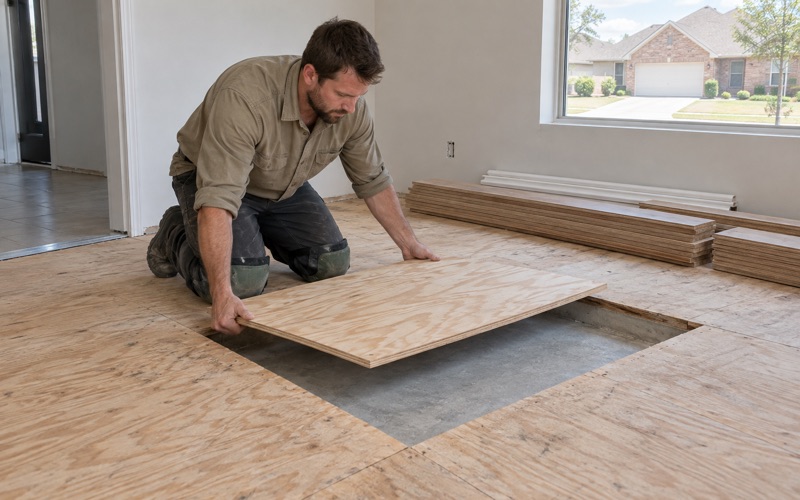
Permit questions in Southlake go to City of Southlake Building Inspections, working from the 2021 International Residential Code adopted by Ordinance No. 1252, effective May 1, 2022. The IRC R105.2 finish-work exemption is why floor covering on its own does not normally pull a permit; where a job opens up into structural subfloor repair, we ask the city before we start rather than afterward. Southlake lies predominantly in Tarrant County, and a Tarrant Appraisal District record is usually the quickest way to confirm a build year when a homeowner is not certain which decade their floor belongs to.
- 20+ Years in North Texas
- Dustless Sanding
- Free Written Estimates