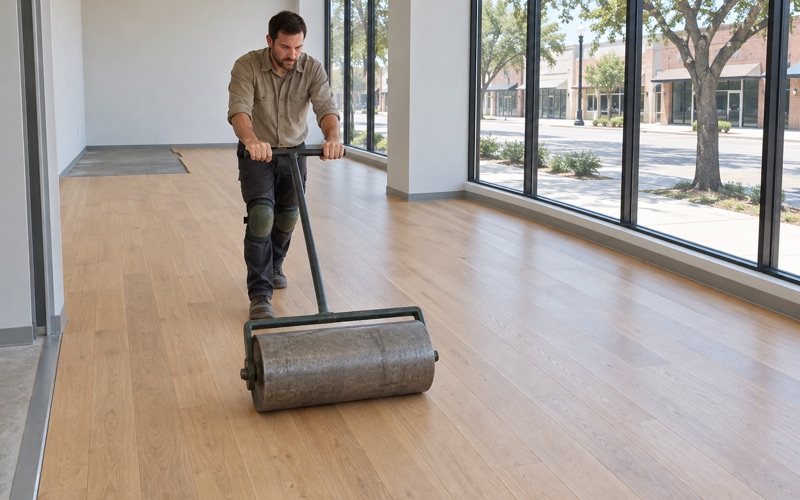
Grapevine Wood Flooring has worked on wood flooring in Trophy Club for more than 20 years, and the calls coming out of this town have changed character. They used to be about tired oak in a house that had earned it. Increasingly they are about floors barely a decade old that already look a decade old.
That is not a knock on the floors. It is what happens when a prefinished engineered floor reaches the end of the run a factory finish was built to give. A floor like that does not age the way a solid plank does. It shows first in the finish, as a haze of fine scuffing that reads across a whole room as dullness rather than as damage in one identifiable spot.
Knowing which of those two conditions you actually have is the entire decision, because one can be brought back with a machine that never touches the wood and the other cannot be brought back at all. We measure before we price, and on an engineered floor the measurement that settles it is wear layer thickness.
Trophy Club’s Newest Floors Are Hitting Their First Hard Age
This is a young housing stock. Of 4,876 housing units in town, 2,626 — 53.9 percent — were built in 2000 or later, with 1,368 of those going up between 2010 and 2019 and another 1,110 between 2000 and 2009. The 1970s and 1980s together account for 1,225 units.
Those two groups do not fail the same way or on the same schedule. Floors in the older houses have moved through decades of seasonal change and present as worn oak: finish long gone in the traffic lanes, some cupping near a doorway, boards with a history. The newer floors have no such history, and yet the prefinished engineered installations among them are now squarely inside the ten to fifteen year window where a factory finish gives out.
Builder-grade engineered is a specification, not a defect
Engineered flooring is real wood over a plywood or composite core, and the number that governs its future is how much real wood sits on top. A two millimeter wear layer is a sound floor. It is simply a floor whose surface has a defined service life. A six millimeter wear layer buys sanding cycles that a two millimeter one was never built to offer, and paying for the thicker one is a decision made years before anyone notices a scratch.
When a subdivision goes in across a few seasons, its floors go in with it — same generation, same wear layer, often the same glue-down engineered installation over the same slab. That is why this arrives here as a pattern across streets rather than as one unlucky house.
What ten years of ordinary traffic actually does
Dogs, chair legs, and the grit that rides in on shoes from a driveway are not abuse. None of it damages wood. It abrades finish, and it abrades it hardest where people walk in a line.
In a house floored continuously through the main rooms, the result is a set of visible lanes: matte where the traffic runs, still reflective along the edges and under furniture. Owners usually describe the floor as looking dirty when it is perfectly clean. What they are seeing is a finish that has stopped returning light evenly.
Looking for wood-flooring closer to Bedford? See Bedford Wood-Flooring.
Surface Scratching and a Worn-Through Finish Are Different Problems
Scratching that lives inside the finish leaves the wood underneath untouched. A floor in that condition can often be abraded and recoated without a drum sander ever coming off the truck. Once the finish is gone in the lanes and feet are landing on bare veneer, the wood itself is taking the wear, and putting a fresh coat over that seals the damage in rather than removing it.
How we tell them apart in your living room
We look at the lanes rather than the middle of the room, and we look at them from a low angle with a light behind the scratch pattern. Fine marks that catch light but hold no color are finish-level. A worn area that has gone gray or blotchy, or that darkens when a drop of water sits on it instead of beading, is telling us the finish is no longer continuous there and the wood is drinking.
Doorways, the path from the garage door, and the arc a pantry door sweeps are where we expect to find it first. If the whole floor is uniformly dull and nothing has worn through, that is the best version of this problem.
Wear layer measured before we quote a refinish
On any engineered floor we measure wear layer thickness before a refinishing number goes on paper, reading it at a floor vent, a threshold cut, or a spare board left in the attic. Under roughly three millimeters there is not enough wood above the core to survive a sanding sequence, and quoting one anyway is how a floor ends up with sand-through to the plywood core in a doorway.
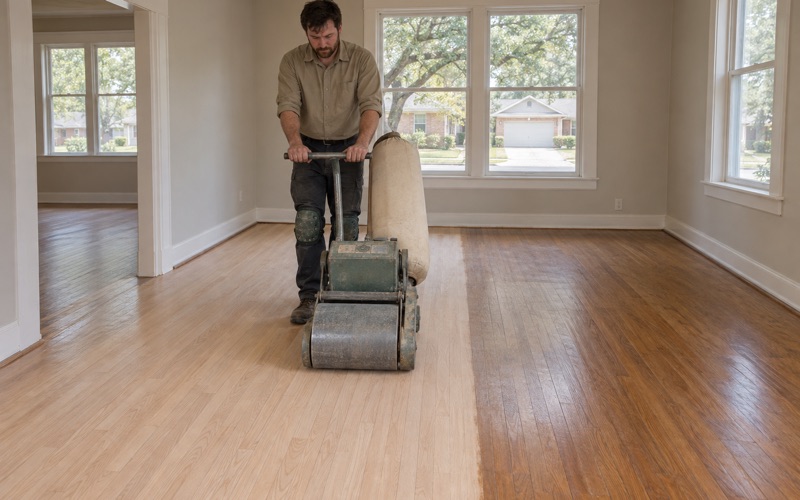
A 36-50-80 grit sequence with a drum sander and an edger removes real thickness — that is what it is for. On a thin rotary-cut veneer it can also open lathe checks that were invisible under the factory coating, so the floor comes out of the sanding looking worse than it went in. We would rather tell you that before the machines arrive than discover it in your hallway.
Why the Fix Is Not the Same Job as on an Oak Floor
A site-finished solid white oak floor, at 1360 on the Janka scale, has thickness to spare above its tongue and can be taken back to bare wood more than once across its life. Red oak and maple floors in the older part of town are in the same category. An engineered floor gets one sanding if the wear layer allows it, and sometimes none.
That single difference reorders everything downstream. On solid wood, sanding is the default answer and a recoat is the shortcut. On engineered flooring, recoating is the primary strategy and sanding is the exception you have to qualify for.
The slab underneath changes the method too
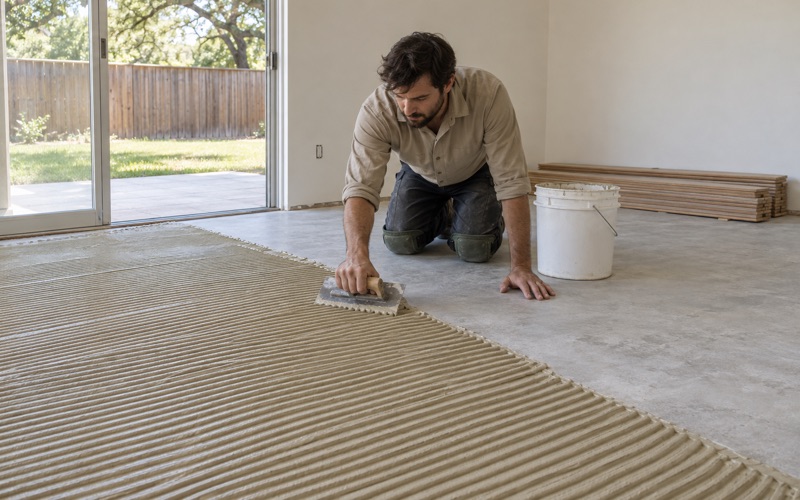
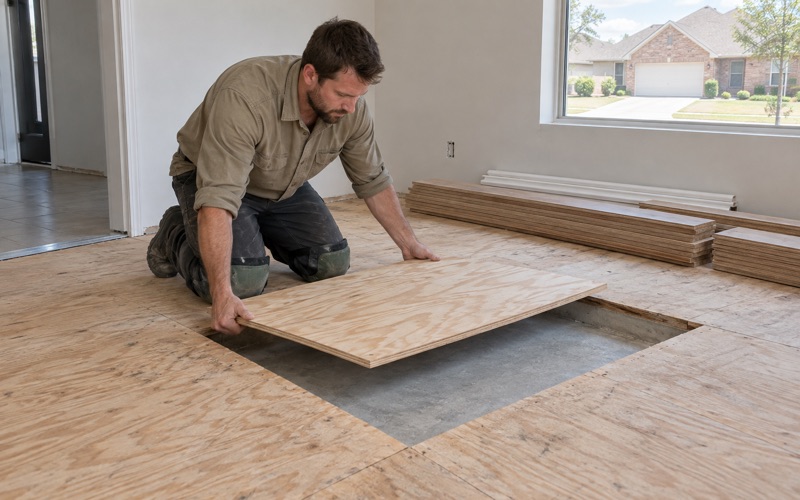
The post-2007 houses here sit on post-tension slabs. Anything fastened into one of those needs the tendon layout located first, which rules out treating a floating floor or a glue-down as interchangeable with a nail-down assembly. In the older cohort the slabs are conventionally reinforced and that constraint does not apply, so the same crew changes method between two jobs in the same town on the same day.
Moisture is the other constraint, and it is the one that decides schedules. We run an ASTM F2170 in-situ relative humidity test and record the number before an installation date is set, not after the wood is sitting in the house. A slab at or under 75 percent RH is the condition we are looking for; where it is not there yet, the honest answer is a later start date or a different assembly with a vapor retarder, not a faster crew.
Where the reading is taken matters here
Houses fronting the golf course carry irrigation immediately outside the slab edge, and the perimeter of those floors runs wetter than the interior of the same room. A single reading taken in the middle of a living room does not represent a course-side wall, so we take the perimeter readings separately and let the wettest one set the schedule. Interior-lot houses in the same subdivision do not behave the same way, which is why we do not carry one house’s numbers to the next.
Recoat, Replace, or Leave It a While Longer
We price repair, refinish and replacement in that order, and we say which one is right first even when it is the cheapest of the three. On floors of this age, it often is.
Screen-and-recoat while there is still finish to save
A screen-and-recoat abrades the existing coating with a buffer and lays a new one over it. The wood is never cut. Done before the lanes wear through, it resets the appearance of the whole floor and restarts the clock on the surface, and it is the single highest-value thing an owner of a ten-year-old engineered floor can do.
It has to be honest about the existing finish, though. A recoat bonds to what is there, and where the old coating is failing or contaminated, a new waterborne polyurethane over it will let go in sheets. Dustless containment goes up and gets shown to you before the first machine runs, and you get a written cure and occupancy schedule before the first coat goes down — cure time is not dry time, and the schedule says plainly when furniture and pets come back.
Board replacement instead of a whole floor
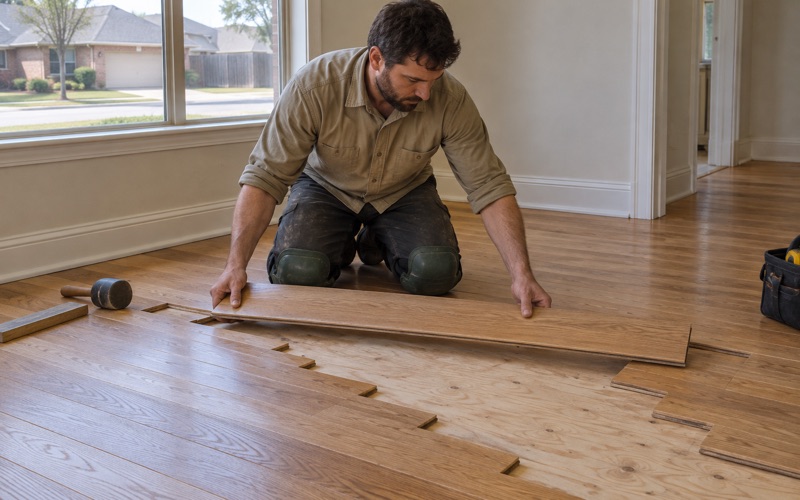
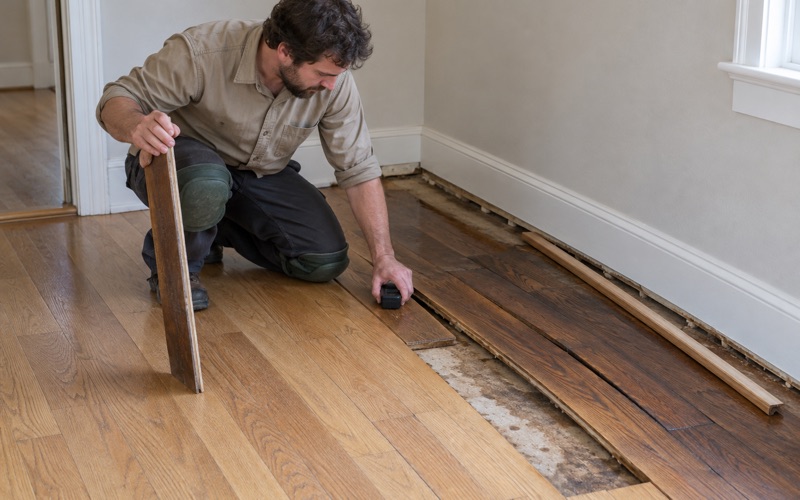
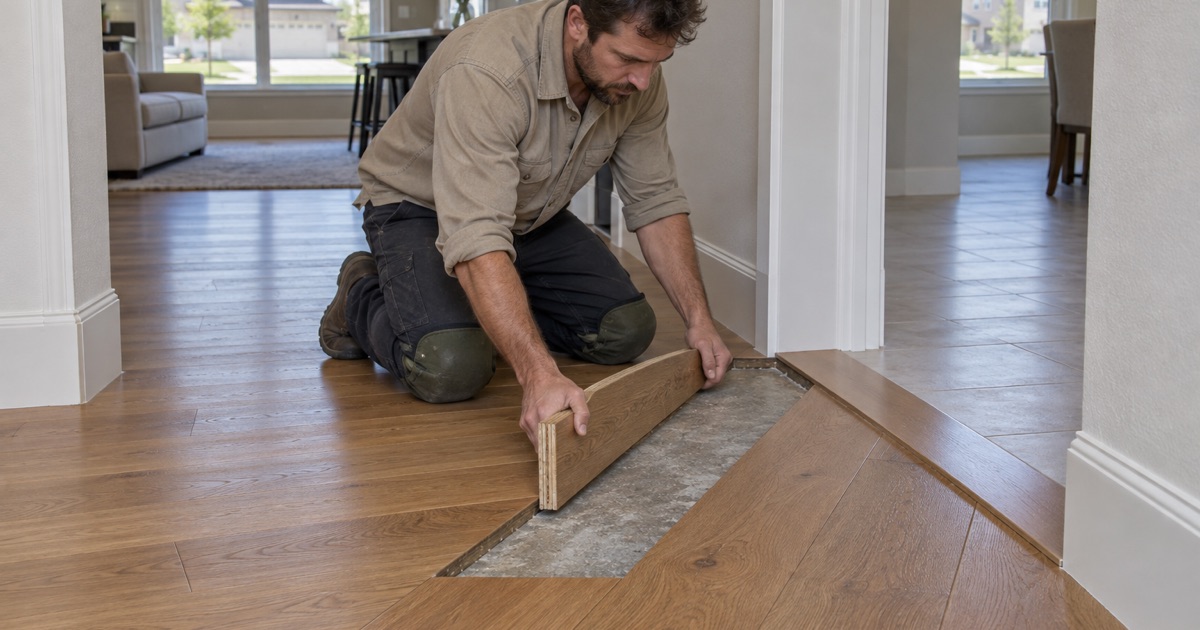
Where the damage is localized — a run of boards under a leaking dishwasher line, a patch inside a doorway — we replace boards and weave them into the surrounding field rather than stopping the repair at a T-mold across an opening. On a prefinished floor the match is found rather than made, so we say up front how close it will get and where a reducer or threshold makes a cleaner break than a marginal blend. Replacement boards are acclimated inside the house, in the room they are going into, never in the garage and never left on the truck.
When a floor truly is finished, replacement is a clean decision rather than a defeat. It is also the moment to choose a thicker wear layer or a solid floor deliberately, instead of inheriting whatever the house was built with.
Who signs off, and what else is in play in this town
Trophy Club spans the Denton and Tarrant county line along State Highway 114, but permitting runs through Town of Trophy Club Community Development. The town adopted the 2021 International Residential Code along with the rest of the 2021 International Code family, in effect since April 2022, and requires a permit before an addition, alteration or repair of an existing building, with a narrow exception for emergency work. We confirm what a given scope needs rather than assuming a floor is exempt.
Water and sewer come from Trophy Club Municipal Utility District No. 1, a separate governmental entity from the authority that issues the permit. On a water-damage claim that matters, because the loss documentation and the repair approval travel to different desks. We document water damage room by room with photographs, moisture meter readings and a map for the claim file, and we sequence flooring after foundation repair and plumbing rather than ahead of it, so your floor is not paying for someone else’s schedule.
One crew handles the work from tear-out to final coat, and the sanding is never subcontracted out. On floors this young, with this little wood to spend, the person running the machine should be the person who measured what was under it.
- 20+ Years in North Texas
- Dustless Sanding
- Free Written Estimates