Grapevine Wood Flooring has been doing wood flooring in University Park for more than twenty years, and it is the one part of our service area where the boards under the carpet are routinely older than the people asking about them. Much of what we are called out to see here is original solid hardwood that has already been sanded more than once. What we end up quoting is usually a decision about how much of it is worth saving.
That changes the order in which we look at things. We price repair first, refinishing second and replacement last, and we say which one we think is right before anything else is discussed, because on a floor of this age the cheapest correct answer is very often the first one. A board-by-board repair woven into the surrounding field reads as original; a full replacement never does.
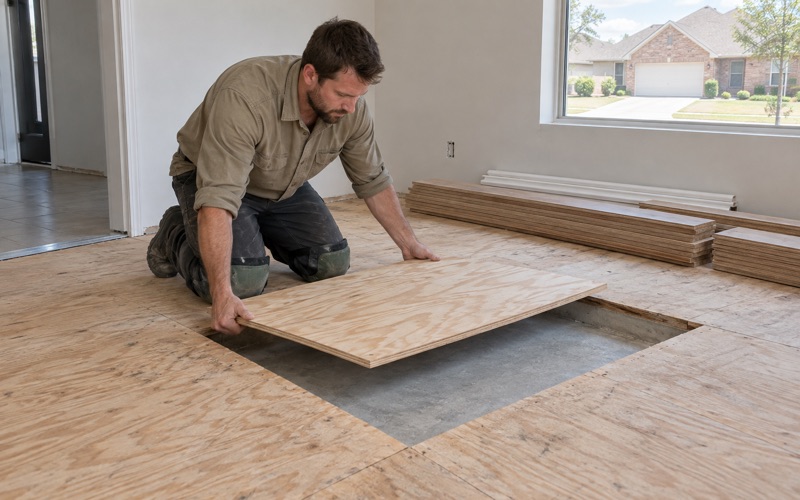
It also changes the questions we ask before we quote. We want to know whether foundation work or plumbing is planned, because a floor laid ahead of either is a floor that gets opened back up. We want to see how the subfloor is built, and we want a moisture meter on it before anyone commits to a start date.
The one city on our map with genuinely pre-war floors
University Park’s housing stock is not shaped like the rest of this region. Of 7,444 housing units, 1,316 were built in 1939 or earlier, and another 574 went up during the 1940s, so 1,890 units — 25.39 percent of the city — predate 1950. Against a regional pattern where pre-1950 stock runs under three percent, the thing that is a rarity almost everywhere else is ordinary here.
That is a function of when the place was built. The city incorporated in 1924 with a population of 1,200 and developed around Southern Methodist University, with Snider Plaza opening in 1927. The houses that went up in that first decade are the ones we are still sanding.
The gap where the post-war subdivisions should be
The stock also skips the era that usually fills a Dallas County suburb. Only 80 units, 1.07 percent of the total, were built in the 1960s, and 334 in the 1970s. The mid-century inventory of strip oak over slab that we handle constantly elsewhere is largely absent, which means a job here tends to be either genuinely pre-war or genuinely modern with very little sitting between the two.
A built-out grid, rebuilt one lot at a time
Another 2,679 units, 35.99 percent of the total, date from 2000 or later. The city is built out, so that construction arrived as teardown and replacement on existing lots rather than as new subdivision, smaller original houses giving way to larger ones as lot values rose. A single block can hold a recent build next door to a house whose floors have never come up.
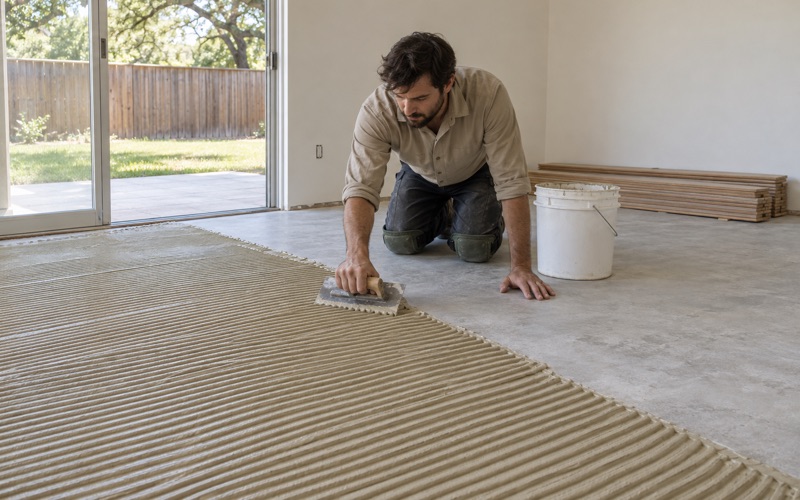
We treat those as two different jobs, because they are. Nothing about an address tells us which one we are walking into, and we will not tell a homeowner what their floor is built on before we have opened an access point and looked — parcel-level construction records were not something we could pull for these addresses. On the newer houses the slab protocol applies: an ASTM F2170 in-situ relative humidity test, with the number recorded before an installation date is set rather than after the wood is already on site.
Looking for wood-flooring closer to Forest Hill? See Wood-Flooring Services in Forest Hill.
Strip flooring over joists, not over concrete
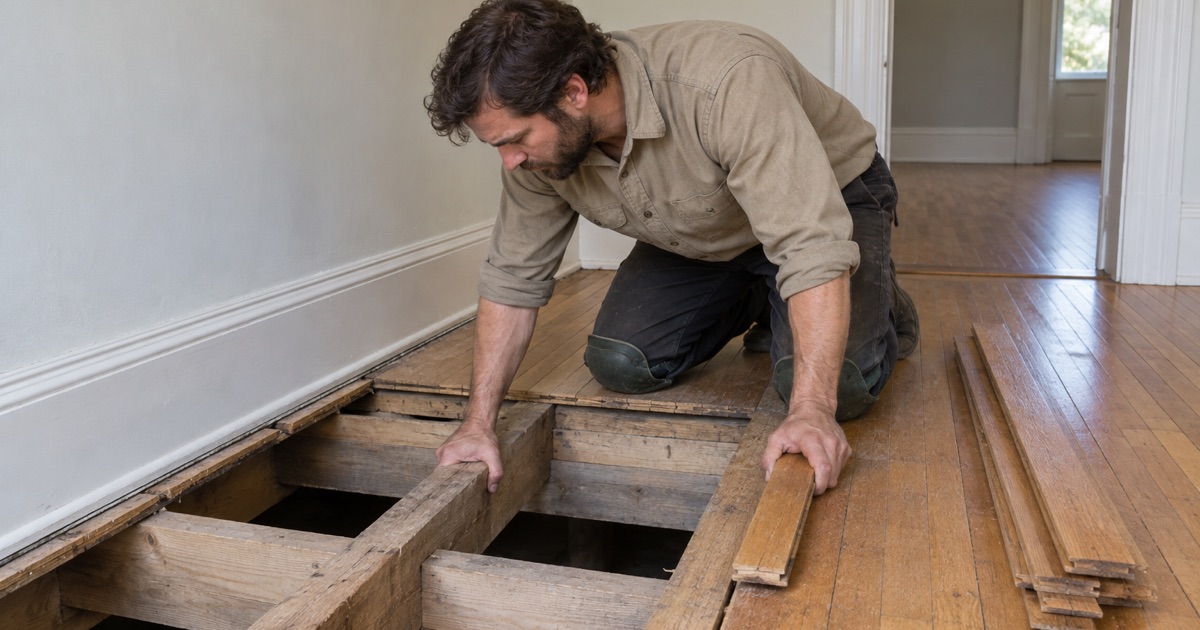
A pre-war floor in this city is framed. The boards are narrow, site-finished, tongue-and-groove strip flooring fastened to a board subfloor that in turn sits on joists, with air underneath instead of concrete. Everything downstream of that — how the floor moves, how it sounds, how it fails and how it gets repaired — follows from it.
Sag, deflection and the order of operations
A framed floor announces a structural problem long before a slab would. Deflection between joists shows up as a spring underfoot, and a settled bearing point shows up as a slope you can feel walking one direction across a room. Sanding a floor flat over a structural sag removes wood from the high spots and leaves the boards thinnest exactly where they could least afford it.
So we measure before we sand, and when the framing is still moving we say the floor is not ready. Our work is sequenced after foundation repair and after plumbing rather than ahead of either. A refinish that goes down first is a refinish paying for somebody else’s schedule.
What the space underneath does to the wood
Air under a floor is a moisture path, and the boards take humidity up from below and give it back as conditions change. Over a season that shows on the surface as cupping, or as crowning where a cupped floor was sanded flat before it had equalized. We read equilibrium moisture content on the boards and on the subfloor, top and underside where the framing gives us access, before anything is scheduled.
Those readings are also why acclimation matters more here than on a new install. Replacement material goes inside the house, in the room it is destined for, never in the garage and never left on the truck overnight. Wood that equalizes somewhere else arrives at the wrong moisture content and moves after it has been nailed down.
The ground under the city belongs to the same story. University Park sits in the Northern Blackland Prairie, a fine-textured, calcareous, shrink-swell clay province rather than the sandy to loamy Woodbine-derived soils found in other parts of this metropolitan area. Seasonal movement in that clay is what the framing above it has been riding on since it was built.
Cut nails, face-nailing and what they leave behind
Pre-war strip flooring was not fastened the way a modern floor is. Cut nails are common in this stock, and older work often shows boards face-nailed through the surface rather than blind-nailed through the tongue. They hold extremely well, and they complicate every repair that follows.
Lifting a board without destroying four others
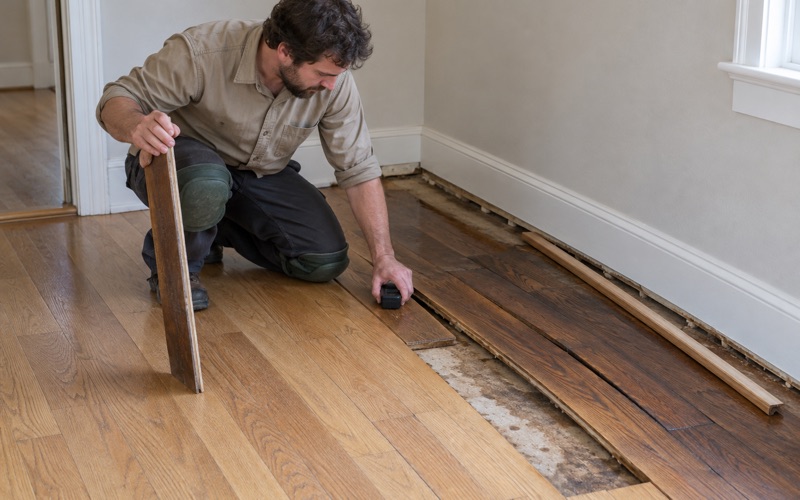
A face-nailed board locked in place by decades of accumulated finish does not come out cleanly. Getting one up without splitting its neighbors is slow, deliberate work, and the fastener holes left behind are part of what the floor looks like rather than a defect to be filled flush. We salvage whatever comes up whole and store it secured rather than sending it to the skip, because a board milled alongside the original run is the best match that will ever exist for the board next to it.
Weave-in, lacing and the dutchman patch
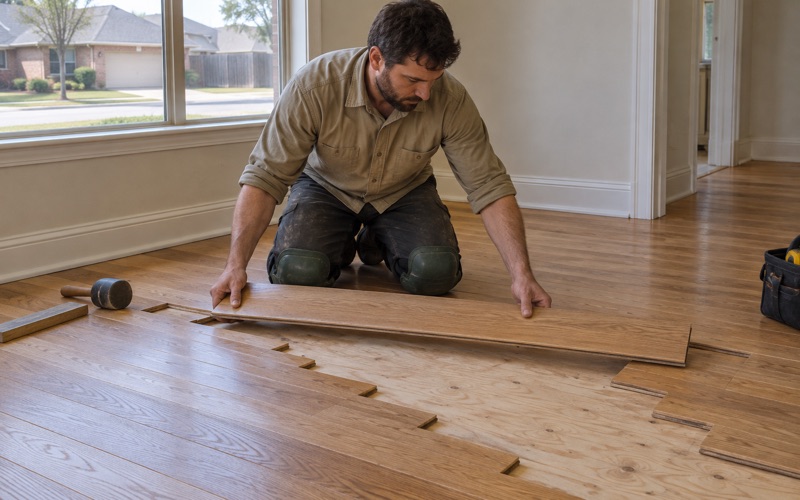
Where boards do have to be replaced we weave them in rather than dropping a rectangle into the field. That means staggered joints, a lacing run out into the surrounding boards, and, where a single defect has to come out of an otherwise sound board, a dutchman patch cut to follow the grain. Overwood at the seams is the tell that a repair was set in rather than worked in, and flattening it is the first thing that happens before the field is touched.
Grit, machines and containment
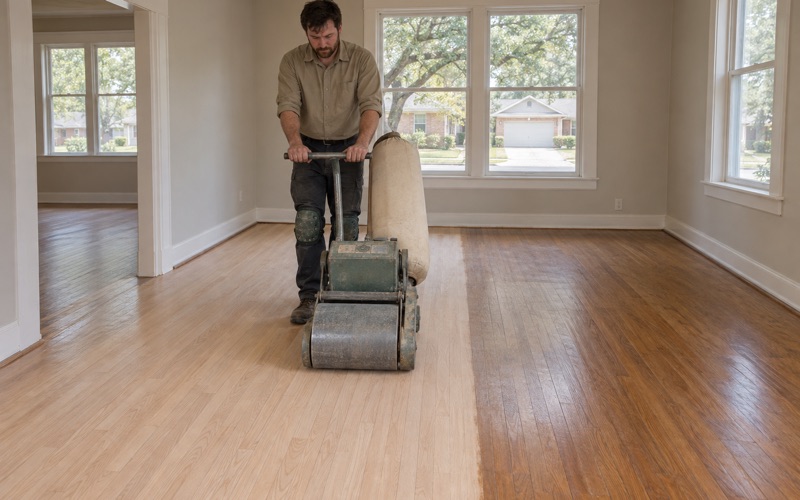
A floor this old rarely takes a standard approach straight off. We open with the 36-50-80 grit sequence adjusted to what the boards will actually give up, drum sander through the field, edger at the perimeter, buffer to blend everything before finish goes down. Where a floor only needs its top coat renewed, a screen-and-recoat leaves the wood alone entirely, and that is the answer we give whenever it is the right one.
Dustless containment goes up on every sanding job and is set up and shown to you before the first machine runs. In housing of this vintage there is a second reason for it beyond the mess, since the EPA RRP lead-safe rule governs how painted surfaces are disturbed in pre-1978 housing. In a city where houses of that age are ordinary rather than rare, that is not an edge case.
Matching a profile that has not been milled in eighty years
Modern strip flooring is not the same product. Widths, tongue-and-groove profiles and thicknesses have all shifted, so a new board set beside an original one reads wrong at the seam before anyone gets as far as noticing color. Matching is the hardest part of a repair on this stock, and it is the part a homeowner judges the finished result on.
Species, hardness and how a board wears in
Most of what we lift here is red oak or white oak, and the two do not take color the same way even when the milling lines up. White oak sits at 1360 on the Janka hardness rating and hickory at 1820, which matters less for the match on day one than for how the repair wears afterward — a harder species set into a softer field will still be standing proud of it years later. We match species and mill profile first, color second, and we say so plainly when an exact match is not available.
Thickness is the real budget
How many times a floor has already been sanded decides what is possible now. Every pass takes wood, and a pre-war floor on its third or fourth refinish may have very little left above the tongue. We check that before quoting, the same way we measure wear layer thickness before quoting a refinish on engineered flooring, where under about three millimeters there is nothing left to sand.
Working inside the city’s hours
Construction in University Park is permitted between 7:00 a.m. and 6:00 p.m., Monday through Saturday, except by special permission, and is prohibited on Sundays and on specified holidays including New Year’s Day, Independence Day, Thanksgiving and Christmas. Sanding, finishing and cure schedules have to fit inside that window, and a finish needing an uninterrupted run cannot borrow a Sunday to get there. We build the calendar around it and hand over a written cure and occupancy schedule before the first coat goes down, including when pets and furniture come back.
Cure time and dry time are not the same number, and they differ again between a waterborne polyurethane, an oil-modified polyurethane and a hardwax oil. The city also requires contractors to be registered before they work here, with registrations expiring on the same annual date as the state license. Whether a particular floor job stays on the finish-work side of the line or crosses into remodeling is a question for the City of University Park Building Inspection Division, which exempts items such as wallpapering, painting and similar finish work from a construction permit while most remodeling and additions require one — so we ask rather than assume.
One crew stays on the job from tear-out to final coat, and the sanding is never subcontracted out. On floors that have survived this long, continuity is most of the craft.
- 20+ Years in North Texas
- Dustless Sanding
- Free Written Estimates