Grapevine Wood Flooring has been doing wood flooring in Watauga for more than 20 years, and the first thing we settle on a tired-looking floor is which of two very different problems it has. Either the finish has failed, or the wood underneath has been sanded away. Those two conditions ask for opposite work, and confusing them is how a homeowner pays for a full sand they never needed.
Most of the calls we take here describe the same handful of symptoms: dull lanes down the hallway, a cloudy patch in front of the sink, scuffing that no longer cleans off. None of those symptoms, on its own, says anything reliable about how much wood is left above the tongue. They describe where people walk.
So we test before we price, and we price repair, refinish and replace in that order, naming the cheaper option first whenever it is the honest one. A floor that only needs its finish renewed should be quoted as exactly that. The rest of this page is how we tell the two apart and what each answer costs you in time.
A worn floor is usually a worn-out finish
A wood floor’s finish is a sacrificial layer. Oil-modified polyurethane, waterborne polyurethane and hardwax oil all do the same basic job, which is to take the abrasion so the wood does not have to, and all of them are expected to give out long before the boards do. When a floor looks spent, the first hypothesis worth testing is that the sacrificial layer has simply finished its service.
Wood itself wears slowly underfoot. What actually removes thickness from a board is a drum sander, not shoes, so the number of times a floor has been refinished matters far more than the number of years it has been walked on. A floor sanded once in three decades usually has plenty left; one sanded three times may not.
Species hardness matters less to this question than people assume. Red oak, white oak at 1360 on the Janka scale and hickory at 1820 differ in how they resist a dropped pan, but none of them protects the coating sitting above it. A hard wood under a failed finish still reads as a worn-out floor from standing height.
The age of the housing stock points the same way
Watauga’s building record sits in a narrow window of years. 63.1% of the city’s housing units were built between 1970 and 1989, with 37.1% of them going up in the 1980s and 26.0% in the 1970s, and only 14.4% of the stock was built in 2000 or later. The city went from 7,050 residents in 1976 to 20,009 by 1990, and the houses record that stretch almost exactly.
A floor in that cohort has had decades to accumulate coats, cleaning products and repair attempts, and much of it has been recoated at least once by someone. That history is usually what we are actually looking at when a floor reads as damaged. The wood is often in better shape than the surface makes it look.
Who is asking, and why it changes the answer
78.0% of Watauga’s occupied units are owner-occupied, so the person calling is usually a long-tenured owner planning to stay rather than someone dressing a house for sale. That changes what the right recommendation even is. An owner keeping the house cares how many refinishes the floor has left in it, not only how it photographs this month.
It also makes the cheap answer the correct answer more often than people expect. Renewing a finish now preserves the wood thickness that pays for a real refinish years from now.
Looking for wood-flooring closer to Lantana? See Wood-Flooring Services in Lantana.
Telling a failed finish from wood that is gone
Nobody can settle this from across the room, and we do not try. Sheen, color and scratch patterns tell us the finish is unhappy; they say nothing dependable about the thickness of the wood carrying it. The separation has to be made by testing, in places where being wrong costs nothing.
Where a floor shows its cross-section
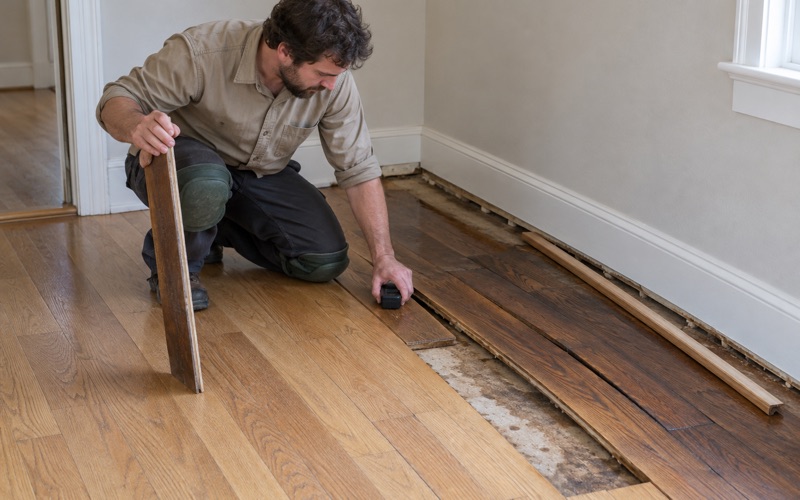
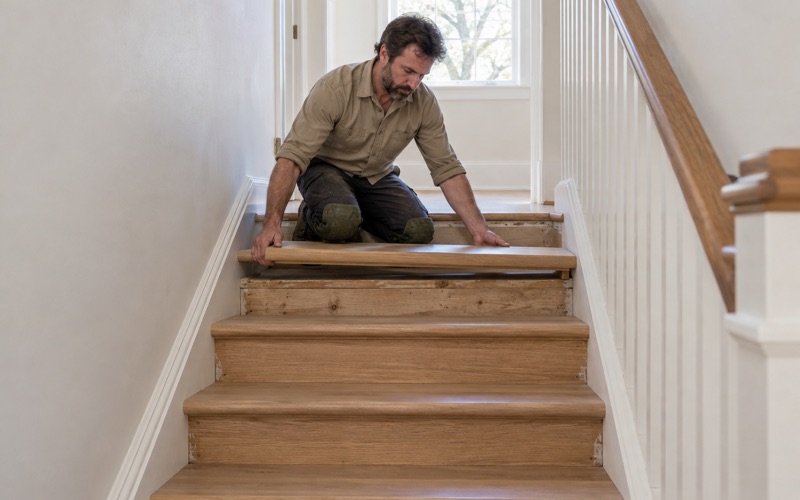
Floor vent cutouts, the edge under a threshold or a reducer, and the board ends at a stair nosing all expose a profile of the board. That is where remaining thickness above the tongue can be read rather than guessed. We also look for overwood and for edges sitting low against the field, which is the signature of a floor that has already been through an edger more than once.
Absorption tells us about the finish rather than the wood. A drop of water that darkens a board in the traffic lane and beads in a closet a few feet away is a finish worn through in one place and intact in the other. That is a recoat conversation, not a sanding one.
On engineered floors the answer is a measurement
Engineered flooring takes the judgment out of it, because the decision is a number. We measure wear layer thickness before quoting any refinish on engineered, since under about three millimeters there is nothing left to sand, while a six millimeter wear layer behaves much like solid wood. A two millimeter wear layer is a recoat candidate and nothing more.
The failure to avoid is a sand-through to the plywood core, which cannot be undone and turns a refinish into a replacement. Lathe checks, the fine cracks left in rotary-peeled veneer, are another reason to stay conservative, because hard abrasion can open them up under a new coat. When the measurement says no, we say no and price a recoat or board replacement instead.
Peeling, flaking and the coat that never bonded
Peeling is not wear, and it is the failure most often misread as a floor that is used up. When a finish comes away in flakes, sheets or crescents at the board edges, the coat did not bond to what was under it. That is bond line failure, and adding more finish on top of it makes the problem worse rather than better.
The causes are almost always contamination or chemistry. Acrylic polishes, wax, oil soaps and some supermarket floor cleaners leave residue that no coating will grip. So does recoating a floor without abrading it first, or putting a waterborne polyurethane over an oil-modified surface that was never opened up. A sealer left past its recoat window can do the same thing.
Why another coat makes a peeling floor worse
A new coat bonds to the failing coat, not to the wood beneath it. The bond line that already let go is still the weakest layer in the stack, so the whole thing comes away together the next time something drags across it. Money spent coating over a bond failure leaves with the flakes.
This is the one case where we will not sell the cheaper service even when a homeowner asks for it. A peeling floor has to be taken back past the failed layer, which usually does mean a full sand rather than a screen. Quoting a recoat there would be selling a job we already know fails.
Delamination is a different problem again
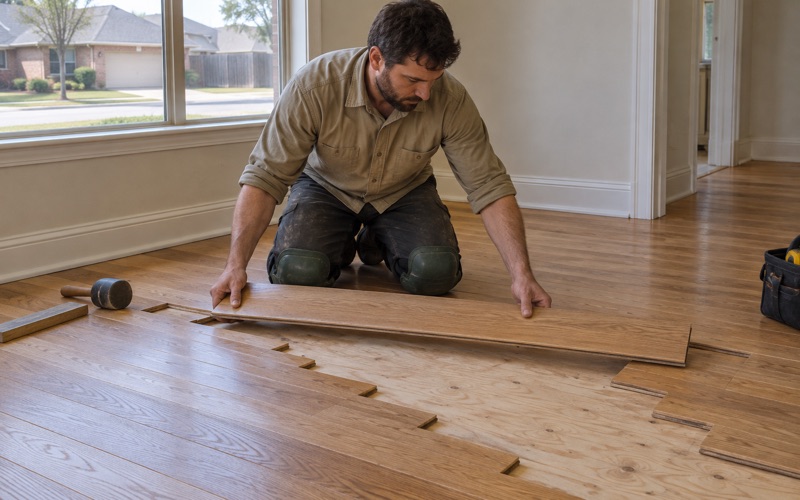
On engineered boards, veneer separating from the core is delamination rather than a finish failure, and no coating addresses it. Those boards come out. Depending on the run and the layout we replace them with a weave-in, a lacing repair, or a dutchman patch where only part of a board is involved.
What a screen-and-recoat can and cannot fix
A screen-and-recoat abrades the existing finish with a buffer and a screen, then puts fresh coats over the prepared surface. It renews the finish without touching the wood, which is why it is quick, far cheaper than sanding, and why it preserves thickness for later. It is the right answer on a floor whose surface is tired but sound.
What it cannot do is reach anything below the finish. Gray or blackened boards, pet stains that have soaked into the wood, scratches cut through to bare timber, dents, cupping and open gaps are all wood problems. A recoat over them seals the damage in under fresh gloss, and the same goes for a floor whose color the owner wants changed, because stain lives in the wood rather than the topcoat.
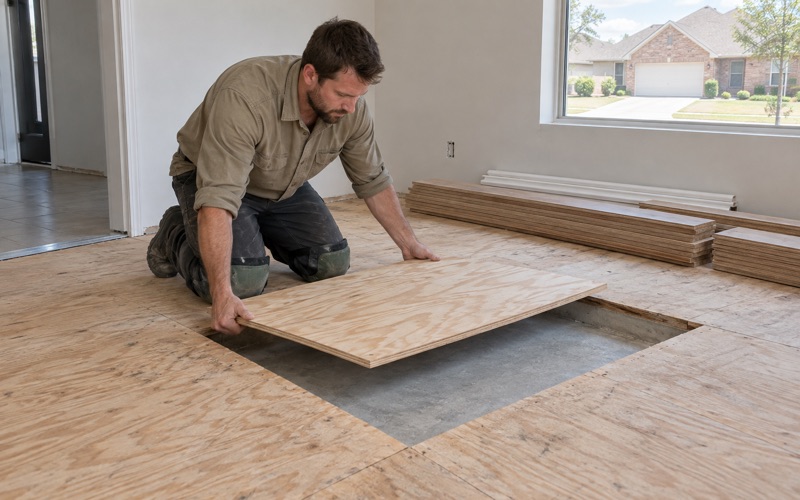
We stop at the subfloor as well. If a floor is moving, hollow or out of flat, the fix sits under the boards and no amount of finish work will hold it. Watauga follows the 2024 International Residential Code, and permit questions on anything past finish repair belong to the City of Watauga Development Services, Inspection Services.
The test patch that decides it
Before we commit anyone to a full sand, we cut a test area in a closet or a back corner and take it through the start of a 36-50-80 grit sequence. That tells us whether the existing finish releases cleanly, what the wood looks like underneath, and whether the boards can carry the abrasion at all. On a recoat candidate we run an adhesion test on the prepared surface before anyone commits to coating the whole floor.
Because Watauga covers only 4.16 square miles, coming back to read a test patch is a short trip rather than a scheduling problem. We would rather spend that hour than guess at it. A test that comes back saying recoat saves a homeowner most of the cost of the job.
If a full sand is the answer
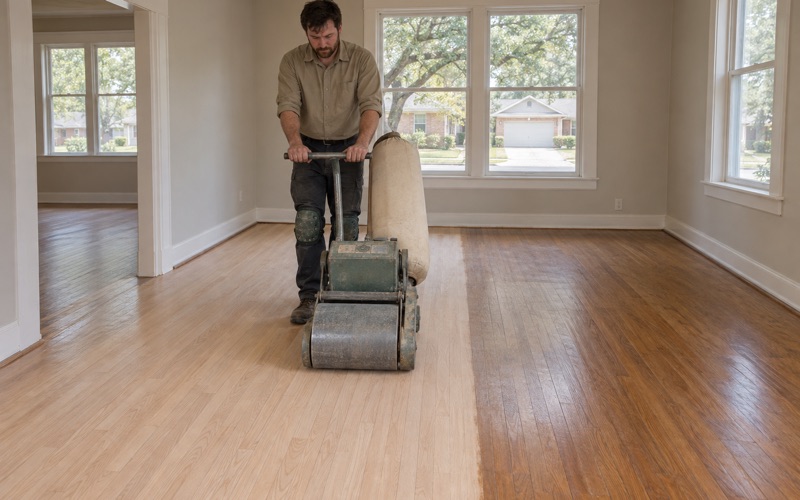
When the sand is genuinely necessary, one crew runs it from tear-out to final coat and the sanding is never subcontracted out. Dustless containment is set up and shown to you before the first machine runs, rather than described to you afterward. The drum sander, the edger and the buffer each have their own role, and the people who cut the floor are the people who coat it.
The federal RRP lead-safe rule attaches to pre-1978 housing, and part of Watauga’s 1970s cohort falls on that side of the line. Where it applies, containment and cleanup are set by rule rather than by preference. It is worth knowing before a sanding crew arrives, because it changes how the work is staged in an occupied house.
Before the first coat goes down you get a written cure and occupancy schedule, including when furniture and pets come back. Dry time and cure time are not the same number, and treating them as one is how a week-old finish collects chair prints. On a recoat that schedule is much shorter, which is one more reason we test rather than assume.
- 20+ Years in North Texas
- Dustless Sanding
- Free Written Estimates