
Grapevine Wood Flooring has handled water damaged hardwood floor repair in Grapevine, TX for more than 20 years, serving surrounding cities including Southlake, Colleyville, Coppell, Euless, Trophy Club. A water loss puts a homeowner under time pressure at exactly the moment when the most expensive decisions are being made, and the single most useful thing a flooring contractor can do in the first week is document properly and then wait for the numbers rather than start cutting.
So our first visit is a measuring and recording visit. We photograph the affected rooms, take moisture meter readings area by area, establish where the water came from and how far it traveled, and draw a line-of-sight map showing where the flooring runs continuously from one room into the next. That file goes to you, and through you to your adjuster, before any board is lifted.
We do not adjust claims and we will not tell you what your policy covers. What we will do is make sure the decision is made against evidence: what is wet, how wet, how far it extends, what the material actually is, and what repair or replacement each option would involve. Everything after that follows the drying, because a floor repaired while it is still wet is a floor repaired twice.
Finding the Water Before Repairing the Floor
Slab Leaks and Supply Line Failures
On slab-on-grade housing, which is most of this city, a supply line failure under the concrete announces itself as a warm spot underfoot, an unexplained water bill or cupping confined to one part of a room. Nothing is fastened or bonded to that slab until the line is located and repaired and the concrete has been allowed to dry and retested. We record the readings while the floor is open, because that evidence disappears once the room is put back.
Appliance and Fixture Overflows
Dishwashers, refrigerator ice lines, washing machine hoses and water heaters account for a large share of interior losses, and they share a pattern: the water runs under cabinets and into adjoining rooms before anyone sees it on the surface. We check under toe kicks, along the cabinet run and into the rooms beyond the visible edge, because the extent of a floor loss is almost always larger than the extent of the puddle.
Roof, Window and Exterior Water
Water arriving from outside tends to concentrate along an exterior wall, under a window or around a door threshold, and it can recur seasonally rather than all at once. That pattern matters for the claim, since a recurring intrusion is treated very differently from a single sudden event. We note the distribution and the staining pattern, and we recommend that the building envelope be corrected before flooring is replaced.
What Water Does to a Wood Floor
Cupping, Buckling and Crowning After a Loss
Water reaching a floor from below or from a spill that sat wets the underside of the boards first, so the edges rise and the floor cups. Enough pressure across a room with no expansion gap left and the floor buckles clear of the substrate. Crowning, the reverse profile, usually appears later and usually because someone sanded while the boards were still wet. All three are why the drying comes before the decision.
Black Staining and Mold Under the Boards
Dark staining along board edges means water reached the wood and stayed there long enough to react. Light discoloration sands out; deep black usually does not, because it has penetrated further into the board than a sander can safely follow. Below the surface, prolonged moisture in the substrate and framing raises a microbial question that belongs to a remediation contractor, and we will say when we think it needs one.
Delamination and Bond Failure on Engineered and Glue-Down Floors
On a glue-down installation, water at the slab interface breaks the adhesive bond, and the affected boards sound hollow underfoot long before they look wrong. On engineered flooring, sustained moisture can separate the wear layer from the plywood core, which is delamination and cannot be repaired in place. We tap-test the area to map the true boundary of the failure, because the damaged zone routinely extends past the visibly affected boards.
Drying, Documenting and the Claim File
Moisture Readings Room by Room
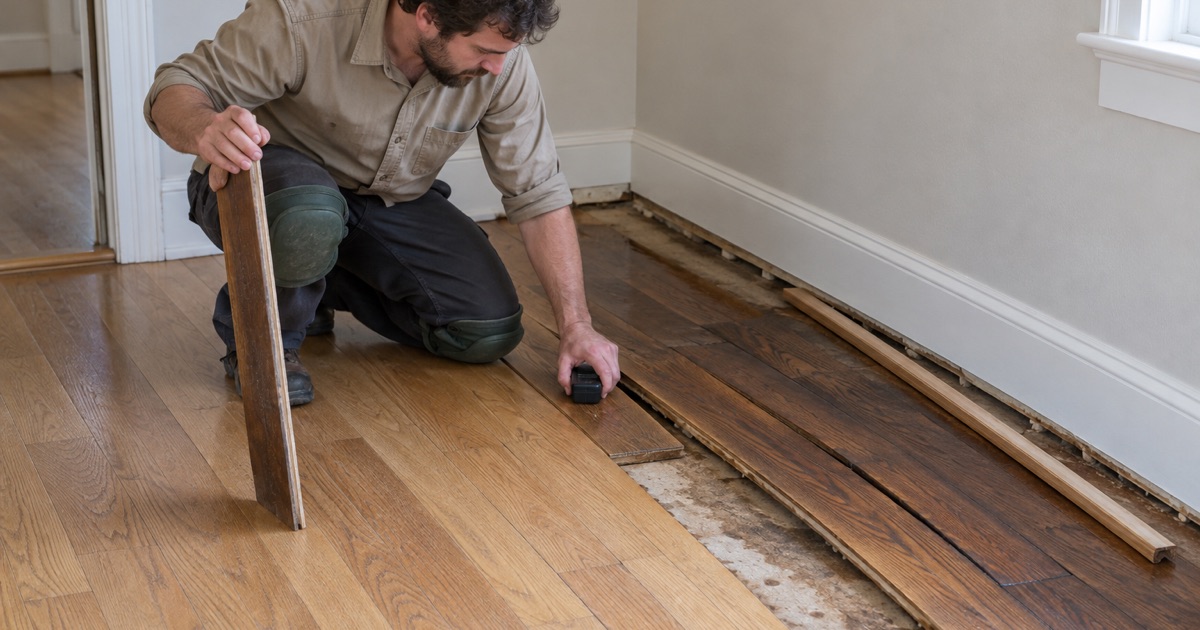
We record readings with a moisture meter across the affected area and into the adjoining rooms, note them by location, and repeat them as drying progresses. Two things come out of that. First, a defensible boundary for the scope of repair rather than an argument about where the damage stops. Second, an objective signal for when the floor has returned to equilibrium moisture content and is ready to be worked on.
Continuous Flooring and Line of Sight
Where the same flooring runs uninterrupted from a damaged room into an undamaged one, repairing only the damaged room can leave a visible seam across a sightline that anyone standing in the hall will notice. Continuous flooring and line of sight are the terms used when the extent of a repair is being decided. Our map records which spaces share flooring and which are separated by a threshold, doorway or transition strip.
Material Evidence and the Estimate
Adjusters commonly work from an itemized estimate, and independent identification of an existing flooring product, such as an ITEL report, is sometimes commissioned to establish what the material is and whether it can still be obtained. We provide the underlying facts: species, construction, board width, wear layer thickness, finish type and installation method. Those details are what any estimate or identification is built on, and getting them wrong early costs weeks later.
Repairing or Replacing After the Floor Is Dry
Waiting for Equilibrium Moisture Content
The single most common expensive mistake after a water loss is sanding or reinstalling too early. A floor that reads wet will keep moving, and any work performed on it moves with it. We wait for readings in the flooring and the substrate to stabilize within a normal range for the conditioned house, confirm them over more than one visit, and then schedule. The wait is usually shorter than people fear and always shorter than doing it twice.
Board Replacement, Weave-Ins and Refinishing
Where the floor can be saved, damaged boards come out and matching material is woven into the field so no continuous seam betrays the repair. Partial damage in an otherwise sound board takes a dutchman patch. The repaired area is then sanded and finished with the surrounding floor so the color is made in the room, which is the only reliable way to make new wood disappear into old.
Full Replacement and Rebuilding the Substrate
Where the flooring cannot be saved, the substrate underneath it still has to be proven before anything new goes down. That means a slab retested with an in-situ relative humidity test, or a wood subfloor checked for swelling, delamination and fastener holding, with damaged panels replaced and the surface brought back into flatness tolerance. Installing new flooring over a substrate that was only visually inspected is how a second claim starts.
- 20+ Years in North Texas
- Dustless Sanding
- Free Written Estimates