Grapevine Wood Flooring has been installing and refinishing wood flooring in White Settlement for more than twenty years, and this is one of the few cities on our map where we open the conversation by asking whether the caller lives in the house or rents it out. The answer changes almost everything that follows, from the age of the subfloor to the fasteners we expect to find under it, to whether the honest recommendation is a refinish or a replacement.
That is not a general observation about homeowners and landlords. It is specific to the housing stock in this city, where the two tenures were built roughly a generation apart and the older half is the owner-occupied half. The usual assumption runs the other way, which means an installer working from habit is wrong about the house before the tape measure comes out.
So we quote here from what is actually under the floor rather than from a city-wide average. Repair, refinish and replace get priced in that order, with the cheaper of the three named first whenever it is genuinely the right call, and the number underneath the quote comes off a moisture meter and a wear layer gauge instead of an assumption.
In White Settlement the owners live in the older houses
Taken as a whole, the median year structure built in White Settlement is 1974. Split the same stock by tenure and that single number comes apart: the median year built for owner-occupied units is 1965, and for renter-occupied units it is 1981. That sixteen-year gap is the most useful thing we know about working in this city.
Sixteen years is not a rounding difference in flooring terms. It spans a change in how houses were framed and floored, a change in what subfloor sheathing was commonly available, and the point at which lead-based paint left the residential supply. A crew that shows up expecting the mid-1970s house implied by the city-wide median will be roughly fifteen years too new for the customer who actually hired it.
Who is calling, and what they own
Owner-occupied units make up 60.7 percent of the occupied housing here, 3,952 owner households against 2,557 renter households out of 6,509 occupied units. On top of that, 66.1 percent of the city’s housing units are single-family detached, and 3,829 of those detached houses are owner-occupied.
So the homeowner paying for a wood floor in White Settlement is, more often than not, standing in a detached house older than 1970. That is a restoration conversation rather than a new-construction one, and it is the conversation we prepare for before the truck is loaded.
What a median can and cannot tell us
A median describes a cohort and never the particular house we are standing in, and there are newer owner-occupied houses here alongside older rentals. What the two medians do is set the expectation we arrive with, which decides what comes off the truck first and which questions get asked before a price is discussed.
Looking for wood-flooring closer to Azle? See Wood-Flooring Services in Azle.
1960s owner stock and what is under it
A median build year of 1965 sits on the tail of this city’s largest building wave. Of 7,485 housing units, 1,993 went up between 1950 and 1959, which is 26.6 percent and makes the 1950s the modal decade, and 33.8 percent of the stock predates 1960 altogether. The 1970s added only 14.8 percent.
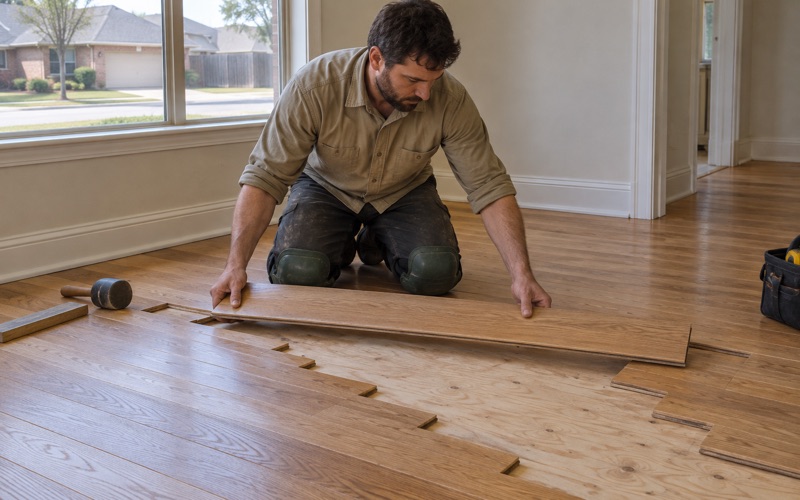
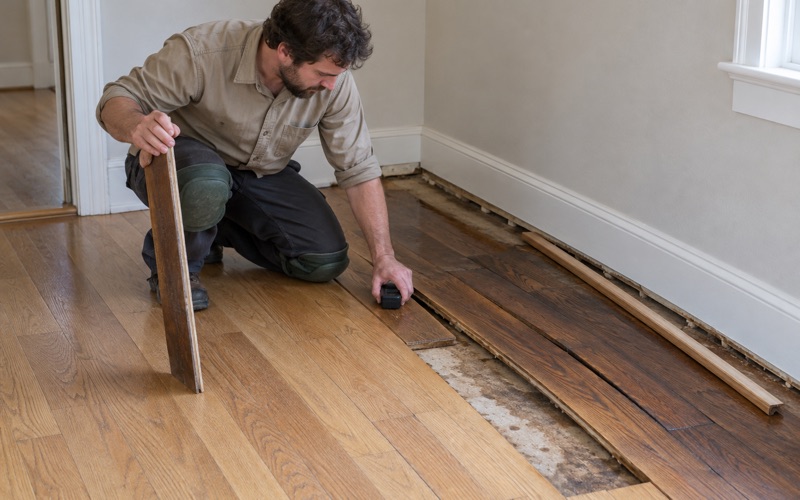
Underfoot that usually means a thin, tightly fastened floor system rather than a modern one. We expect narrow tongue-and-groove boards over plank or early sheathing subfloor, cut nails or early cleats toward the older end of the range, and a site-finished surface that has been walked on for decades.
Older still, and framed differently
A smaller cohort here predates all of that: 535 units were built before 1950, 79 of them in 1939 or earlier and 456 between 1940 and 1949. In that oldest slice we still expect to find raised pier-and-beam framing over a crawlspace rather than anything poured.
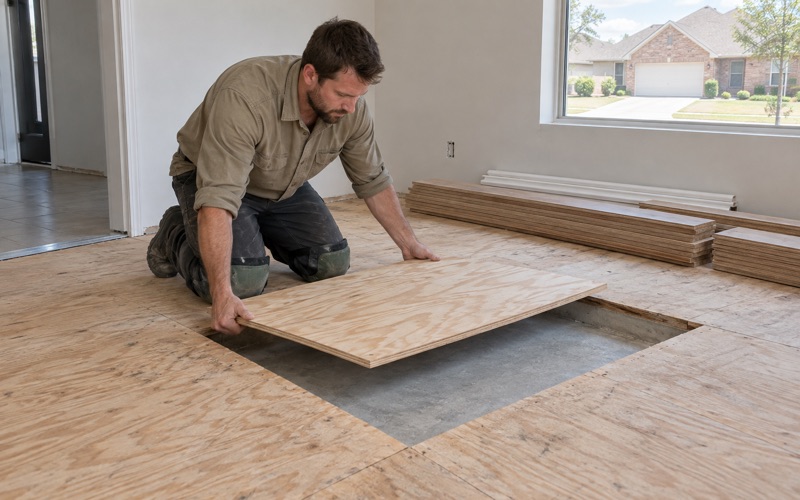
A floor over a crawlspace answers to the humidity underneath it, so equilibrium moisture content readings taken at the subfloor matter more there than any number on a delivery ticket. Cupping and crowning in that stock are almost always a message about the crawlspace rather than about the boards.
Sanding a floor that has been sanded before
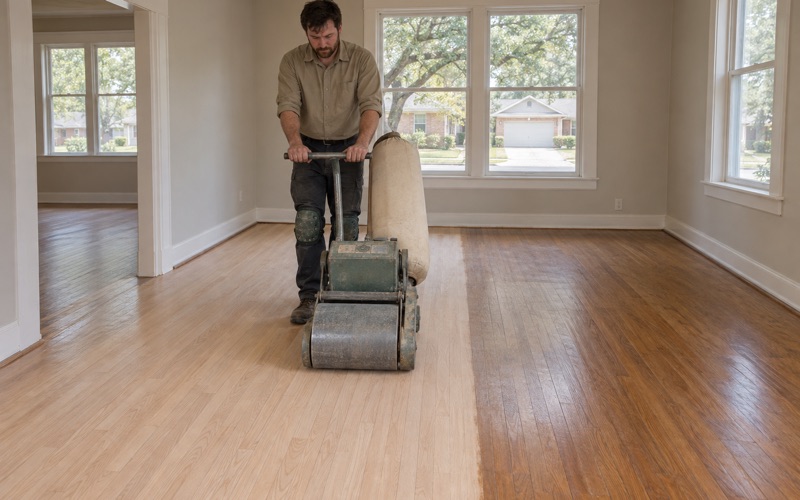
On a 1960s floor the question is rarely whether it can be refinished. It is how much wood is left above the tongue. We check that before quoting, because a board already taken down once or twice will not survive an aggressive 36-50-80 grit sequence, and a drum sander that finds the tongue turns a refinish into a board replacement halfway through the job.
Where a board is genuinely past saving we cut it out and lace the new material into the field rather than dropping in a rectangle, using a weave-in or a dutchman patch depending on how much of the run is involved. The surface comes back flat with no overwood at the seams, so the coats that follow do not telegraph the repair.
Lead-safe work in pre-1978 housing
A 1965 median puts most of the owner-occupied stock into the pre-1978 housing category, which brings the EPA RRP lead-safe rule into any job that disturbs painted surfaces. Base shoe, baseboards, stair risers, nosing and door casings all sit directly in the path of a sanding job, so this is a containment and sequencing question rather than a footnote at the end of a proposal.
Dustless containment goes up on every sanding job before the first machine runs, and we walk you through the setup while it is still empty. Collection runs on the edger and the buffer as well as the drum sander in the middle of the room, which in a compact house, where the work area and the living area are the same rooms, is the difference between staying put and moving out for a week.
The 1981 rental stock and what is worth doing to it
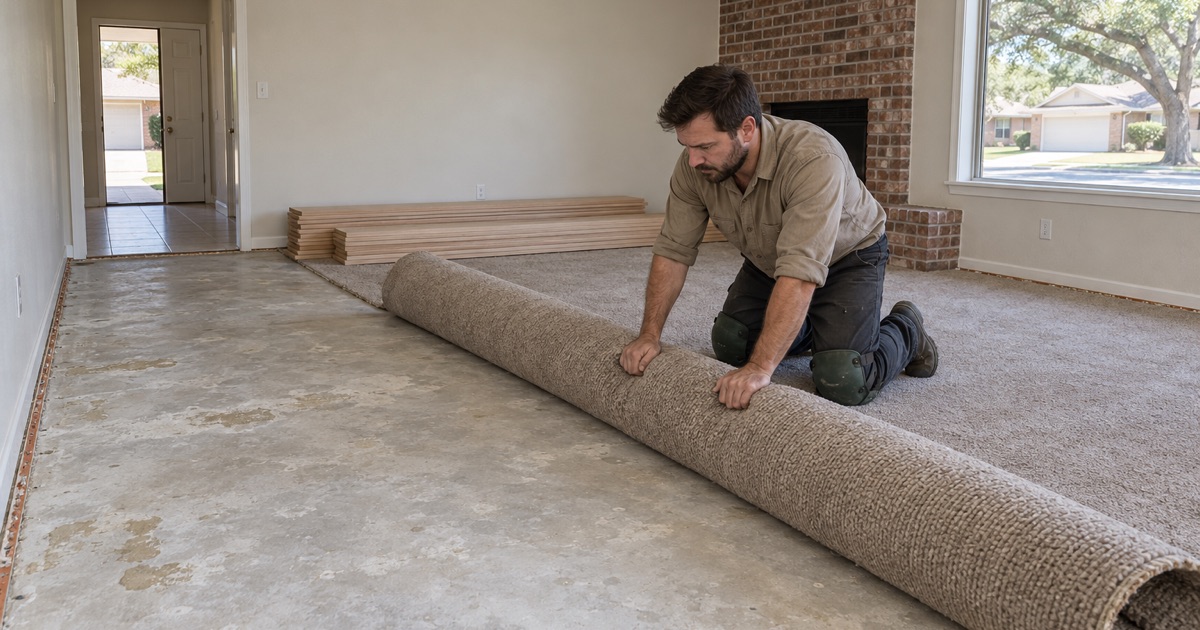
The renter-occupied half of the city carries a median year built of 1981, and 39.3 percent of the housing stock went up in 1980 or later. Floors from that period are far more likely to sit on a slab-on-grade than the owner-occupied stock is, and that single difference changes which test comes first.
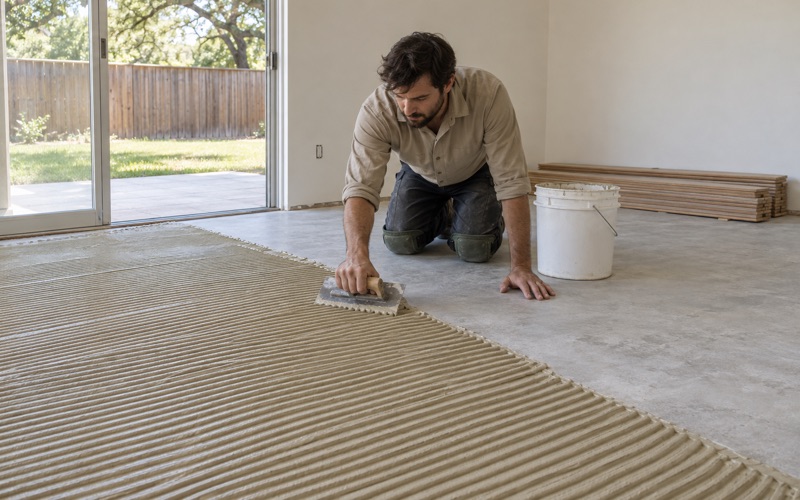
On a slab we run an ASTM F2170 in-situ relative humidity test and record the number before an installation date goes on the calendar, not after the wood is already stacked in the living room. A slab reading at or under 75 percent RH is a different job from one reading higher, and where a calcium chloride test is the specified method we run that instead. Discovering moisture late is what turns a new floor into a claim file.
What a turnover floor is actually buying
Rental turnover asks a narrower question than a homeowner’s remodel does: what holds up for the next tenant, at a price that makes sense against the unit. The median value of an owner-occupied unit here is $187,100, which is a useful ceiling to keep in view, because a specification that makes sense in a far more expensive market does not automatically make sense on this street.
In practice that means a serious look at a screen-and-recoat before anyone proposes a full sand, and a straight answer about engineered flooring. We measure wear layer thickness with a gauge before quoting a refinish, because under about three millimeters there is nothing left to sand and a two millimeter wear layer will sand-through to the plywood core no matter who is running the machine.
Choosing for the traffic, not the brochure
Janka hardness rating is the useful shorthand in this decision. White oak at 1360 Janka and red oak are the steady answer for a floor that has to take turnover traffic and still be refinishable later; hickory at 1820 Janka is harder again and hides dents well, while maple looks superb and is less forgiving about wear patterns and stain.
For a glue-down engineered installation over a slab we care about the wear layer at least as much as the species, since a six millimeter wear layer can be sanded like solid wood and a two millimeter one cannot. A floating floor installs faster and is cheaper to pull up later, which is occasionally the right answer in a rental and almost never the right answer in a house someone means to keep.
Permits, sequence and the way the work runs here
Residential permitting in this city runs through the City of White Settlement Permits Department, with the Tarrant Appraisal District holding the property record and Tarrant County above both. Regional amendments to the model codes are coordinated through the North Central Texas Council of Governments, which is worth knowing before anyone quotes a code section from memory.
White Settlement has adopted the 2018 editions of the International Building Code, International Residential Code, International Plumbing Code, International Energy Conservation Code, International Mechanical Code, International Fire Code, International Fuel Gas Code, International Swimming Pool and Spa Code, International Existing Building Code and International Property Maintenance Code, together with the 2017 National Electrical Code. That is two full cycles behind the current editions, so envelope, vapor retarder and mechanical assumptions carried over from a city on a newer cycle do not transfer here; we read the adopted edition rather than the newest one.
Moving material through a small house
The 1950s wave that gave this city its modal decade was aircraft-worker housing, and it was built small. Narrow doorways, tight hallways and low ceiling heights are normal in that cohort, together with original wall and attic insulation that is minimal by modern standards, and all of it makes long-board maneuvering, staging and material handling a real line in the schedule rather than an afterthought.
That history is close to the surface here. White Settlement incorporated in 1941, and in February 1942 Consolidated Aircraft began B-24 Liberator production at Air Force Plant 4, with Liberator Village housing units going up across the city for the workers. The city covers 5.1 square miles, all of it land, bordered by Lockheed Martin and Naval Air Station Fort Worth Joint Reserve Base, and its population was estimated at 18,084 in 2021.
Acclimation, sequence and the finish schedule
We acclimate wood inside the house, in the room it is going into, never in the garage and never left overnight on the truck. In a house of this vintage the garage and the living room are not the same environment, and a floor that reaches equilibrium moisture content in the wrong one announces it a season later.
We also sequence around the other trades instead of ahead of them. If foundation work or a plumbing repair is coming, the floor goes in afterward so it is not paying for somebody else’s schedule, and where a leak has already done damage we document it room by room with photographs, moisture readings and a line-of-sight map so the claim file has what it needs.
One crew carries the job from tear-out to final coat and the sanding is never subcontracted out. Before the first coat goes down you get a written cure and occupancy schedule, because dry time and cure time are different numbers, and whether the floor is finished in waterborne polyurethane, oil-modified polyurethane or a hardwax oil changes when furniture, rugs and pets are allowed back.
- 20+ Years in North Texas
- Dustless Sanding
- Free Written Estimates